

- On Saturday, macro analyst Garett Jin said that the U.S. debt, now over $39 trillion and rising interest costs, signaled a structural "plateau," making a debt-driven feedback loop more likely.
- He said that geopolitical shocks, such as a disruption in Hormuz, could worsen inflation and deficits.
- Jin said that the dollar would slowly lose value because people were losing faith in it and moving their money into gold and assets like Bitcoin.
As concerns grow about the long-term viability of U.S. government debt, global capital flows, and the dollar's future position in the international financial system, macro investors are paying increasing attention.
Garett Jin, a macro researcher known as a "crypto whale" who shorted Bitcoin (BTC) before the October black swan event last year, said in a Substack article on Saturday that the U.S. may be entering a fundamentally distinct phase of the debt cycle.
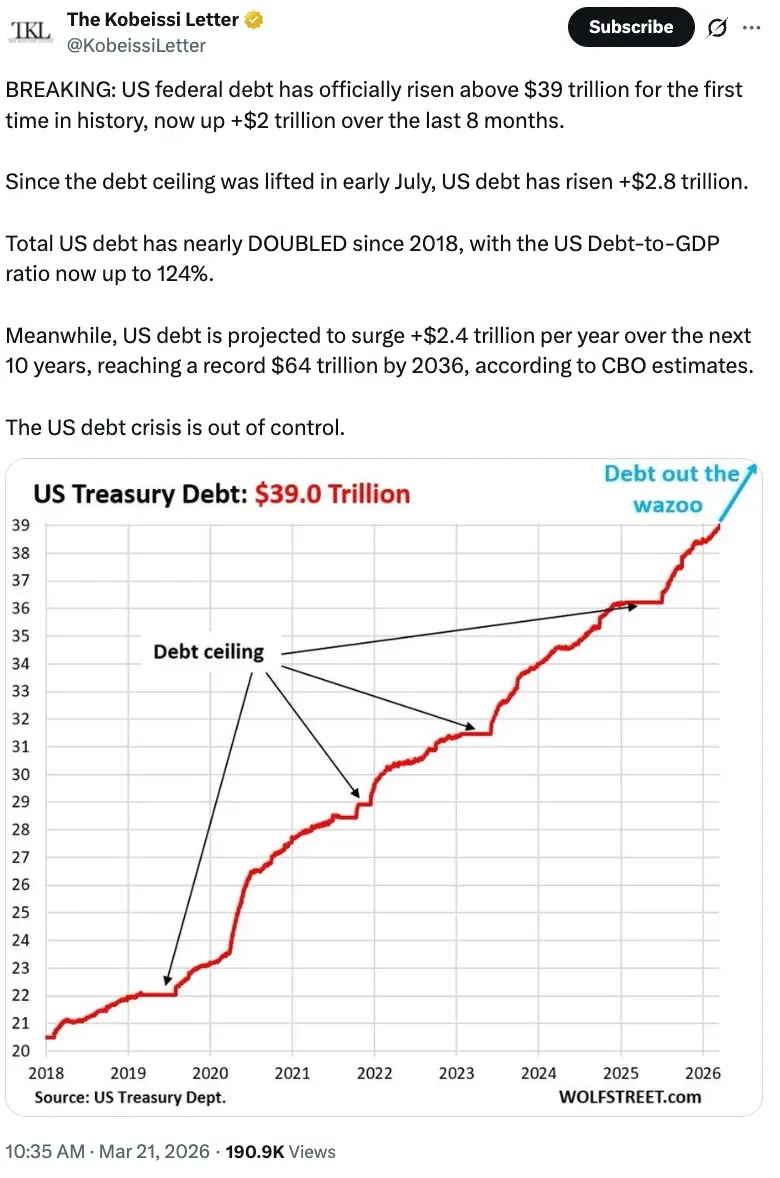
The federal debt is now above $39 trillion, and the debt-to-GDP ratio is over 125%, the highest since World War II. Jin said that the U.S. dollar remains America's most important power but cautioned that this monetary supremacy is now under more structural threat.
The Compounding Interest
He pointed out that the rate at which debt is growing is speeding up and is being driven more and more by structural expenditures and rising interest costs than by productive investment. Interest payments alone are approaching $1 trillion a year and are expected to exceed $2 trillion in the next ten years.
Jin called this situation a "compound interest problem," where rates rise and debt increases. He cited Ray Dalio's idea of a "debt death spiral," in which higher interest rates, more borrowing, and less demand for government debt combine to drive a downward spiral.
Jin argued that a disruption in the Strait of Hormuz could worsen macroeconomic risks by raising oil prices and causing inflation, thereby limiting the Federal Reserve's ability to adjust its policies. He added that this would worsen fiscal deficits and that the Treasury would have to issue more bonds, just as demand from other countries drops. Jin said that big economies are holding less U.S. debt and are more cautious after Russia's reserves were blocked.
He also points out early signs of weakness in the petrodollar system, which might mean these changes will gradually erode the dollar's supremacy over time rather than cause an abrupt replacement.
Death Of The Dollar?
According to Jin, the short-term "fear flows" into the dollar are driving the markets right now. However, over time, structural shifts such as a declining reserve share and changing trade settlement patterns might affect how capital is allocated worldwide.
Jin said that the collapse of reserve currencies is not caused by a single alternative currency, but by a loss of “trust.” He said that central banks are increasing their holdings of gold and other currencies, and that new payment systems are being built on top of the current dollar infrastructure– signalling Bitcoin.
Bitcoin was trading at $70,230, almost flat in the last 24 hours. On Stocktwits, retail sentiment around BTC remained in the ‘bullish’ zone, as chatter levels remained at ‘low’ over the past day.
He believed that this difference between short-term resilience and long-term structural change is giving investors chances in all types of assets, such as commodities and digital assets.
Before the market crash on October 10, Jin was connected to a big whale that opened over $1.1 billion in Bitcoin shorts. When the market dropped in a black swan event, the positions made more than $80 million in profit in 24 hours–catching people's attention because of the trade's timing and size.
Read also: BlackRock’s ETHB Bucks Trend As Other Ethereum ETFs See Outflows
For updates and corrections, email newsroom[at]stocktwits[dot]com.