

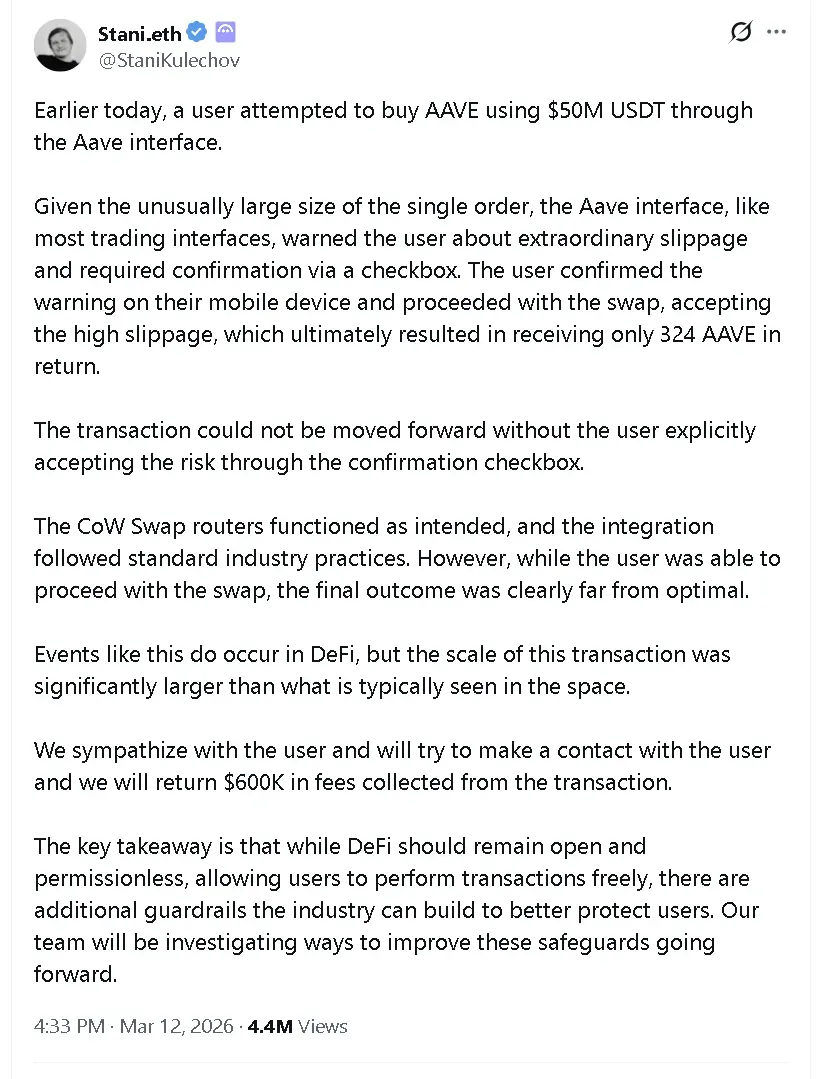
- Aave founder Stani Kulechov said the crypto project is attempting to track down the trader and refund approximately $600,000 in fees tied to the trade.
- One block builder extracted about $34 million worth of Ethereum during the transaction.
- The event sparked debate across the crypto community around why a trader would execute a $50 million trade on mobile and accept a 99% slippage risk.
Aave (AAVE) founder Stani Kulechov offered to refund $600,000 after a crypto trader lost nearly $50 million trying to buy AAVE using Tether (USDT).
The trader’s $50 million stake was effectively drummed down to $36,000 after the large transaction caused significant slippage, with many users on social media questioning whether such a trade should have been possible in the first place and whether there were any nefarious reasons behind it.
AAVE’s price rose more than 6% in the last 24 hours to over $114. Retail sentiment around the token trended in ‘bullish’ territory over the past day on Stocktwits. Chatter remained at ‘high’ levels.
How The $50 Million AAVE Trade Unfolded
A crypto trader wanted to buy $50 million worth of AAVE, so he headed to Cow Swap to make the purchase. For such large orders, slippage risk increases because the resulting supply crunch could heavily influence prices. Slippage is the gap between the price you expect to pay for your purchase and the price you actually pay when the trade is executed.
In this case, the $50 million buy order spiked AAVE’s price so high mid-order that the trader only received 325 AAVE tokens for his efforts – out of which $600,000 was just fees. Where things get murky is that the trader was warned by Aave’s app that such a big order comes with a 99% slippage risk, and the trader accepted anyway.
In a post on X, Aave engineer Martin Grabina said the issue was not slippage but that the user accepted a quote with about 99% price impact. The interface had shown an estimated rate of less than 140 AAVE for 50 million USDT and displayed a price impact warning before the user confirmed the order.
Where Did The Rest Of The Money Go?
The remaining $49.8 million went into the liquidity pool on SushiSwap. It bought every cheap AAVE token available, and the rest of the money just stayed in the pool.
What is more interesting is that maximum extractable value (MEV) bots captured millions in arbitrage. On-chain data from Arkham Intelligence, flagged by crypto analyst Emmett Gallic, showed that Titan Builder extracted $34 million in Ethereum (ETH) from the transaction before sending the proceeds to Coinbase. Another bot extracted almost $10 million in Ethereum.
MEV bots like Titan Builder used a strategy commonly referred to as a “sandwich trade,” in which automated systems buy tokens ahead of a large transaction and sell them immediately afterward once the price has been pushed higher.
Retail Traders Debate What Went Wrong
One user on Stocktwits pointed out that a trader is most likely to accept “slippage” risk, unlikely to anticipate that a MEV bot would hit his transaction.
However, a user on Twitter posted that the transaction may have been a way to cover up money laundering. “$154K per AAVE isn’t a fat finger, it’s a laundering free,” they wrote.
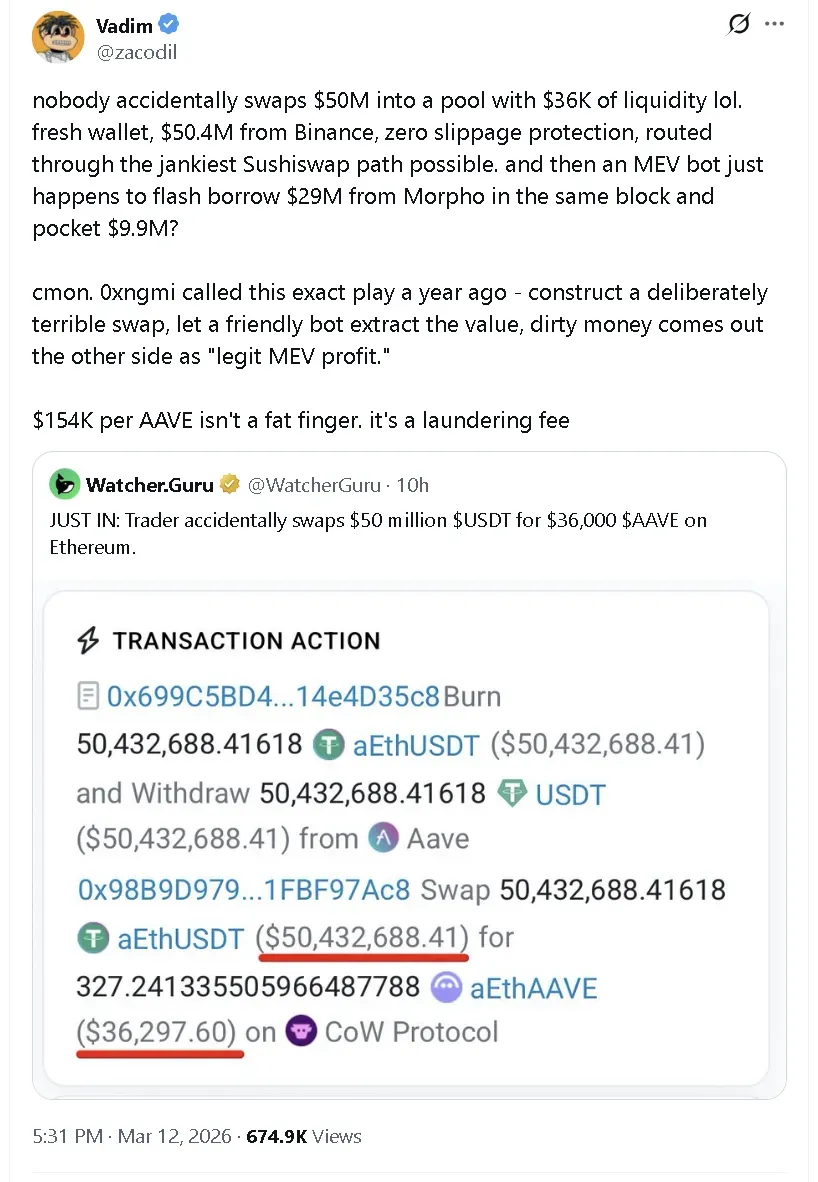
Others were more curious as to why a trader was trying to buy 3% of AAVE’s total circulating supply in a single transaction.
The incident occurred only days after roughly $27 million in positions were liquidated on the Aave protocol, which some market participants linked to a temporary pricing issue involving the token wstETH.
Read also: Solana, Dogecoin Outperform Bitcoin’s Rally To $71,000 Ahead Of PCE Inflation Data
For updates and corrections, email newsroom[at]stocktwits[dot]com.