

- Blue Owl permanently halted redemptions for investors from its inaugural private retail debt fund, according to the Financial Times.
- The news follows the company's fourth-quarter earnings and its announcement that it plans to sell $1.4 billion in assets to return capital and reduce debt.
- According to Arthur Hayes, deeper strains could push the Federal Reserve toward renewed monetary expansion.
Arthur Hayes, co-founder of BitMEX and chief investment officer at the Maelstrom Fund, said Blue Owl’s decision to halt redemptions for retail investors points to rising liquidity stress in financial markets and bolsters his thesis that the Federal Reserve may be forced to print more money soon.
“Warm up that printer, Powell,” Hayes wrote in a post on X, taking the development as a sign that his thesis that the crunch on software and AI stocks would eventually weigh on smaller institutions. He forecasts that as the crisis deepens, the Federal Reserve will be forced to print more money to stabilize the system.
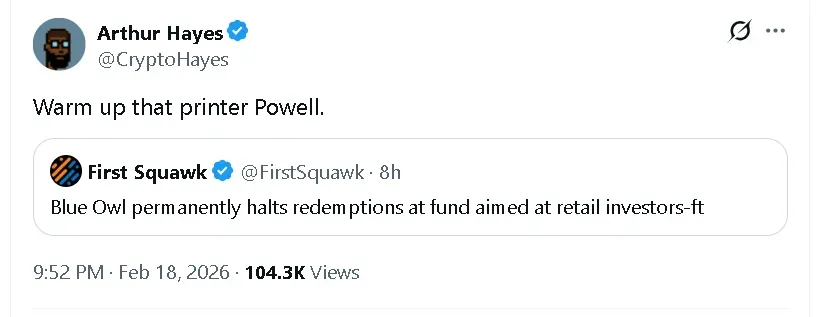
Hayes's comments follow a recent Substack post in which he said that when the Fed expands liquidity, risk assets such as Bitcoin (BTC) and Ethereum (ETH) tend to rebound. He noted BTC has historically responded strongly to monetary easing.
OBDC Stock Gains Pre-Market
Despite the announcement, OBDC’s stock rose as much as 3.5% in pre-market trade on Thursday. However, retail sentiment on Stocktwits around the company continued to trend in ‘bearish’ territory over the past day, even as chatter rose to ‘high’ from ‘low’ levels.
What Happened With Blue Owl?
According to a report by the Financial Times, Blue Owl Capital has permanently halted redemptions from its inaugural private retail debt fund, backtracking from an earlier plan to reopen to redemptions this quarter.
The report followed the company’s latest earnings update, which showed investment income of $447.75 million and adjusted net investment income of $0.36 per share. Blue Owl also said it is selling $1.4 billion in assets across three credit funds to return capital to investors and reduce debt, citing weakness in direct lending and software-related investments.
The decision also drew commentary from other corners of the crypto circle. The chief investment officer at ProCap and an advisor to Bitwise Asset Management wrote on X that investors should not confuse scarcity with illiquidity. “Being long scarcity might lead to illiquidity, but being long illiquidity doesn’t necessarily mean you’re long scarcity, you’re long exit liquidity,” he said, pointing out that when redemptions are paused, investors may discover that demand for the underlying assets is thinner than expected.
For updates and corrections, email newsroom[at]stocktwits[dot]com.