


Advertisement|Remove ads.
Bitcoin's August Curse Returns? Analysts See Conflicting Signals Despite Bullish Setups



- Bitcoin surged 7.36% in July, but August has been one of the worst months for the cryptocurrency historically, as analysts are divided on a deeper correction or a rally to $83,000.
- On-chain data does not show signs of investors dumping large amounts of BTC.
- On the other hand, net exchange outflows suggest modest accumulation rather than aggressive buying.
Advertisement|Remove ads.
Bitcoin (BTC) entered August in the mid-$60,000 range with analysts sharply divided on what happens next after ending July on a positive note, up over 7.36%, in line with historical data.
Historically, August has been one of the weaker months for Bitcoin. Since 2013, Bitcoin has averaged a return of 1.1% in August, but has a median return of -6.99%, suggesting that the months have an overall negative bias that is hidden by the average. In recent years, BTC fell 6.5% in August 2025, 8.6% in 2024, 11.3% in 2023 and 13.9% in 2022, extending a string of weak late-summer performances with only a major exception being 2021, when Bitcoin rallied 13.8%, while 2017 delivered an outsized 65.3% gain during the bull market, according to Coinglass data.
BTC’s price was trading at $63,208, up 0.2% in the last 24 hours. On Stocktwits, Bitcoin was one of the top trending tickers. Retail sentiment around BTC remained in the ‘bearish’ zone, while chatter stayed at ‘normal’ levels.
Advertisement|Remove ads.
One Stocktwits user pointed out that August and September were both ‘bearish’ months for Bitcoin, while some said that Strategy’s (MSTR) Michael Saylor would panic sell more Bitcoin.
Advertisement|Remove ads.
But, What Are Analysts Saying?
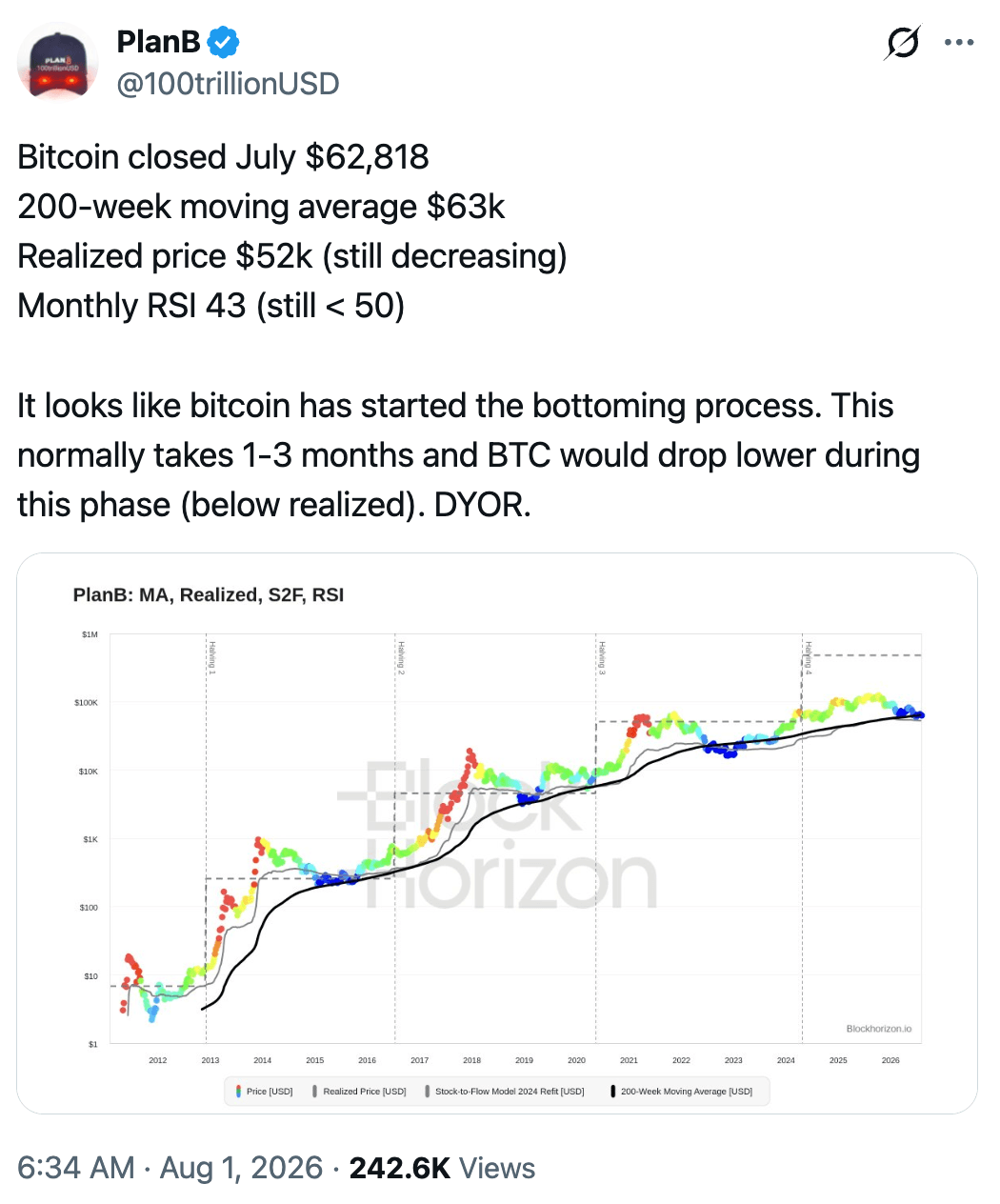
On the one hand, pseudonymous analyst PlanB said that Bitcoin is in a “bottoming process.” He pointed out on X that Bitcoin ended July at about $62,800, near its 200-week moving average, with a monthly RSI below 50 and a falling realised price. His analysis showed that previous market bottoms have taken anywhere from one to three months to form, meaning Bitcoin could still dip further before a sustainable recovery begins.
Others view the softness as just a routine month-end correction. Crypto analyst Michaël van de Poppe believes Bitcoin (BTC) will recover over the next few weeks, claiming that the wider uptrend is still in place as long as BTC stays above the $60,000 support level.
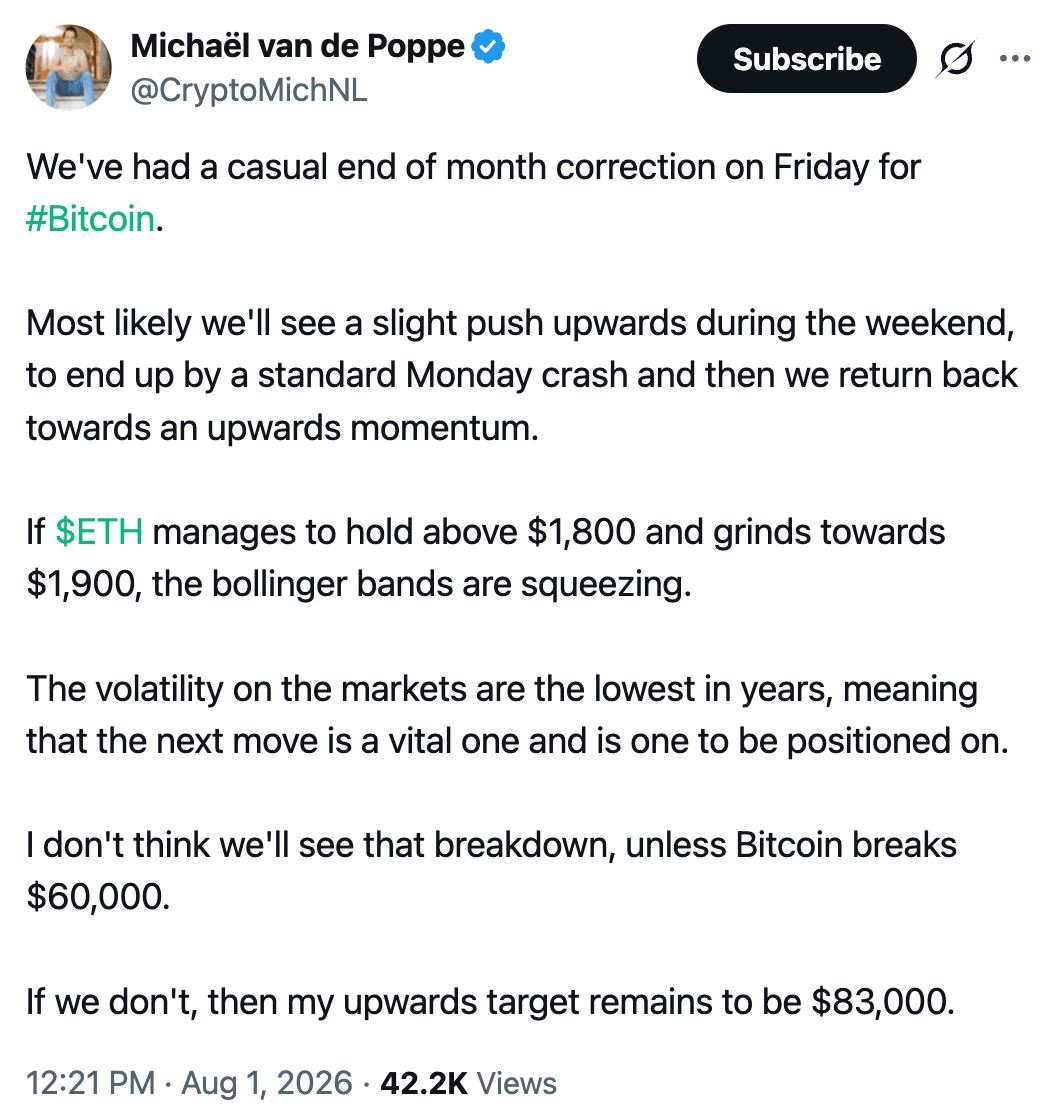
He said the “upward target remains to be $83,000” and points to compressed volatility across crypto markets that could be a sign of a big breakout.
Advertisement|Remove ads.
No Signs of Large-Scale Distribution
Santiment data showed that spikes in both inflows and outflows of Bitcoin to and from exchanges in recent months have broadly reflected routine transfers between exchanges and private wallets, rather than a clear directional trend.
![Bitcoin (BTC) [05.12.16, 02 Aug, 2026].png](https://news.stocktwits-cdn.com/Bitcoin_BTC_05_12_16_02_Aug_2026_81301747e1.png)
Crucially, there has been no lasting growth in exchange inflows that is a sign often linked to growing sell-side pressure, and no extended period of outflows dominating that would indicate aggressive accumulation into self-custody.
The latest data indicates net outflows, with around 795 BTC leaving exchanges and 333 BTC coming into exchanges. This is a modestly bullish signal for the near term by reducing the amount of Bitcoin readily available to sell, but the lack of sustained large-scale outflows suggests investors have yet to enter a strong accumulation phase.
Advertisement|Remove ads.
Read also: Jordi Visser Says Bitcoin's Returns Mirror Leopold's Hedge Fund Before It Crashed — Here’s Why
For updates and corrections, email newsroom[at]stocktwits[dot]com
Comments posted here will also appear on symbol pages.

Latest News
/filters:format(webp)https://news.stocktwits-cdn.com/large_Coinbase_ed6fc0a54f.webp)
/filters:format(webp)https://news.stocktwits-cdn.com/Anushka_Basu_make_me_smile_in_the_picture_b92832aa_af59_4141_aacc_4180d2241ba8_1_2_png_1086e0ed8c.webp) Anushka Basu·18m ago
Anushka Basu·18m ago/filters:format(webp)https://news.stocktwits-cdn.com/large_Getty_Images_2246906029_12e72a0754.jpg) Anushka Basu·2h ago
Anushka Basu·2h ago/filters:format(webp)https://news.stocktwits-cdn.com/large_kevin_o_leary_OG_jpg_2789641a97.webp) Anushka Basu·3h ago
Anushka Basu·3h ago/filters:format(webp)https://news.stocktwits-cdn.com/large_Getty_Images_495548174_f3e67390cf.jpg) Anushka Basu·4h ago
Anushka Basu·4h ago/filters:format(webp)https://news.stocktwits-cdn.com/large_Getty_Images_2286958469_d1bf5147bd.jpg) Anushka Basu·5h ago
Anushka Basu·5h ago/filters:format(webp)https://news.stocktwits-cdn.com/large_Getty_Images_1042183586_jpg_3373e909e0.webp) Anushka Basu·7h ago
Anushka Basu·7h ago