


Advertisement|Remove ads.
Chamath Palihapitiya Says Bitcoin Faces Two ‘Structural’ Headwinds – But Two Of Crypto's Biggest CEOs Call The Threat Overblown
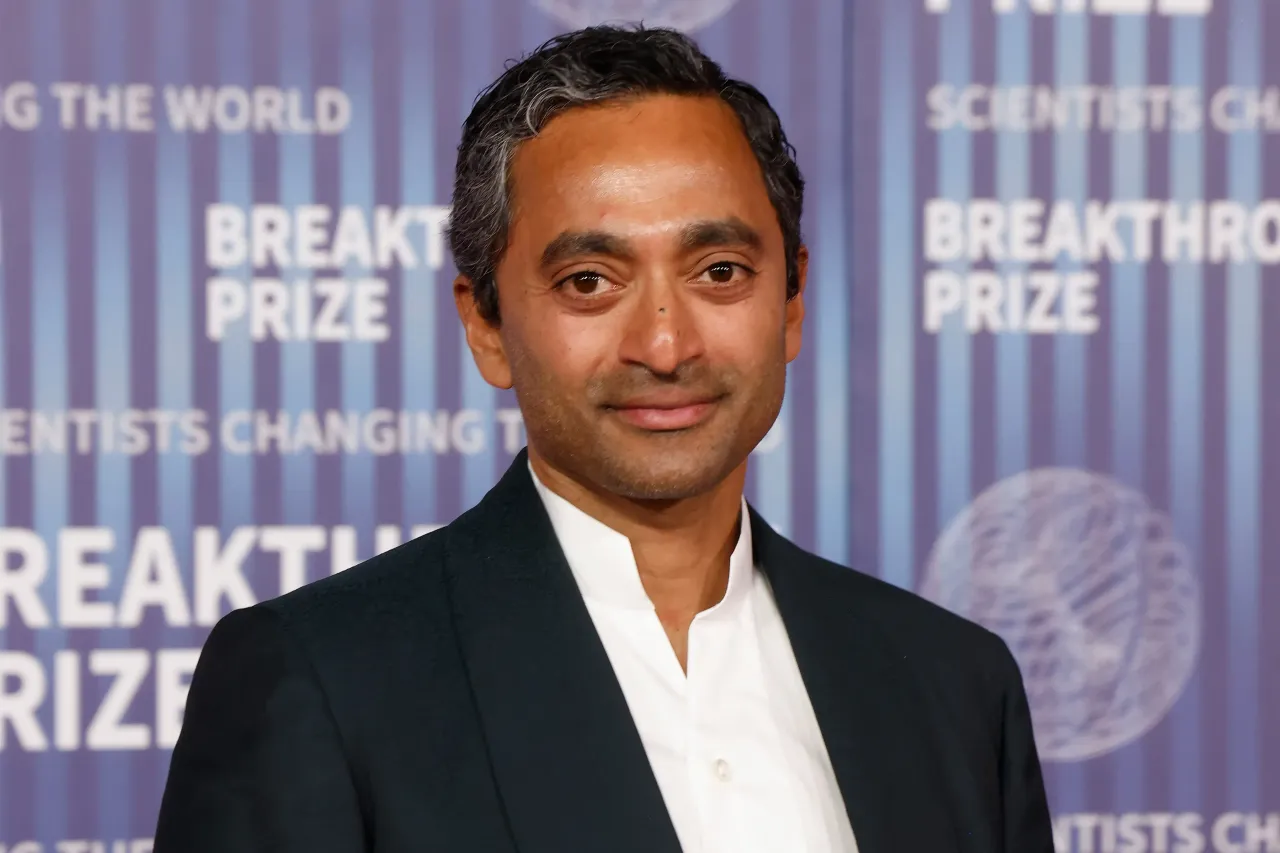


- Chamath Palihapitiya said on Sunday that there are two structural headwinds facing Bitcoin
- These include capital rotating into prediction markets and AI offering better returns on energy, rather than on mining.
- Both Armstrong and Strike CEO Jack Mallers dismissed the idea that less mining activity would meaningfully hurt Bitcoin.
Advertisement|Remove ads.
A sharp public debate broke out among some of crypto’s biggest voices over whether Bitcoin’s (BTC) biggest challenge is no longer regulation or adoption, but competition for capital from artificial intelligence (AI) and prediction markets.
Billionaire investor Chamath Palihapitiya called these two trends “structural” risks; however, Coinbase (COIN) CEO Brian Armstrong and Twenty One Capital (XXI) CEO Jack Mallers strongly pushed back on these claims, saying they misunderstand the forces that ultimately drive Bitcoin's value.
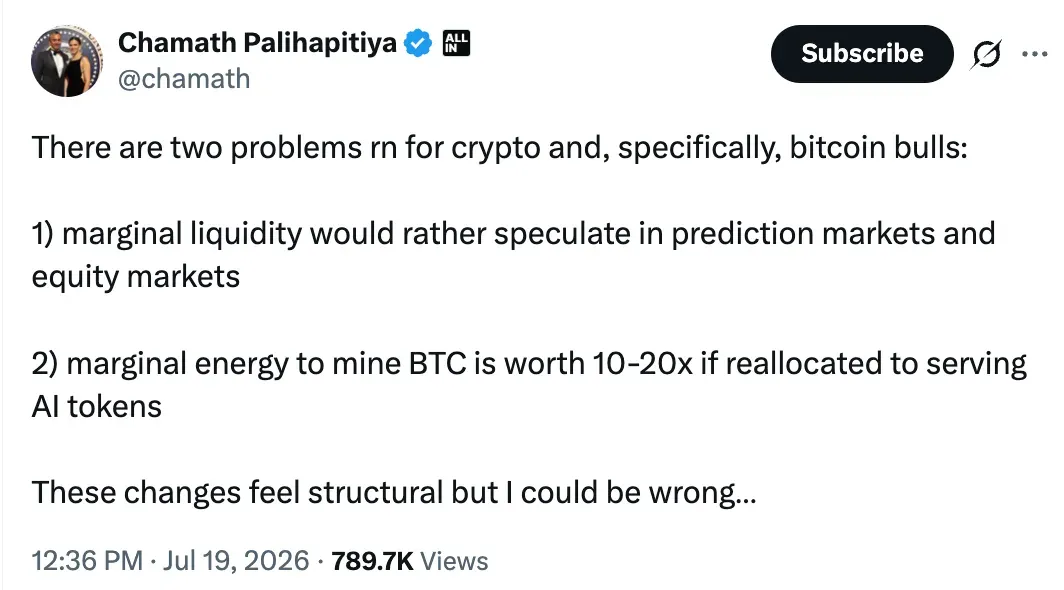
“There are two problems [right now] for crypto and, specifically, bitcoin bulls,” Palihapitiya wrote on X. He said marginal liquidity would “rather speculate in prediction markets and equity markets,” and marginal energy used to mine Bitcoin “is worth 10-20x if reallocated to serving AI tokens.” ‘They look structural,’ he said, ‘but I could be wrong.
Advertisement|Remove ads.
Bitcoin’s price was down by 0.4% during the past 24 hours. On Stocktwits, the retail sentiment around BTC remained in the ‘neutral’ zone, while chatter around it stayed at ‘low’ levels over the past day.
Coinbase CEO Brian Armstrong Says Bitcoin's Economics Still Hold Up
Armstrong replied to Palihapitiya’s first point that it “seems temporary,” while the energy argument sounded “more durable.” But the Coinbase CEO questioned the fundamental mechanics, pointing out that the flow of hash power or energy leaving Bitcoin mining did not control its price, since the network's difficulty would recalibrate to produce the same number of blocks at the same rate if miners went offline.
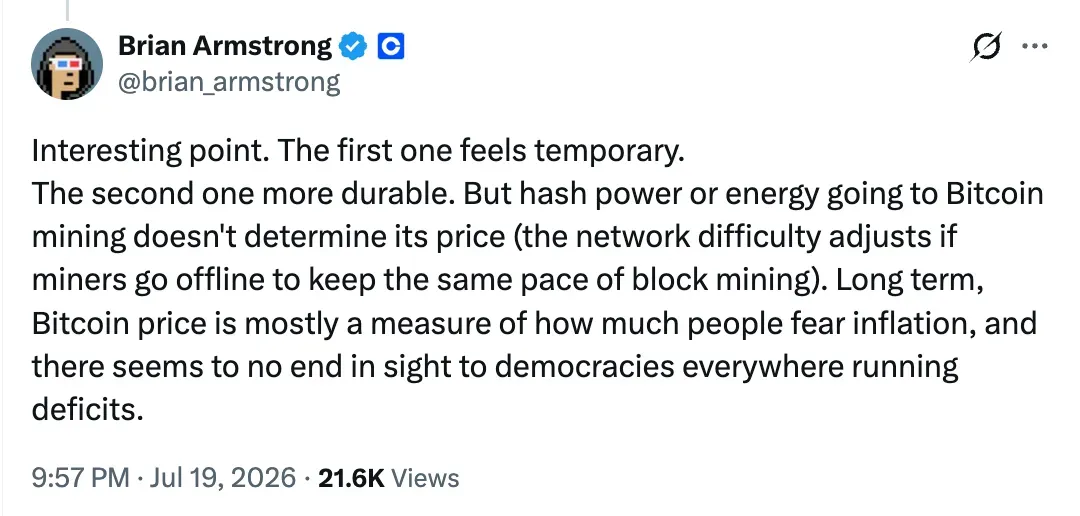
“Long term, Bitcoin price is mostly a measure of how much people fear inflation, and there seems to no end in sight to democracies everywhere running deficits,” Armstrong wrote.
Advertisement|Remove ads.
Jack Mallers: Speculative Capital Was Never Bitcoin's Core Demand
Jack Mallers, CEO of Twenty One Capital, responded directly to Palihapitiya’s post, addressing it as “two problems with your two problems.”
Money chasing prediction markets, memecoins, or AI was never durable Bitcoin demand initially, Mallers said on the liquidity-rotation point. Bitcoin has succeeded, he said, “replacing savings, and becoming money,” and not by winning “marginal speculative rotations.”
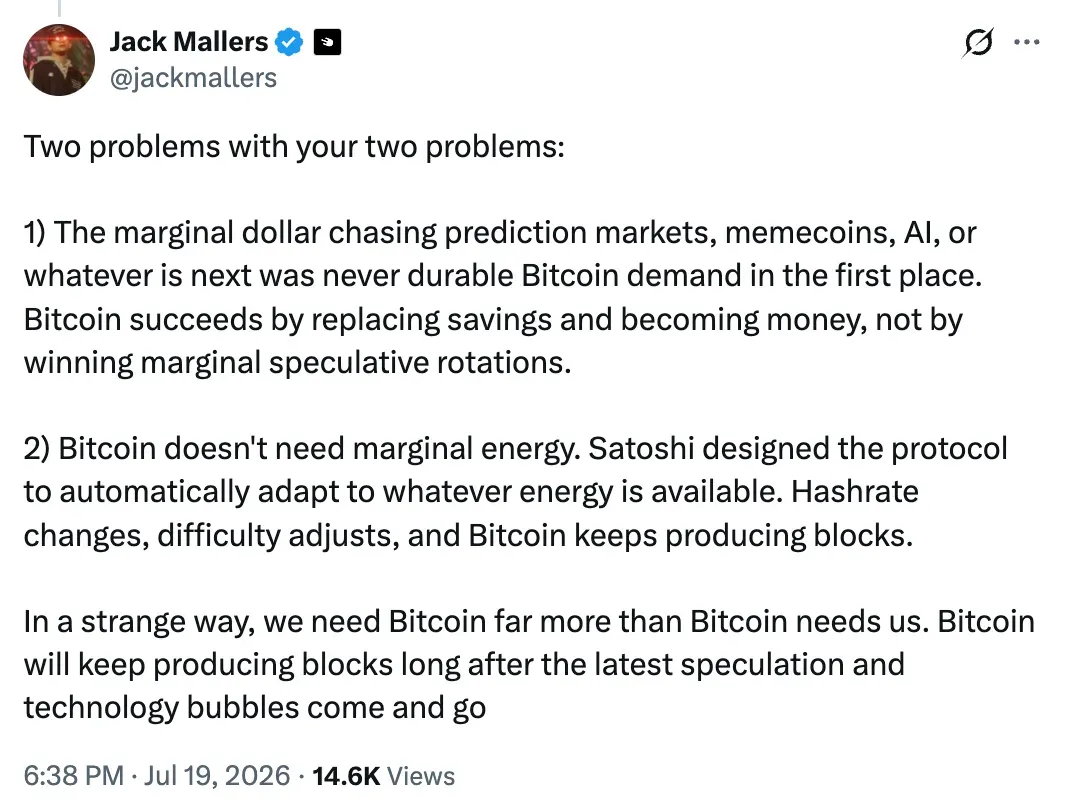
On the energy argument, Mallers said Bitcoin “doesn’t need marginal energy,” citing the same difficulty-adjustment mechanism Armstrong brought up. The protocol was designed by Satoshi Nakamoto “to automatically adapt to whatever energy is available,” so hashrate and difficulty adjust while Bitcoin “keeps producing blocks,” he said.
Advertisement|Remove ads.
Why Prediction Markets Are Suddenly Part Of The Bitcoin Conversation
Palihapitiya's liquidity-rotation argument surfaced as Hyperliquid (HYPE) sought to expand into prediction markets. The platform said on Sunday it had planned to roll out an outcome-market product, HIP-4, for permissionless deployment, following the same builder-centric approach that took its perpetual futures business from validator-gated to industry-leading in a year.
For updates and corrections, email newsroom[at]stocktwits[dot]com.
Advertisement|Remove ads.
Comments posted here will also appear on symbol pages.

Latest News
/filters:format(webp)https://news.stocktwits-cdn.com/large_Getty_Images_2250750247_d50a6c9e19.jpg)
/filters:format(webp)https://news.stocktwits-cdn.com/shivani_photo_jpg_dd6e01afa4.webp) Shivani Kumaresan·5m ago
Shivani Kumaresan·5m ago/filters:format(webp)https://news.stocktwits-cdn.com/large_Getty_Images_526244096_9d89ef6f9b.jpg)
/filters:format(webp)https://news.stocktwits-cdn.com/IMG_9209_1_d9c1acde92.jpeg) Yuvraj Malik·9m ago
Yuvraj Malik·9m ago/filters:format(webp)https://news.stocktwits-cdn.com/large_cathiewood_OG_jpg_a3c8fddb3f.webp)
/filters:format(webp)https://news.stocktwits-cdn.com/IMG_8805_JPG_6768aaedc3.webp) Deepti Sri·9m ago
Deepti Sri·9m ago/filters:format(webp)https://news.stocktwits-cdn.com/large_Getty_Images_2259661360_jpg_dfabfb9ee4.webp) Deepti Sri·26m ago
Deepti Sri·26m ago/filters:format(webp)https://news.stocktwits-cdn.com/large_Getty_Images_2196088644_jpg_95092cdbbe.webp)
/filters:format(webp)https://news.stocktwits-cdn.com/Aashika_Suresh_Profile_Picture_jpg_2acd6f446c.webp) Aashika Suresh·45m ago
Aashika Suresh·45m ago/filters:format(webp)https://news.stocktwits-cdn.com/Getty_Images_2239438553_jpg_ae3a87d29d.webp) Shivani Kumaresan·2h ago
Shivani Kumaresan·2h ago