


Advertisement|Remove ads.
Congress’ Plan To Slap Wash-Sale Rules On Bitcoin Could Leave Everyday Crypto Use In Limbo, Research Firm Warns
![This image has been altered: [Double exposure].) In this photo illustration a double exposure picture with bitcoin coin and American flag. (Photo illustration by Omar Marques/SOPA Images/LightRocket via Getty Images)](https://news.stocktwits-cdn.com/large_Getty_Images_963468264_jpg_07e939d5d9.webp)


- A draft crypto tax bill from Senator Cynthia Lummis and the Miller-Horsford PARITY Act, have been proposed to extend the wash-sale rules to all digital assets, not just stocks.
- In a report by Coin Center, Professor Abraham Sutherland said that the rule is fundamentally “unworkable” for crypto, because none of the three main conditions in the rule apply to digital assets.
- Every day crypto activity, like monthly purchases, salary payments, spending, all of that, quickly generates compliance calculations that no typical taxpayer would be able to do, Sutherland said.
Advertisement|Remove ads.
Coin Center on Tuesday called two congressional proposals to extend the wash-sale rule to Bitcoin (BTC) and digital assets fundamentally unworkable, warning the bills would cripple routine crypto use including DeFi transactions and everyday payments.
There are currently two separate legislative proposals that would extend wash-sale rules to digital assets. The first is the Digital Asset PARITY Act, a Senate bill introduced by Senator Cynthia Lummis (R-WY) in June 2025. The second is a House discussion draft released in December 2025 by Representatives Max Miller (R-OH) and Steven Horsford (D-NV), known as the Miller-Horsford Digital Asset Tax Bill.

While the two bills differ in technical scope, both propose applying Section 1091 of the tax code—the wash-sale rule—to Bitcoin and all digital assets. The bipartisan nature of the House proposal, co-sponsored by a Republican and a Democrat, signals that the push to extend the rule has cross-party support despite significant industry pushback.
Advertisement|Remove ads.
Neeraj Agarwal of Coin Center, said on X that “Congress wants to extend wash-sale rules to crypto. Doing so would make everyday crypto use, DeFi, and multi-wallet tracking nearly unworkable.”
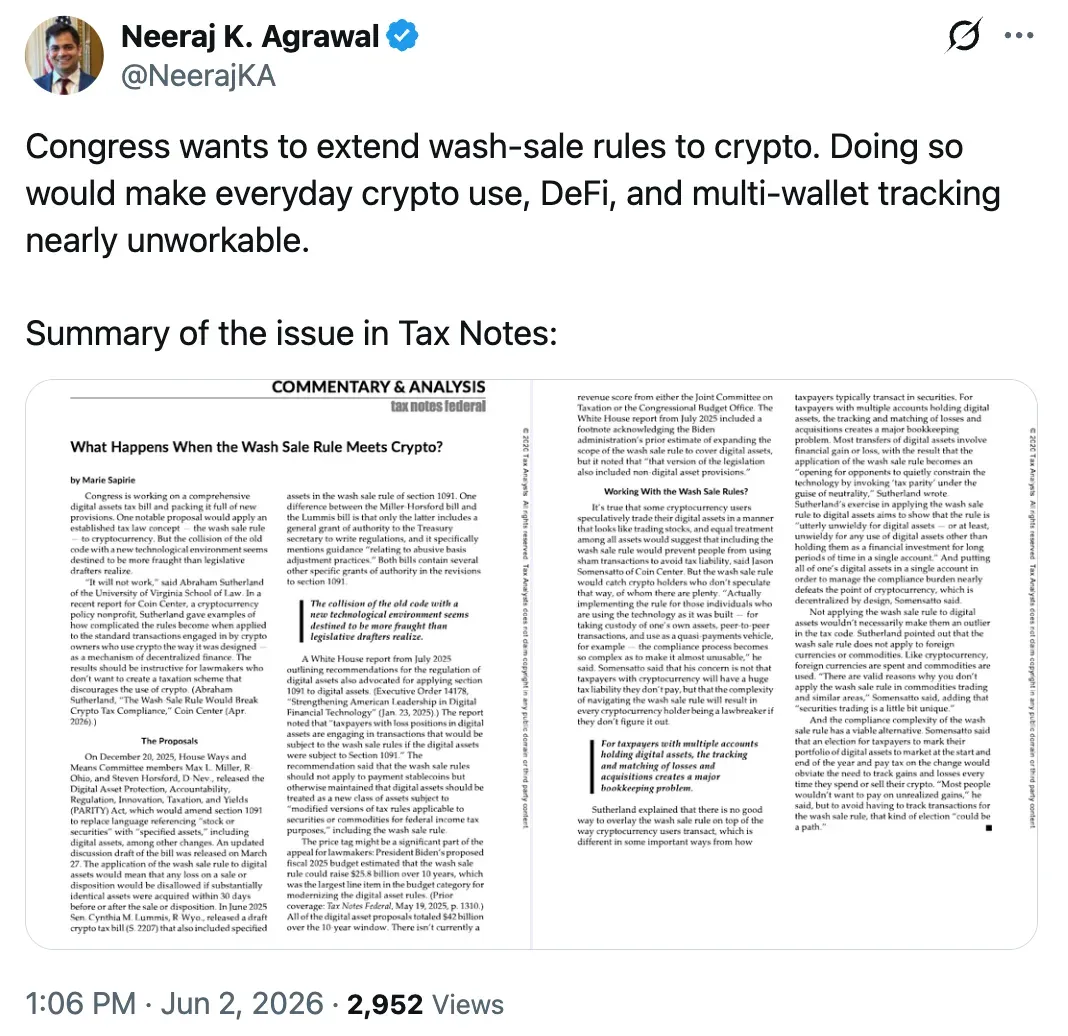
Why Are Wash Rules Bad For Crypto?
In a report released by Coin Center, a cryptocurrency policy research institution, Abraham Sutherland, an adjunct professor at the University of Virginia School of Law in the United States, pointed out that the forthcoming wash sale rules would only add unnecessary burdens and lack practical feasibility. None of the three core preconditions required for the traditional rules to take effect is satisfied for digital assets.
The asset attributes of cryptocurrencies differ from those of traditional stocks. They have five categories of daily transaction uses and three cross-platform holding scenarios. The tracking of their tax-related losses requires that any loss recorded in a taxpayer’s digital asset account must be matched against the unit-level purchase records of all accounts within a 61-day window.
Advertisement|Remove ads.
Sutherland also walked through detailed scenarios showing that even a handful of routine transactions, such as monthly recurring purchases, salary payments in crypto, or everyday spending, quickly produced compliance calculations no ordinary taxpayer could complete without an all-seeing software system with access to every wallet and account they control.
Bitcoin’s price was trading at $67,561, down over 5% in the last 24 hours. On Stocktwits it was the top trending ticker. The retail sentiment around BTC remained in the ‘extremely bearish’ zone, while chatter around it moved to ‘high’ from ‘normal’ levels over the past day.
The Policy Case Against Extension
Sutherland argued that the wash sale rule, originally developed to prevent sham transactions with no actual economic value, fails to align with tax policy principles and cannot be applied to crypto assets. Sutherland also cited a de minimis exemption Congress created for small foreign-currency gains as a model for sensible digital-asset tax reform, a direction that runs counter to expanding the wash-sale regime.
Advertisement|Remove ads.
The Biden administration estimated that broadening the rule’s scope would add $25.8 billion in tax revenue over a decade and make it the largest single item in its digital-asset tax reform budget — a fiscal incentive that Coin Center warned lawmakers should not let override the rule’s basic unworkability.
Read also: Coinbase Backing ProShares' GENIUS Money Market ETF To Build Stablecoin Reserve Infrastructure
For updates and corrections, email newsroom[at]stocktwits[dot]com
Advertisement|Remove ads.
Comments posted here will also appear on symbol pages.

Latest News
/filters:format(webp)https://news.stocktwits-cdn.com/large_Getty_Images_2294264991_a1d08b075d.jpg)
/filters:format(webp)https://news.stocktwits-cdn.com/Anushka_Basu_make_me_smile_in_the_picture_b92832aa_af59_4141_aacc_4180d2241ba8_1_2_png_1086e0ed8c.webp) Anushka Basu·2h ago
Anushka Basu·2h ago/filters:format(webp)https://news.stocktwits-cdn.com/large_Getty_Images_1925090359_f160f05588.jpg) Anushka Basu·3h ago
Anushka Basu·3h ago/filters:format(webp)https://news.stocktwits-cdn.com/large_Getty_Images_2213700296_87303c323b.jpg) Anushka Basu·4h ago
Anushka Basu·4h ago/filters:format(webp)https://news.stocktwits-cdn.com/large_franklin_templeton_OG_jpg_4b3a7330d9.webp) Anushka Basu·5h ago
Anushka Basu·5h ago/filters:format(webp)https://news.stocktwits-cdn.com/large_Getty_Images_1445160636_5780a5fdde.jpg) Anushka Basu·7h ago
Anushka Basu·7h ago/filters:format(webp)https://news.stocktwits-cdn.com/Getty_Images_540198451_jpg_3e5f3d8ee7.webp) Anushka Basu·8h ago
Anushka Basu·8h ago