


Advertisement|Remove ads.
FOMC Meet: Fed Is Largely Expected To Keep Rates Unchanged, But Economists Say The Risks Have Shifted


- ING Chief International Economist James Knightley said the Fed is likely to leave interest rates unchanged after the June Consumer Price Index came in below expectations and labor market data softened.
- Gregory Daco, chief economist at EY-Parthenon, expects the Fed to be on hold for the rest of the year.
- Economists at BofA expect a total of three 25-basis-point rate hikes this year, while adding that the surge in oil prices has made the July decision a close call.
Advertisement|Remove ads.
The Federal Reserve is widely expected to leave interest rates unchanged at the conclusion of its two-day policy meeting on Wednesday, but economists say a combination of sticky inflation, tariffs, geopolitical tensions and shifting communication from Chair Kevin Warsh has made the outlook less straightforward than in recent meetings.
While most major firms still expect the Fed to hold rates steady, several have described the July decision as a closer call than previously anticipated, arguing that policymakers must balance signs of cooling inflation against renewed price pressures and uncertainty over the economy's trajectory.
Why Economists Still Expect A Hold
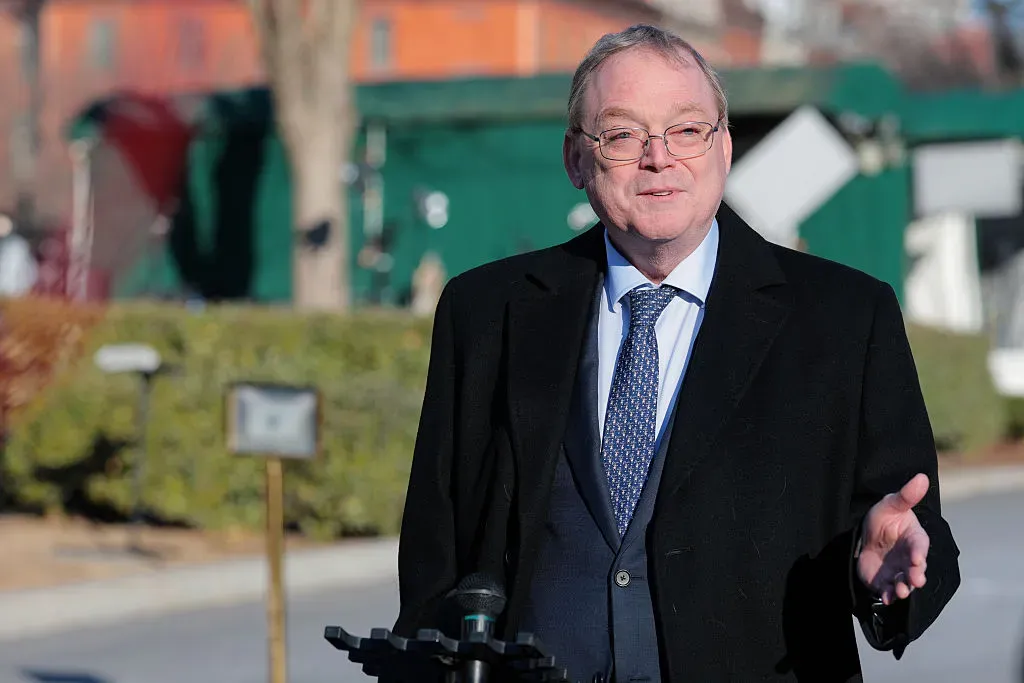
ING Chief International Economist James Knightley said the Fed is likely to leave interest rates unchanged after the June Consumer Price Index (CPI) came in below expectations and labor market data softened. While higher oil prices have fueled speculation about another rate hike, Knightley argued the recent economic data has reduced the urgency for further tightening.
Advertisement|Remove ads.
“The FOMC statement, and Warsh’s own commentary, emphasized a commitment to delivering price stability,” he said.
Gregory Daco, chief economist at EY-Parthenon, expects the Fed to be on hold for the rest of the year. During an interview with Bloomberg, Daco said that even though patience regarding inflation is running thin among those on the Federal Open Market Committee (FOMC), he believes there are some disinflationary trends that are likely to carry through the year-end.
“Very importantly, the labor market is not inflationary. Wage growth is still trending down, towards 3.5%; that’s not inflationary… that should not be a source of inflation going forward,” he said.
Advertisement|Remove ads.
Economists Caution That The Risks Have Shifted
While economists broadly expect the Federal Reserve to keep rates unchanged, several say the balance of risks has become more complicated since the June meeting. Rising oil prices, the uncertain inflationary impact of tariffs and mixed economic data have made the policy outlook less clear-cut.
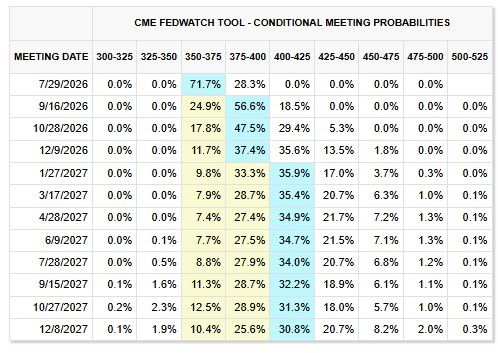
Data from the CME FedWatch tool shows that there are 56.6% odds in favor of a 25 basis point rate hike for the first time in September, 47.5% in October, and 37.4% in December this year.
According to a Morningstar report citing a note from BofA, the firm’s economists expect a total of three 25 bps rate hikes this year.
Advertisement|Remove ads.
“Our base case is that the Fed will stay on hold at 3.50%-3.75% in July. But the spike in oil prices has made it a close call. Not hiking could challenge the Fed’s credibility on inflation. But raising rates would go against [Warsh’s] framework of looking through supply shocks,” the firm stated.
Vanguard economists echoed similar sentiments about the Fed holding in July. However, if inflation does not ease, the firm expects that the Fed may have the catalyst it needs to change its monetary policy direction.
“You’re going to need to see some continuation toward 2%, and if it were to stall at all, that’s definitely a catalyst for the Fed to change course a bit,” the economists said.
Advertisement|Remove ads.
At the time of writing, the SPDR S&P 500 ETF (SPY), which tracks the S&P 500 index, gained 0.47%; the Invesco QQQ Trust ETF (QQQ) was down 0.46%; and the SPDR Dow Jones Industrial Average ETF Trust (DIA) rose 1.33%. Retail sentiment on Stocktwits regarding the S&P 500 ETF was in the ‘bearish’ territory.
The iShares 20+ Year Treasury Bond ETF (TLT) was up 0.63%, while the iShares 7-10 Year Treasury Bond ETF (IEF) was up 0.33%.
Advertisement|Remove ads.
For updates and corrections, email newsroom[at]stocktwits[dot]com.
Comments posted here will also appear on symbol pages.

Latest News
/filters:format(webp)https://news.stocktwits-cdn.com/Getty_Images_2252212060_jpg_132910f66d.webp)
/filters:format(webp)https://news.stocktwits-cdn.com/Harshita_3cfe02022c.jpg) Harshita Tyagi·5m ago
Harshita Tyagi·5m ago/filters:format(webp)https://news.stocktwits-cdn.com/large_Tom_Lee_c6db3cdfe4.webp)
/filters:format(webp)https://news.stocktwits-cdn.com/Prabhjote_DP_67623a9828.jpg) Prabhjote Gill·10m ago
Prabhjote Gill·10m ago/filters:format(webp)https://news.stocktwits-cdn.com/gettyimages_2169566257_594x594_183e2c9f35.jpg)
/filters:format(webp)https://news.stocktwits-cdn.com/Heera_1_1c30cb0170.PNG) Heera Hari·36m ago
Heera Hari·36m ago/filters:format(webp)https://news.stocktwits-cdn.com/large_michael_saylor_OG_4_jpg_292dd07afc.webp) Prabhjote Gill·1h ago
Prabhjote Gill·1h ago/filters:format(webp)https://news.stocktwits-cdn.com/Getty_Images_526218674_jpg_7b7468812b.webp) Heera Hari·2h ago
Heera Hari·2h ago/filters:format(webp)https://st-everywhere-cms-prod.s3.us-east-1.amazonaws.com/large_accenture_logo_resized2_jpg_128c5add71.webp) Harshita Tyagi·2h ago
Harshita Tyagi·2h ago