


Advertisement|Remove ads.
Microsoft Discloses Exact Azure Sales Figures For The First Time Following Longstanding Investor Demand



- Microsoft will start providing specific quarterly revenue metrics for its Azure cloud platform, addressing years of Wall Street criticism over incomplete disclosure.
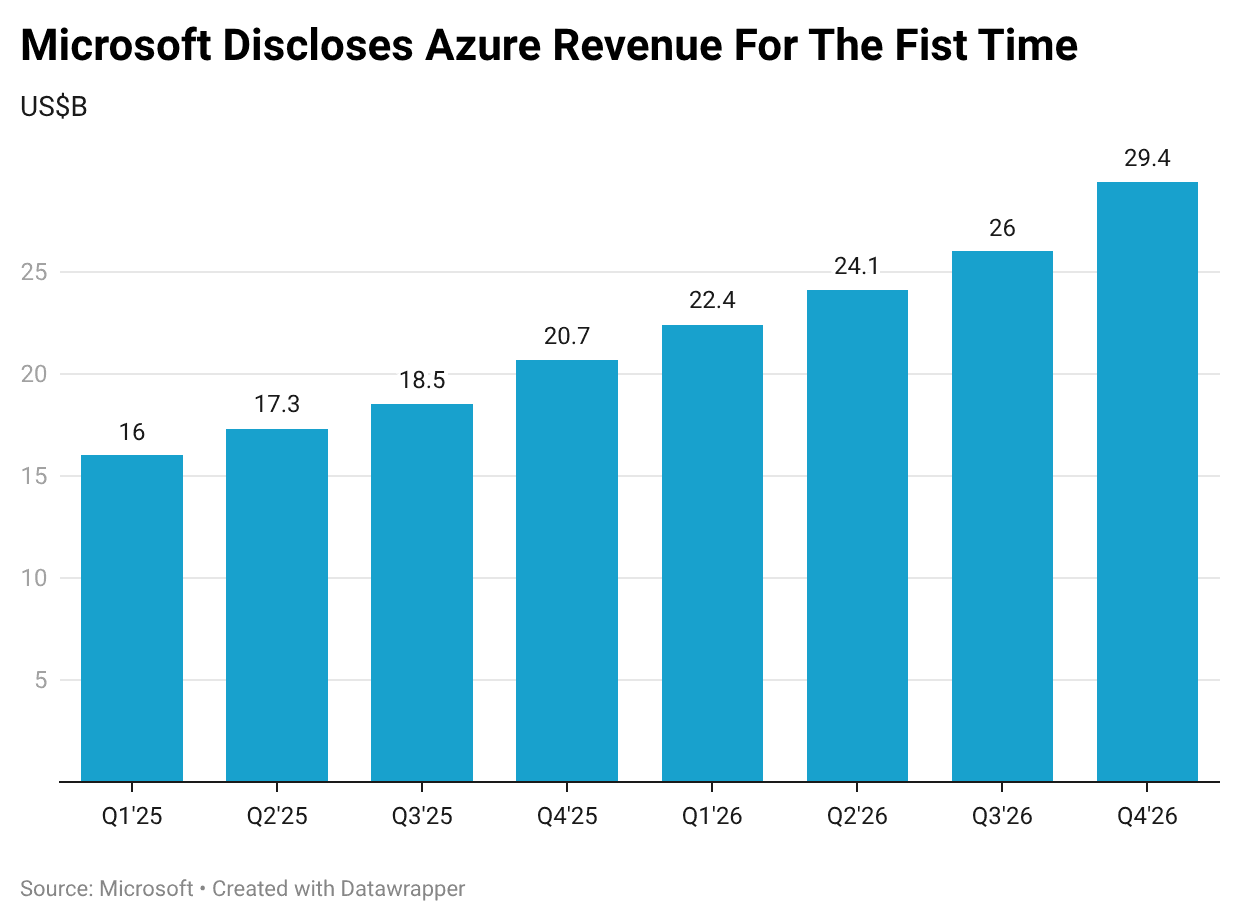
- Historical financial data released by the tech giant showed Azure sales steadily climbing to $29.4 billion in the most recent quarter ending June 2026.
- Microsoft is reorganizing its core divisions into "Agents and Infra" and "Devices and Consumer."
Advertisement|Remove ads.
Microsoft Corp. (MSFT) announced after-hours on Wednesday that it will begin reporting quarterly sales figures for its Azure cloud unit, reversing a years-long policy under sustained pressure from Wall Street investors seeking greater visibility into its primary revenue growth driver.
Microsoft is consolidating two main divisions—Intelligent Cloud and Productivity and Business Processes—into a single segment called "Agents and Infra". Meanwhile, its More Personal Computing segment will be rebranded as "Devices and Consumer".
MSFT stock was marginally up by 0.2% after-hours on Wednesday.
Advertisement|Remove ads.
Surging Revenue Metrics
Historically, the world's largest software vendor provided percentage-based growth rates rather than precise sales revenue for Azure, which offers computing infrastructure and data storage services. Wall Street analysts frequently criticized the lack of precise figures, particularly as Azure emerged as a critical benchmark for the company’s artificial intelligence initiatives.
In a financial filing released on Wednesday, Microsoft provided historical data for the prior eight quarters, revealing steady quarter-over-quarter expansion that reached $29.4 billion in the quarter ending June 30. Total annual sales for Azure topped $100 billion during the most recent fiscal year, up from $75 billion the previous year and representing nearly 30% of total corporate revenues.
"Given Azure's size and scale, it feels like the right moment to bring the extra level of transparency," Jonathan Neilson, head of investor relations at Microsoft, said in an interview with Bloomberg.
Advertisement|Remove ads.
Impact Of AI Expansion
The structural realignment reflects how rapid advances in artificial intelligence are transforming Microsoft's overall strategy and product integration.
"The development of artificial intelligence is changing what we build and how we operate, and it is blurring the boundaries between our products and reshaping our business models," Chief Executive Officer Satya Nadella wrote in a memo regarding the transition.
Advertisement|Remove ads.
Beyond combining main product groups, the company will group LinkedIn revenue with Bing search and other advertising-dependent operations. The updated financial framework will take effect when the company reports its first-quarter earnings this fall.
The shift addresses long-standing critiques from financial commentators and prominent shareholders. Former Chief Executive Officer Steve Ballmer publicly urged Microsoft as early as 2015 to publish explicit revenue totals for the cloud division, noting then that such metrics were vital given the unit's core importance to the company's future.
MSFT Stock: Retail View
Retail sentiment on Stocktwits was ‘bearish’ with ‘low’ message volumes.
Advertisement|Remove ads.
MSFT stock has gained 2.5% year-to-date.
For updates and corrections, email newsroom[at]stocktwits[dot]com.
Comments posted here will also appear on symbol pages.

Latest News
/filters:format(webp)https://st-everywhere-cms-prod.s3.us-east-1.amazonaws.com/large_Morgan_Stanley_b6f4ee64ac.jpg)
/filters:format(webp)https://news.stocktwits-cdn.com/Heera_1_1c30cb0170.PNG) Heera Hari·7m ago
Heera Hari·7m ago/filters:format(webp)https://news.stocktwits-cdn.com/large_Getty_Images_2296215726_e82f86b85a.jpg)
/filters:format(webp)https://news.stocktwits-cdn.com/Harshita_3cfe02022c.jpg) Harshita Tyagi·41m ago
Harshita Tyagi·41m ago/filters:format(webp)https://news.stocktwits-cdn.com/gettyimages_2297721790_612x612_7ed81ac2ea.jpg)
/filters:format(webp)https://news.stocktwits-cdn.com/Prabhjote_DP_67623a9828.jpg) Prabhjote Gill·51m ago
Prabhjote Gill·51m ago/filters:format(webp)https://news.stocktwits-cdn.com/large_viking_fc92506daa.jpg)
/filters:format(webp)https://news.stocktwits-cdn.com/vivekkrishnanphotography_58_jpg_0e45f66a62.webp) Arnab Paul·1h ago
Arnab Paul·1h ago/filters:format(webp)https://news.stocktwits-cdn.com/large_Getty_Images_1251985998_jpg_b1aa149531.webp) Harshita Tyagi·1h ago
Harshita Tyagi·1h ago/filters:format(webp)https://news.stocktwits-cdn.com/large_Getty_Images_1827512590_bbde1a8b68.jpg)
/filters:format(webp)https://news.stocktwits-cdn.com/Anushka_Basu_make_me_smile_in_the_picture_b92832aa_af59_4141_aacc_4180d2241ba8_1_2_png_1086e0ed8c.webp) Anushka Basu·2h ago
Anushka Basu·2h ago