


Advertisement|Remove ads.
VZ, T, TMUS: SpaceX Starlink’s Rise Tests Telecom Giants, But This Analyst Sees Opportunity Ahead


- Morningstar’s Michael Hodel said Starlink has become a profitable satellite internet service, with EchoStar’s deal supporting SpaceX’s wireless expansion plans.
- Hodel expects Starlink to complement rather than replace traditional networks.
- He also highlighted Comcast, Disney, and Omnicom as attractive opportunities in the communications sector.
Advertisement|Remove ads.
Analysts believe SpaceX’s (SPCX) Starlink satellite network is unlikely to dramatically reshape the broadband and wireless landscape, despite investor concerns surrounding the space technology firm’s public debut and its potential impact on traditional communications providers.
Starlink’s Expansion Faces Market Limits
Michael Hodel, Sector director, Communication Services, Morningstar, said in a note that SpaceX’s satellite internet service has quickly attracted customers worldwide and emerged as a profitable part of the company’s broader operations.
The company is also pursuing direct-to-phone connectivity through spectrum acquisitions, raising concerns among traditional telecom providers. EchoStar (ECHO) has sold its nationwide AWS-3 wireless spectrum licenses to SpaceX for $2.6 billion in stock, strengthening the latter’s plans for Starlink’s satellite-based mobile services.
Advertisement|Remove ads.
According to Hodel, Starlink has built a considerable customer base in the U.S., but much of its adoption has come from rural communities that previously relied on slower internet options or older satellite services.
The analyst expects improvements in satellite capacity over time, but believes technical limitations will prevent Starlink from replacing high-performing terrestrial networks in most populated areas.
Wireless Disruption Concerns May Be Overstated
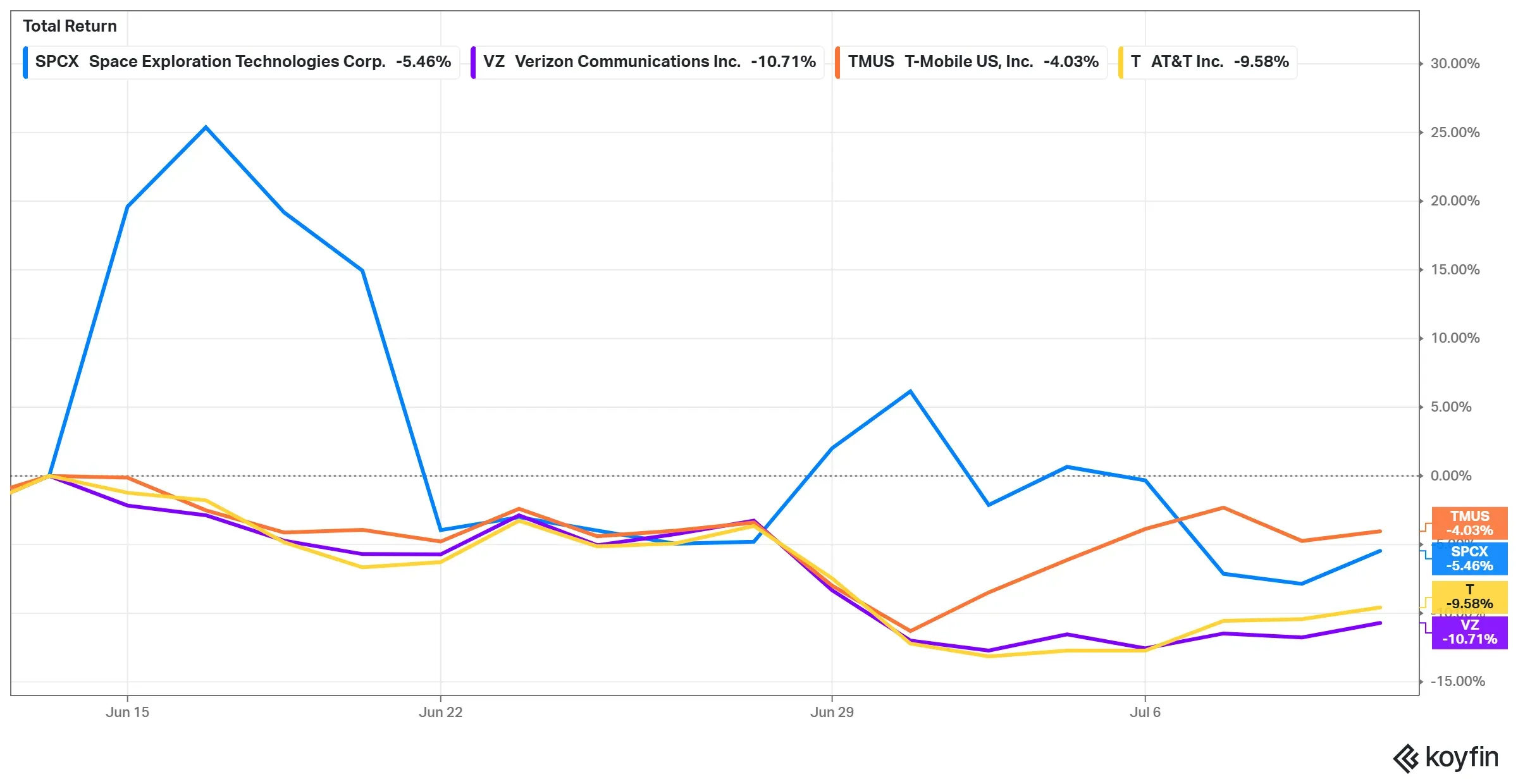
Starlink’s ambitions to connect directly with mobile devices have pressured shares of major telecom companies, including AT&T Inc. (T), Verizon Communications (VZ), and T-Mobile US (TMUS).
Advertisement|Remove ads.
However, Hodel argues satellite coverage works best in remote locations and cannot fully satisfy consumers who expect reliable service everywhere they travel.
He added that building a nationwide wireless network would be difficult for SpaceX because it would need large amounts of spectrum and billions of dollars in infrastructure spending. Major carriers like AT&T, Verizon, and T-Mobile also have little interest in sharing their networks with a new competitor.
Comcast, Disney And Omnicom Stand Out Amid Sector Pressure
Despite industry uncertainty, Morningstar identified several companies as attractive opportunities in the communications sector. Comcast (CMCSA) remains a favored broadband play as the company evaluates options following its media separation plans.
Advertisement|Remove ads.
Walt Disney (DIS) is viewed positively because of streaming improvements, content strength, and growth opportunities beyond conventional television. Hodel also highlighted Omnicom (OMC), noting that while artificial intelligence creates challenges for advertising agencies, companies with strong data capabilities could benefit from changing marketing demands.
SPCX stock has dropped 5% since its June debut, while CMCSA and DIS shares have declined 16% and 15%, respectively. OMC stock has remained flat during the same period.
Advertisement|Remove ads.
For updates and corrections, email newsroom[at]stocktwits[dot]com.
Comments posted here will also appear on symbol pages.

Latest News
/filters:format(webp)https://news.stocktwits-cdn.com/large_Getty_Images_2246580703_jpg_9700e1e7e8.webp)
/filters:format(webp)https://news.stocktwits-cdn.com/shivani_photo_jpg_dd6e01afa4.webp) Shivani Kumaresan·46m ago
Shivani Kumaresan·46m ago/filters:format(webp)https://news.stocktwits-cdn.com/large_Getty_Images_2192591876_jpg_b8c2306674.webp)
/filters:format(webp)https://news.stocktwits-cdn.com/Aashika_Suresh_Profile_Picture_jpg_2acd6f446c.webp) Aashika Suresh·53m ago
Aashika Suresh·53m ago/filters:format(webp)https://news.stocktwits-cdn.com/large_Getty_Images_1402975148_a2f357863f.jpg) Shivani Kumaresan·2h ago
Shivani Kumaresan·2h ago/filters:format(webp)https://news.stocktwits-cdn.com/Getty_Images_2233055049_jpg_0a316df698.webp) Aashika Suresh·2h ago
Aashika Suresh·2h ago/filters:format(webp)https://news.stocktwits-cdn.com/large_Getty_Images_2245498698_eb56c3f1cc.jpg) Aashika Suresh·3h ago
Aashika Suresh·3h ago/filters:format(webp)https://news.stocktwits-cdn.com/large_Blackberry_resized_jpg_a0a7071fd3.webp) Shivani Kumaresan·4h ago
Shivani Kumaresan·4h ago