


Advertisement|Remove ads.
Bitcoin Beats Almost Every Major Asset Over 10 Years, Now Visser Calls It An ‘Anti-Decay’ Hedge


- Macro investor Jordi Visser said wealthy investors should hold Bitcoin as an "anti-decay" hedge against AI-driven growth compression across traditional assets.
- Visser pointed to Nvidia compounding 80% over two years but with all gains concentrated in just four months.
- He argued that the pattern will spread across all AI stocks as competition compresses multiples.
Advertisement|Remove ads.
Investors should hold a significant Bitcoin (BTC) position not just for speculative upside but as an "anti-decay" hedge against the erosion of returns across the fiat assets they already own, according to macro investor Jordi Visser.
In a conversation with Anthony Pompliano on Saturday, Visser argued that AI-driven competition was compressing “multiples” across every traditional growth asset, leaving Bitcoin, with its fixed supply and no competitors, as the natural place for capital escaping that decay.
"It's time to be loud again," Visser said.
Advertisement|Remove ads.
The 'Anti-Decay' Thesis
The Wall Street veteran suggested that older investors who have already built their fortunes should hold a significant Bitcoin position as an "anti-decay" hedge. For younger investors, Visser said Bitcoin "breaks all of this stuff" because it functioned simultaneously as a hedge against abundance and time, and a growth asset in its own right. He said it needs to sit in the growth bucket of a portfolio, not the one-to-two-percent allocation that cautious advisors typically recommend on television.
Visser said he had personally shifted his overweights toward the "scarcity trade,” Bitcoin, silver and precious metals, while maintaining smaller positions in AI infrastructure. He reiterated his view of Bitcoin as "the purest AI trade."
AI Kills Growth, Bitcoin Has No Competition
Visser argued that AI was accelerating competition to the point where no traditional growth asset was safe.
Advertisement|Remove ads.
He pointed to Nvidia (NVDA), which has compounded roughly 80% over the past two years but with all of the gains concentrated in just four months out of 24. The rest of the time, he said, the stock went sideways despite consistently strong earnings, because investors fear competition will erode its dominance.
That pattern, Visser argued, would spread across all AI infrastructure stocks, including Marvell (MRVL) and Micron (MU), as open-source models compress margins. He pointed to Anthropic as an example, noting that even the fastest-growing tech company in history was already facing questions about whether competition would slow its growth.
From Thesis To Flows
Visser's argument appeared to be playing out in real time this week. US spot Bitcoin ETFs pulled in roughly $1.92 billion, their strongest inflow week since October’s flash crash, according to SoSoValue data.
Advertisement|Remove ads.
The inflows came against a macro background. The US Treasury doubled its long-end bond buybacks as national debt approached $40 trillion and annual interest costs exceeded $1 trillion.
The renewed demand also came as Bitcoin surged more than 22% over the week. Pompliano said the week had "shaken awake" the Bitcoin community and that it would be "one of the biggest ETF inflow weeks since the all-time high Bitcoin price."
The long-term case for Bitcoin also showed up in the data.
Advertisement|Remove ads.
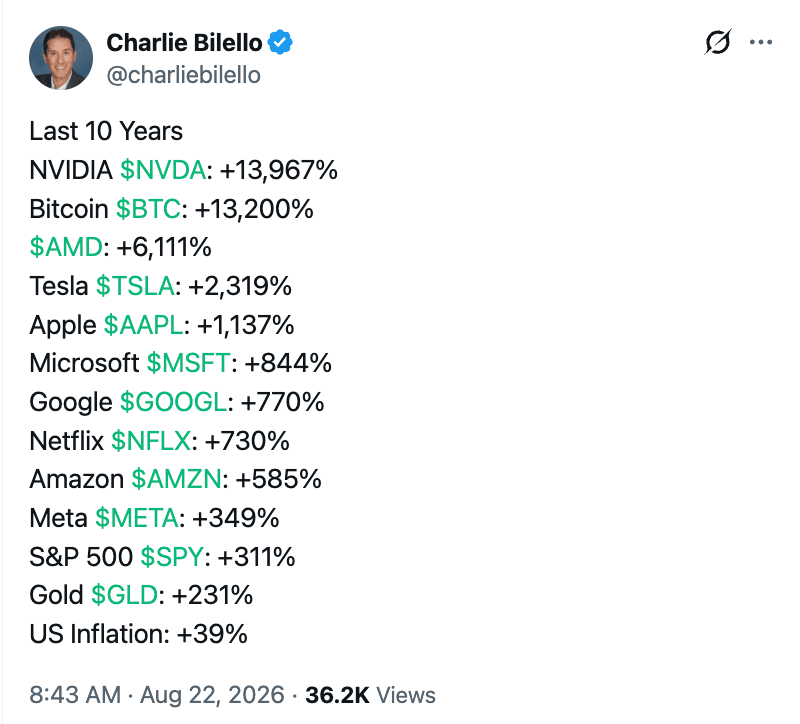
Charlie Bilello, Chief Market Strategist at Creative Planning, posted 10-year return figures on Saturday showing Bitcoin was up 13,200% over the past decade, trailing only Nvidia at 13,967%. Both dwarfed every other major asset class, with AMD (AMD) at 6,111%, Tesla (TSLA) at 2,319%, Google (GOOG) at 770%, the S&P 500 (SPX) at 311%, gold at 231%, and US inflation at 39%.
Bitcoin's price was trading at $77,071, up 0.2% over the past day. On Stocktwits, retail sentiment around BTC remained in the 'extremely bullish' zone, accompanied by 'extremely high' chatter levels over the past day.
Read also: Sandbox Says Bridge Exploit Was ‘Minimal’ - On-Chain Data Tells A Very Different Story
Advertisement|Remove ads.
For updates and corrections, email newsroom[at]stocktwits[dot]com.
Comments posted here will also appear on symbol pages.

Latest News
/filters:format(webp)https://news.stocktwits-cdn.com/large_Getty_Images_1241478218_fce09285f2.jpg)
/filters:format(webp)https://news.stocktwits-cdn.com/Anushka_Basu_make_me_smile_in_the_picture_b92832aa_af59_4141_aacc_4180d2241ba8_1_2_png_1086e0ed8c.webp) Anushka Basu·3h ago
Anushka Basu·3h ago/filters:format(webp)https://news.stocktwits-cdn.com/large_Getty_Images_2290627662_00dc8e527a.jpg) Anushka Basu·3h ago
Anushka Basu·3h ago/filters:format(webp)https://news.stocktwits-cdn.com/large_Getty_Images_1925090364_jpg_cd701c3c60.webp) Anushka Basu·4h ago
Anushka Basu·4h ago/filters:format(webp)https://news.stocktwits-cdn.com/large_Getty_Images_1243325380_a94a416d84.jpg) Anushka Basu·6h ago
Anushka Basu·6h ago/filters:format(webp)https://news.stocktwits-cdn.com/large_Getty_Images_1064216666_b954d2e335.jpg) Anushka Basu·7h ago
Anushka Basu·7h ago/filters:format(webp)https://news.stocktwits-cdn.com/large_Getty_Images_2202592117_494a3dc034.jpg) Anushka Basu·8h ago
Anushka Basu·8h ago