


Advertisement|Remove ads.
Bitcoin’s Biggest Governance Fight In Years Just Took A New Turn — Here’s What Michael Saylor And David Bailey Are Saying


- The BIP-110 proposal, which sought to ban the attachment of images and text to Bitcoin transactions, collapsed with under 1% of miners' support ahead of activation.
- “Hard consensus is Bitcoin’s immune system,” said Strategy’s Michael Saylor, who pointed out that bad ideas must fail before they can harm the network.
- David Bailey said it was a “hostile takeover attempt,” noting a years-long campaign of pressure that led Bitcoin Core developers to leave the project.
Advertisement|Remove ads.
A heated debate over Bitcoin's governance returned to the spotlight over the weekend after Strategy (MSTR) Executive Chairman Michael Saylor reiterated that changes to the network require overwhelming consensus, while Nakamoto (NAKA) CEO David Bailey argued that the controversial BIP-110 proposal has failed to gain meaningful support from miners ahead of its activation window.
Although Saylor did not mention BIP-110 directly, his comments came as the proposal continues to divide developers, miners, and other participants in the Bitcoin ecosystem.
“Hard consensus is Bitcoin’s immune system,” Saylor said in an X post on Saturday, without citing the plan specifically. He said protocol changes “must earn overwhelming alignment,” so bad ideas fail before they become what he dubbed “iatrogenic” – damage caused by the intended cure.
Advertisement|Remove ads.
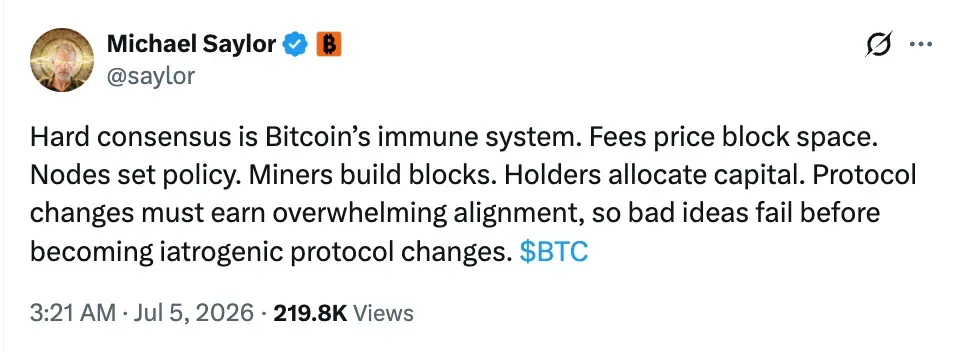
In the post, Saylor defined the network's division of labor: nodes establish policy, miners construct blocks, holders allocate capital, and fees price block space.
Bailey Says Proposal Has Failed To Gain Meaningful Support
Bailey, a vocal critic of BIP-110, called the proposal a "hostile takeover attempt" in posts on X, stating that it had attracted "not even 1% of blocks signaling" ahead of its proposed activation period, despite supporters operating their own mining pool.
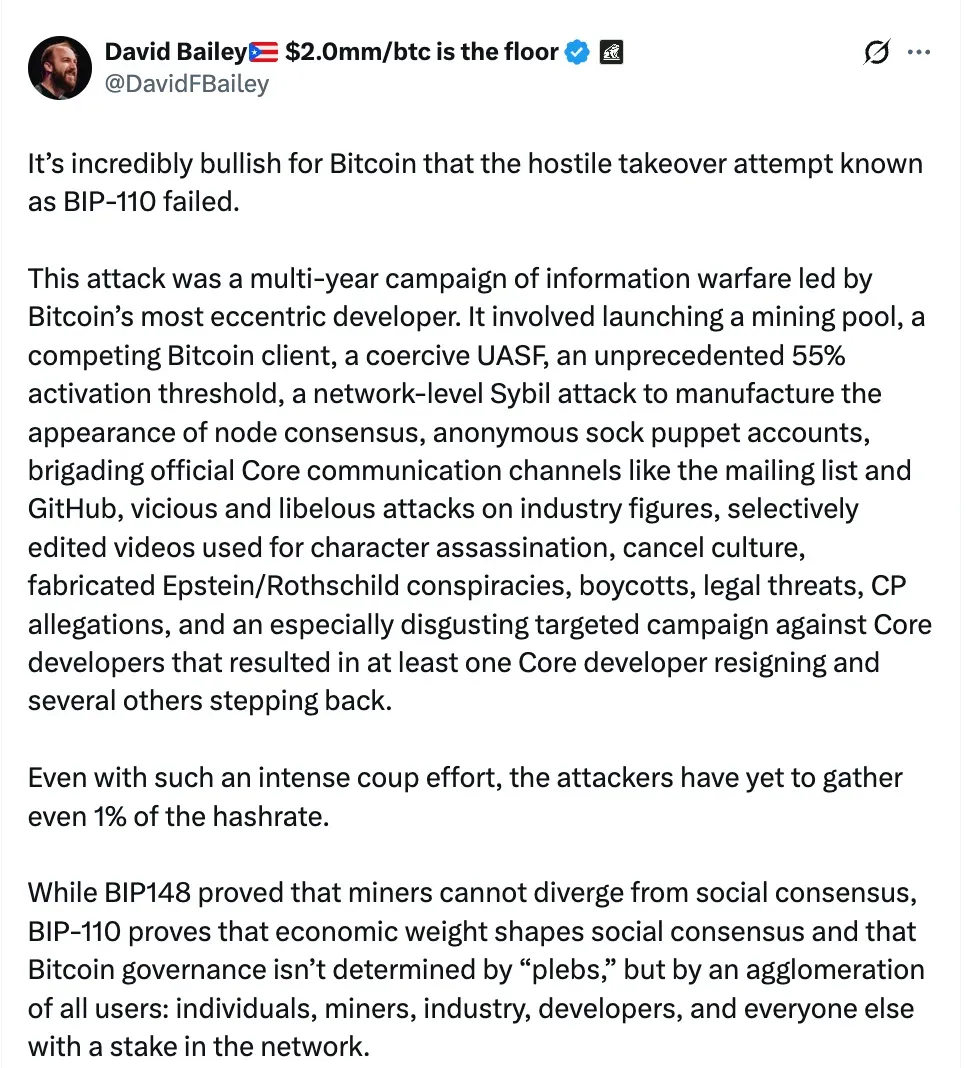
"It was all a lie.” Bailey warned users to exercise caution when instructed to "run my software, or Bitcoin dies," as there is no substantial support from nodes.
Advertisement|Remove ads.
What Is The BIP-110
BIP-110 is a proposal that seeks to modify the rules of Bitcoin so that users cannot attach huge amounts of extra data — such as photos or text called inscriptions — to transactions. Supporters argue this data clogs the network, increases costs, and makes the program more expensive to run.
Critics argue the remedy is faulty and might disrupt sections of the ecology that have been developed around inscriptions. But for the shift to happen, miners need to get behind it. Almost none has done it so far. If its proponents try to push it through when the enforcement window opens around Aug. 7, the network might divide into two incompatible versions of Bitcoin.
Governance Dispute Extends Beyond The Proposal
Bailey described the proposal as the culmination of a multi-year pressure campaign involving a rival Bitcoin client, a coercive user-activated soft fork with an unprecedented 55% activation threshold, and an effort to manufacture node consensus.
Advertisement|Remove ads.
He was also accused of a campaign of harassment against Bitcoin Core engineers, which he said caused at least one to leave and others to step back. The allegations could not be independently confirmed.
The episode showed that Bitcoin governance is not decided by any one faction but by an ‘agglomeration of all users’ — individuals, miners, industry and developers, Bailey added.
Bailey Warns Of 'AI Slop' In Governance Debate
Bailey also cited what he called a new attack vector. The BIP-110 campaign, he said, was the first on Bitcoin “widely powered by AI slop.” He said that AI-generated material generates confirmation bias and “a single low-effort prompt can take 100x more effort” to rebut. He calculated that the debate had taken more than a million hours of human time in society.
Advertisement|Remove ads.
When BIP-110 splits off, supporters “will have destroyed their credibility” and filtered themselves out of the network, making Bitcoin Core better situated, Bailey added. He urged the sector to become more involved in Bitcoin Improvement Proposals, saying that without stakeholder engagement the network defaults “to ossification.”
Bitcoin’s price rose over 0.6% to $62,476 in the last 24 hours. On Stocktwits, retail sentiment around it improved to ‘bullish’ from the ‘neutral’ zone, while chatter dropped to ‘low’ levels from ‘normal’ levels over the past day.
Editor's Note: This story has been updated for clarity and attribution. It now makes clear that David Bailey's characterization of BIP-110 as a "hostile takeover attempt" and his assessment that the proposal lacks network support are his views. It also clarifies that Michael Saylor did not comment specifically on BIP-110 but instead made broader remarks about Bitcoin's consensus-driven governance model.
Advertisement|Remove ads.
For updates and corrections, email newsroom[at]stocktwits[dot]com.
Comments posted here will also appear on symbol pages.

Latest News
/filters:format(webp)https://news.stocktwits-cdn.com/gettyimages_1161631184_594x594_0063399eed.jpg)
/filters:format(webp)https://news.stocktwits-cdn.com/IMG_9209_1_d9c1acde92.jpeg) Yuvraj Malik·26m ago
Yuvraj Malik·26m ago/filters:format(webp)https://news.stocktwits-cdn.com/large_Getty_Images_2293730436_c31daad21d.jpg)
/filters:format(webp)https://news.stocktwits-cdn.com/shivani_photo_jpg_dd6e01afa4.webp) Shivani Kumaresan·31m ago
Shivani Kumaresan·31m ago/filters:format(webp)https://news.stocktwits-cdn.com/large_hims_logo_9ad9b7d21e.jpg)
/filters:format(webp)https://news.stocktwits-cdn.com/IMG_8805_JPG_6768aaedc3.webp) Deepti Sri·36m ago
Deepti Sri·36m ago/filters:format(webp)https://news.stocktwits-cdn.com/large_Rocketlab_resized_jpg_92c1a02a7f.webp) Deepti Sri·1h ago
Deepti Sri·1h ago/filters:format(webp)https://news.stocktwits-cdn.com/large_Getty_Images_2209012779_dc13f07008.jpg)
/filters:format(webp)https://news.stocktwits-cdn.com/unnamed_jpg_9dff551b50.webp) Anan Ashraf·3h ago
Anan Ashraf·3h ago/filters:format(webp)https://news.stocktwits-cdn.com/large_Getty_Images_2249581920_jpg_e0f76b0419.webp)
/filters:format(webp)https://news.stocktwits-cdn.com/1707726834303_jpg_11f20a9aa9.webp) Shashank Nayar·3h ago
Shashank Nayar·3h ago