


Advertisement|Remove ads.
Coinbase's Chief Policy Officer Tells Elizabeth Warren She Has CLARITY Act ‘Exactly Backward’ On National Security



- Coinbase Chief Policy Officer Faryar Shirzad said the CLARITY Act would strengthen, not weaken, U.S. national security protections.
- Senator Elizabeth Warren has warned that the legislation could facilitate sanctions evasion, citing concerns raised by national security experts.
- The debate comes amid growing scrutiny of Iran's use of cryptocurrencies and stablecoins to bypass U.S. sanctions.
Advertisement|Remove ads.
Coinbase's (COIN) Chief Policy Officer pushed back against Senator Elizabeth Warren (D-Mass) on Saturday, arguing that her sanctions-evasion warning about the Digital Asset Market Clarity Act, known as the CLARITY Act, turns the bill's national security case on its head.
"The argument that the CLARITY Act compromises national security gets it exactly backward," Faryar Shirzad said. "Right now, the lack of clear rules is what leaves our financial system vulnerable because bad actors thrive in the shadows of regulatory uncertainty. This bill drags them into the light."

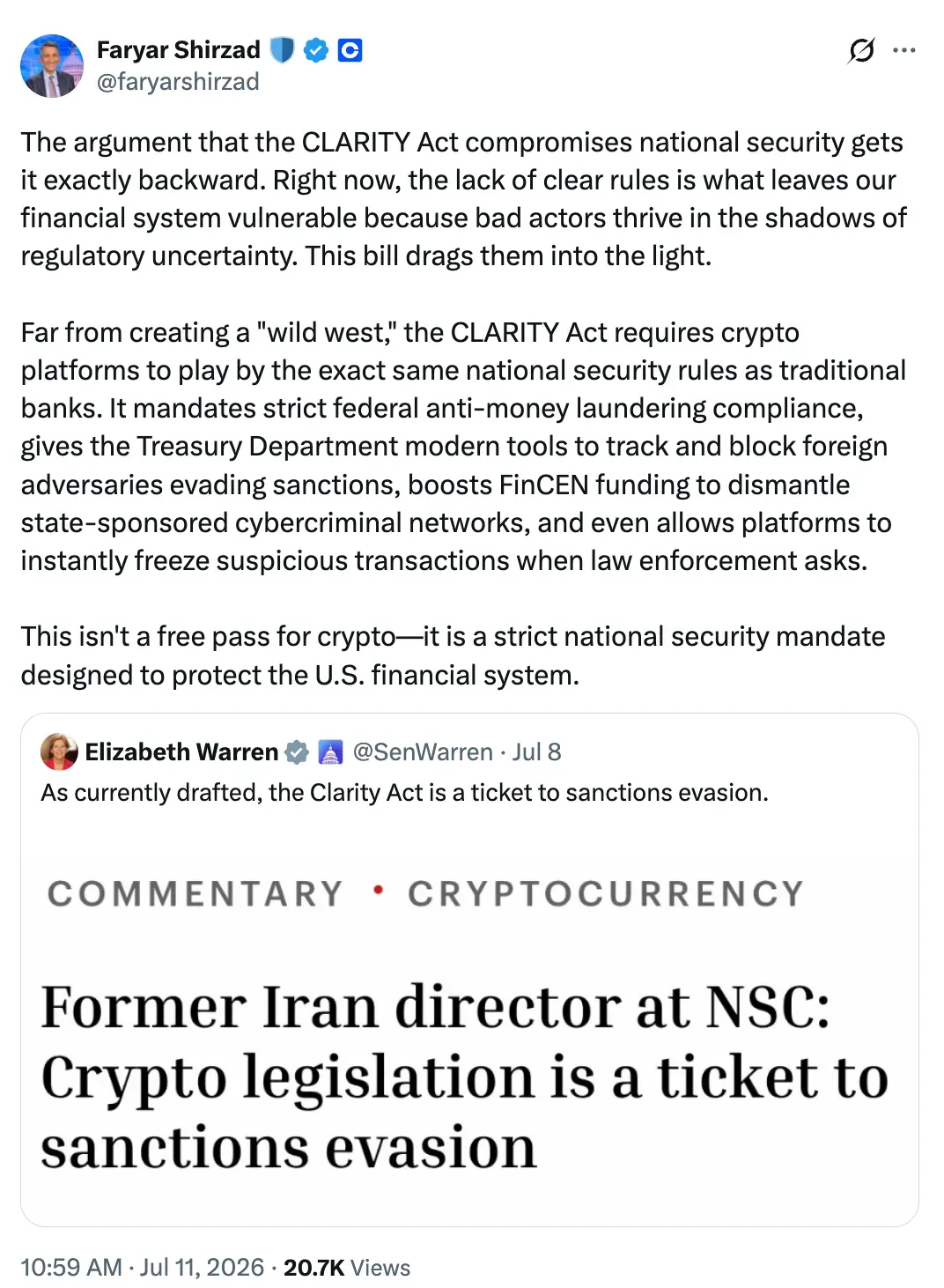
Shirzad said the bill, far from creating a "wild west," would require crypto platforms to follow the same national security standards as traditional banks.
Advertisement|Remove ads.
He said the legislation mandated strict federal anti-money laundering (AML) compliance, gave the Treasury Department tools to track and block foreign adversaries evading sanctions, boosted the Financial Crimes Enforcement Network (FinCEN), and permitted platforms to freeze suspicious transactions at law enforcement's request.
"This isn't a free pass for crypto," he wrote. "It is a strict national security mandate designed to protect the US financial system."
A Democratic Divide
Shirzad's post directly rebutted Senator Elizabeth Warren, who claimed on Wednesday that the CLARITY Act, "as currently drafted,” was “a ticket to sanctions evasion," sharing commentary from a former Iran director at the National Security Council (NSC).
Advertisement|Remove ads.
The exchange highlighted a deepening split among Democrats over the bill. While some have pushed to resolve the CLARITY Act's remaining disputes,
Warren has increasingly centered her opposition on sanctions and national security risk, alongside a separate fight over ethics provisions tied to officials' personal crypto holdings, a dispute Senator Kirsten Gillibrand said could sink the bill entirely without a binding provision barring senior officials from crypto ties.
COIN stock closed up by over 0.40% on Friday. On Stocktwits, the retail sentiment around COIN remained in the ‘neutral’ zone, while chatter around it shifted to ‘normal’ from ‘high’ levels over the past day.
Advertisement|Remove ads.
Iran's Crypto Activity Fuels Debate
The disagreement comes as U.S. policymakers pay closer attention to the role digital assets can play in sanctions evasion.
Chainalysis estimated Iran's crypto economy reached roughly $7.78 billion in 2025, with the Islamic Revolutionary Guard Corps accounting for about half of all on-chain activity in the country.
Iran has also emerged as one of the larger state-linked holders of Bitcoin (BTC), with the country's largest exchange, Nobitex, reportedly founded by two brothers from Iran's elite Kharrazi political dynasty and used to process funds tied to the Central Bank and the IRGC.
Advertisement|Remove ads.
Bitcoin’s price was relatively flat during the past 24 hours. On Stocktwits, the retail sentiment around BTC remained in the ‘neutral’ zone, while chatter around it shifted to ‘low’ from ‘normal’ levels over the past day.
Supporters Say CLARITY Strengthens Enforcement
Supporters of the CLARITY Act, including Shirzad, argue that formalizing market-structure rules, rather than leaving digital assets in regulatory limbo, would give agencies like Treasury and FinCEN stronger, clearer tools to intercept exactly this kind of sanctions evasion going forward.
That urgency has been echoed elsewhere in the bill's corner.
Advertisement|Remove ads.
Senator Cynthia Lummis warned that the CLARITY Act represents Congress's best shot this decade at establishing real digital asset market structure, cautioning that the current momentum "will not come around again this decade."
For updates and corrections, email newsroom[at]stocktwits[dot]com
Advertisement|Remove ads.
Comments posted here will also appear on symbol pages.

Latest News
/filters:format(webp)https://news.stocktwits-cdn.com/large_Getty_Images_2294264991_a1d08b075d.jpg)
/filters:format(webp)https://news.stocktwits-cdn.com/Anushka_Basu_make_me_smile_in_the_picture_b92832aa_af59_4141_aacc_4180d2241ba8_1_2_png_1086e0ed8c.webp) Anushka Basu·2h ago
Anushka Basu·2h ago/filters:format(webp)https://news.stocktwits-cdn.com/large_Getty_Images_1925090359_f160f05588.jpg) Anushka Basu·3h ago
Anushka Basu·3h ago/filters:format(webp)https://news.stocktwits-cdn.com/large_Getty_Images_2213700296_87303c323b.jpg) Anushka Basu·4h ago
Anushka Basu·4h ago/filters:format(webp)https://news.stocktwits-cdn.com/large_franklin_templeton_OG_jpg_4b3a7330d9.webp) Anushka Basu·5h ago
Anushka Basu·5h ago/filters:format(webp)https://news.stocktwits-cdn.com/large_Getty_Images_1445160636_5780a5fdde.jpg) Anushka Basu·7h ago
Anushka Basu·7h ago/filters:format(webp)https://news.stocktwits-cdn.com/Getty_Images_540198451_jpg_3e5f3d8ee7.webp) Anushka Basu·8h ago
Anushka Basu·8h ago