


Advertisement|Remove ads.
Hyperliquid Lands On Singapore's MAS Investor Alert List, Becoming One Of The First Major DeFi Protocols Flagged


- Hyperliquid was added to Singapore's Investor Alert List, with MAS naming both the Hyper Foundation website and trading application.
- Hyperliquid said the listing is not a ban or enforcement action and reiterated that it has never claimed to be licensed by MAS.
- MAS said the list identifies entities that may be wrongly perceived as regulated and does not imply wrongdoing.
Advertisement|Remove ads.
Hyperliquid (HYPE) was added to the Monetary Authority of Singapore's (MAS) Investor Alert List (IAL) on Friday, with the regulator naming both the Hyper Foundation website and the Hyperliquid trading application.
Hyperliquid explained on X that the listing "does not constitute a ban, an enforcement action, or a finding of wrongdoing," adding that it has never claimed to be licensed or authorized by MAS. The project said its permissionless infrastructure remains unchanged, with users maintaining self-custody and transactions settling transparently on-chain.
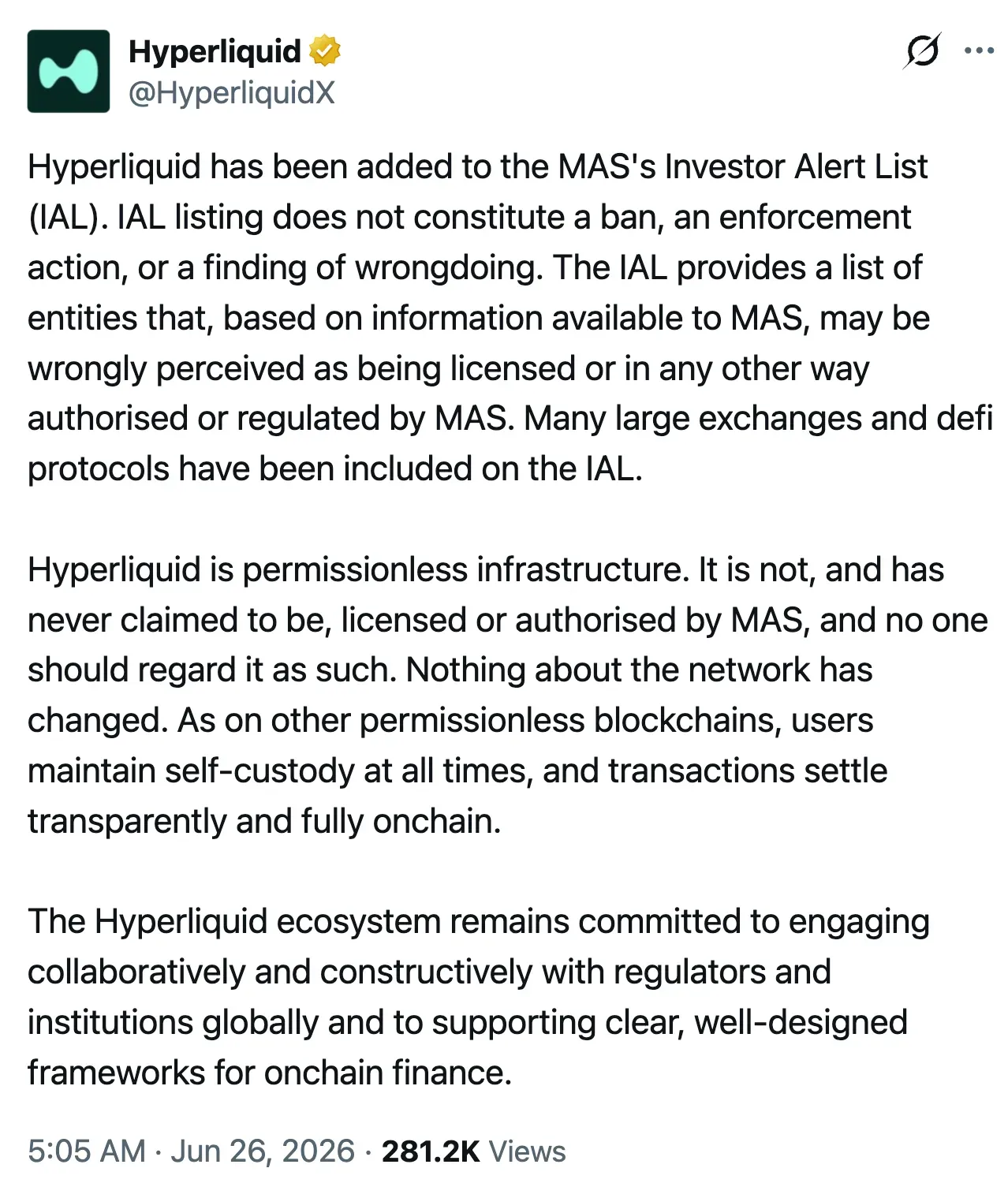
MAS said entities included on the Investor Alert List may be wrongly perceived by the public as being licensed, authorized, or otherwise regulated by the Singaporean regulator. According to MAS, inclusion on the list does not by itself indicate wrongdoing or constitute an enforcement action.
Advertisement|Remove ads.
The Investor Alert List is a consumer-protection register maintained by MAS to flag entities that could be mistaken for regulated firms. Hyperliquid's addition marks one of the first instances of a major decentralized finance (DeFi) protocol appearing on the list.
HYPE's price was down more than 1% over the past 24 hours. On Stocktwits, retail sentiment around the token remained in the 'extremely bearish' zone, while message volume fell from 'low' to 'extremely low' over the same period.
Joins Growing List Of Crypto Platforms
Hyperliquid joins several crypto platforms that have appeared on the MAS Investor Alert List, including Binance (BNB), KuCoin (KCS), Bitget (BGB), and Bybit. Bybit was added to the register earlier this month.
Advertisement|Remove ads.
While the listing does not restrict access to the protocol, it serves as a public notice that the entity is not licensed or regulated by MAS based on information available to the regulator.
The development comes as MAS continues to oversee Singapore's digital-asset sector under a regulatory framework that distinguishes licensed firms from entities operating outside its authorization regime.
MAS Tightens Retail Crypto Safeguards
MAS has steadily tightened retail safeguards in the digital-asset space in recent years. In rules that took effect in 2024, the regulator barred digital payment token service providers from offering credit facilities, leverage, and trading incentives to retail customers, and it prohibited them from lending or staking retail customers' assets after a series of global crypto collapses.
Advertisement|Remove ads.
The watchdog has also restricted crypto firms from marketing their services to the general public since January 2022, limiting promotion to their own corporate channels.
Read also: GME Stock Jumps After-Hours — GameStop Hikes FY26 EBITDA Outlook To $600M, Nearly Double Of FY25
For updates and corrections, email newsroom[at]stocktwits[dot]com.
Advertisement|Remove ads.
Comments posted here will also appear on symbol pages.

Latest News
/filters:format(webp)https://news.stocktwits-cdn.com/large_spacex_grok_jpg_ffce47a5f3.webp)
/filters:format(webp)https://news.stocktwits-cdn.com/unnamed_jpg_9dff551b50.webp) Anan Ashraf·8m ago
Anan Ashraf·8m ago/filters:format(webp)https://news.stocktwits-cdn.com/Getty_Images_2227994766_jpg_090ba3c9b6.webp)
/filters:format(webp)https://news.stocktwits-cdn.com/1707726834303_jpg_11f20a9aa9.webp) Shashank Nayar·12m ago
Shashank Nayar·12m ago/filters:format(webp)https://news.stocktwits-cdn.com/large_Apple_Homepod_jpg_b3fb972fca.webp) Shashank Nayar·35m ago
Shashank Nayar·35m ago/filters:format(webp)https://st-everywhere-cms-prod.s3.us-east-1.amazonaws.com/large_pexels_amar_17592716_a347a238b9.jpg) Anan Ashraf·1h ago
Anan Ashraf·1h ago/filters:format(webp)https://news.stocktwits-cdn.com/gettyimages_1161631184_594x594_0063399eed.jpg) Shashank Nayar·1h ago
Shashank Nayar·1h ago/filters:format(webp)https://st-everywhere-cms-prod.s3.us-east-1.amazonaws.com/large_stock_rising_resized_f17852d7aa.jpg) Anan Ashraf·2h ago
Anan Ashraf·2h ago