


Advertisement|Remove ads.
AMD CEO Lisa Su Sees AI Inference Boom Fueling $1.5T Demand By 2030: 'About 60% Of The Market Going Forward'
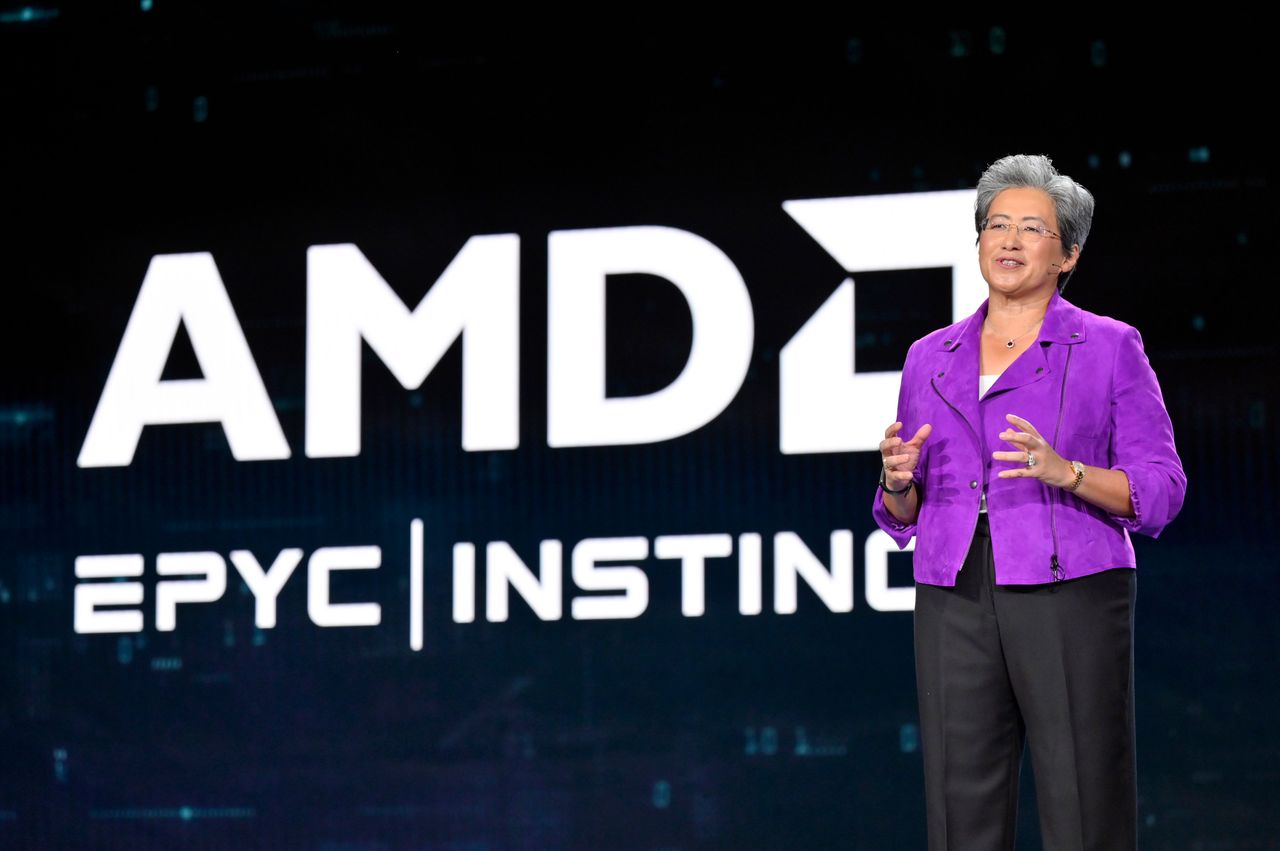


- AMD CEO Lisa Su said AI inference and agentic workloads are driving demand for AI infrastructure.
- She expects CPU demand could grow 50% annually to exceed $200 billion by 2030.
- AMD has begun shipping its Helios AI racks to major customers, including Meta, Microsoft, OpenAI, Oracle and Anthropic.
Advertisement|Remove ads.
Advanced Micro Devices (AMD) CEO Lisa Su sees AI inference driving the next wave of growth, with the data center AI accelerator market potentially reaching $1.5 trillion by 2030. Speaking at the 2026 OCP Global Summit, Su said inference could account for about 60% of the AI market as agentic workloads bring demand for computing power.
AMD CEO Says AI Infrastructure Market Set For Major Growth
Advanced Micro Devices is expanding its AI infrastructure lineup as demand shifts toward systems that can run AI applications at scale. Su highlighted the company’s Helios and Helion rack systems, growing demand for processors, and the development of a new EPYC chip.
“This year is really the year of inference. This is the year where we believe inference is now about 60% of the market going forward. And it's not just inference. It's really the agentic workloads that have really taken off.”
Advertisement|Remove ads.
Su said AMD expects the market for data center AI accelerators to approach $1.5 trillion by 2030. She also pointed to a sharp increase in demand for central processing units (CPUs), driven in part by AI agents that can carry out tasks with limited human involvement.
“We have actually raised the TAM on this three times in the last nine months because we've seen that much growth in the overall CPU demand, which we now believe will grow at approximately 50% CAGR over the next four or five years to over a $200 billion TAM by the time you get to 2030.”
Advanced Micro Devices stock traded over 1% lower in Tuesday’s premarket.
Advertisement|Remove ads.
AMD’s Helios AI Rack Enters Production
AMD's Helios rack-scale system, introduced in July, began production shipments in September. Su said initial systems have reached major customers, including Meta Platforms (META), Microsoft (MSFT), OpenAI, Oracle (ORCL) and Anthropic. Production is expected to increase through the fourth quarter and into the first half of 2027.
Developed with Meta, Helios follows Open Compute Project standards and combines 72 GPUs into a single accelerator system. The rack contains more than 18,000 GPU compute units and 4,600 Zen 6 CPU cores. AMD estimates that the platform can deliver 30% more tokens per dollar, a measure of AI processing value relative to cost.
“Helios is absolutely the most sophisticated and complex system that we've built at AMD together with our partners.”
Advertisement|Remove ads.
AMD’s Helion Targets AI Agents And Enterprise Workloads
AMD also introduced Helion, a rack system designed for agentic AI workloads. The company said the system can support more than 32,000 Zen 6 cores and up to 32 Instinct MI350P GPUs. It supports liquid or air cooling and uses a standard 21-inch rack design.
The system is intended to help data center operators match computing resources to different tasks, from everyday personal assistants to enterprise applications and demanding technical workloads. Su also presented EPYC Verano, a server processor based on AMD's Venice CPU core family. Designed to reduce system power consumption, the chip features six core-complex dies and up to 192 CPU cores, along with improved bandwidth between CPUs and GPUs.
AMD Stock: Retail View
However, on Stocktwits, retail sentiment around the stock slipped to ‘bearish’ from ‘neutral’ the previous day.
Advertisement|Remove ads.
AMD stock has gained over 177% year-to-date.
For updates and corrections, email newsroom[at]stocktwits[dot]com.
Advertisement|Remove ads.
Comments posted here will also appear on symbol pages.

Latest News
/filters:format(webp)https://news.stocktwits-cdn.com/Getty_Images_2235778544_jpg_2b7ceca102.webp)
/filters:format(webp)https://news.stocktwits-cdn.com/Prabhjote_DP_67623a9828.jpg) Prabhjote Gill·7m ago
Prabhjote Gill·7m ago/filters:format(webp)https://news.stocktwits-cdn.com/large_Christopher_Waller_jpg_172aacdad6.webp)
/filters:format(webp)https://news.stocktwits-cdn.com/Harshita_3cfe02022c.jpg) Harshita Tyagi·24m ago
Harshita Tyagi·24m ago/filters:format(webp)https://news.stocktwits-cdn.com/large_Getty_Images_2251310649_694022e43a.jpg)
/filters:format(webp)https://news.stocktwits-cdn.com/Whats_App_Image_2026_05_11_at_09_45_43_1_jpeg_a08c0cf251.webp) Aveek Bhowmik·47m ago
Aveek Bhowmik·47m ago/filters:format(webp)https://news.stocktwits-cdn.com/large_Tom_Lee_c6db3cdfe4.webp)
/filters:format(webp)https://news.stocktwits-cdn.com/Anushka_Basu_make_me_smile_in_the_picture_b92832aa_af59_4141_aacc_4180d2241ba8_1_2_png_1086e0ed8c.webp) Anushka Basu·1h ago
Anushka Basu·1h ago/filters:format(webp)https://news.stocktwits-cdn.com/large_oil_stocks_jpg_6935abe231.webp) Aveek Bhowmik·2h ago
Aveek Bhowmik·2h ago/filters:format(webp)https://news.stocktwits-cdn.com/large_Getty_Images_1454302914_ad119364f4.jpg)
/filters:format(webp)https://news.stocktwits-cdn.com/shivani_photo_jpg_dd6e01afa4.webp) Shivani Kumaresan·2h ago
Shivani Kumaresan·2h ago