


Advertisement|Remove ads.
AMD Reportedly Sees AI Chip Demand Outrunning Supply — Lisa Su Plans ‘Substantial’ 2027 Ramp
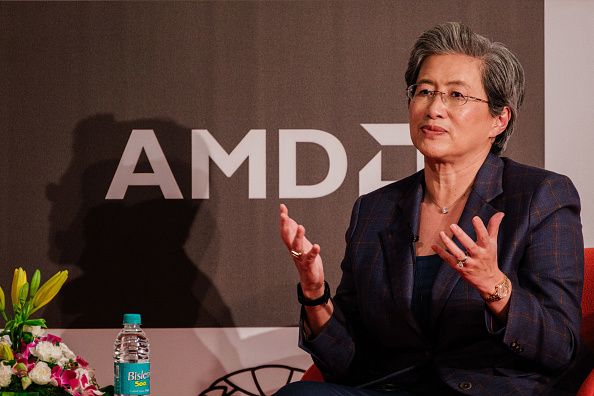


- AMD CEO Lisa Su met Foxconn in Taipei and was due to meet TSMC to ensure the firm's supply chain can increase CPU and GPU output.
- AMD needs additional advanced wafer capacity over the next several years, said Su.
- Citi raised its AMD price target to $800 and sees the CPU market growing from $29 billion in 2025 to $300 billion by 2030, per TheFly.
Advertisement|Remove ads.
Advanced Micro Devices (AMD) reportedly plans a substantial increase in chip supply next year as artificial intelligence (AI) demand continues to exceed what the company can currently provide, CEO Lisa Su told reporters in Taipei on Tuesday.
“We’ve been able to increase our supply as we’ve gone through 2026,” Su said, adding that AMD would “substantially increase” supply in 2027, according to Reuters.
Su expects chip demand to remain very high for the next few years. AMD needs more advanced wafer capacity and is now planning supply three to five years ahead, the report cited Su saying.
Advertisement|Remove ads.
At the time of this writing, AMD stock was trading over 1.5% higher in Tuesday’s premarket session.
AMD Pushes Suppliers To Keep Pace
Su said one purpose of her Taiwan visit was to ensure AMD’s supply chain can increase production of central processing units (CPUs) and graphics processing units (GPUs). She had met Foxconn and was scheduled to meet Taiwan Semiconductor Manufacturing Co. (TSM) as part of discussions with local partners.
AMD is also working with memory suppliers to secure enough components. Memory remains constrained across the industry, including the high-bandwidth memory used in AI servers, Su said, according to Taiwan’s Central News Agency.
Advertisement|Remove ads.
AMD's Data Center Business Is Accelerating
AMD’s latest financial results show the scale of that demand. The company’s second-quarter (Q2) Data Center revenue reached $6.7 billion, up 107% year over year, driven by strong demand for EPYC processors and Instinct GPUs.
The segment accounted for 58% of AMD’s $11.5 billion quarterly revenue. AMD expects that momentum to continue as its Helios rack-scale AI systems ramp. Helios was already in production, according to company’s July statement, with OpenAI deployments expected to begin in the fourth quarter and accelerate through 2027.
Citi Raises AMD Target On Agentic AI Opportunity
On Tuesday, Citi raised its price target on AMD stock to $800 from $575 earlier, arguing that the emergence of always-on personal AI agents such as Meta’s Muse could sharply increase demand for computing, memory and networking infrastructure.
Advertisement|Remove ads.
The firm now estimates that CPU total addressable market (TAM) could expand from $29 billion in 2025 to $300 billion by 2030, representing a roughly 60% compound annual growth rate, according to TheFly.
Agentic AI could require substantially more compute than traditional chatbots because the agents operate continuously and execute tasks in the background, the firm said, adding that it sees AMD as the primary beneficiary of a “CPU renaissance”.
The Citi analyst noted that Meta is one of AMD's largest customers in its server business.
Advertisement|Remove ads.
What Retail Thinks About AMD Stock
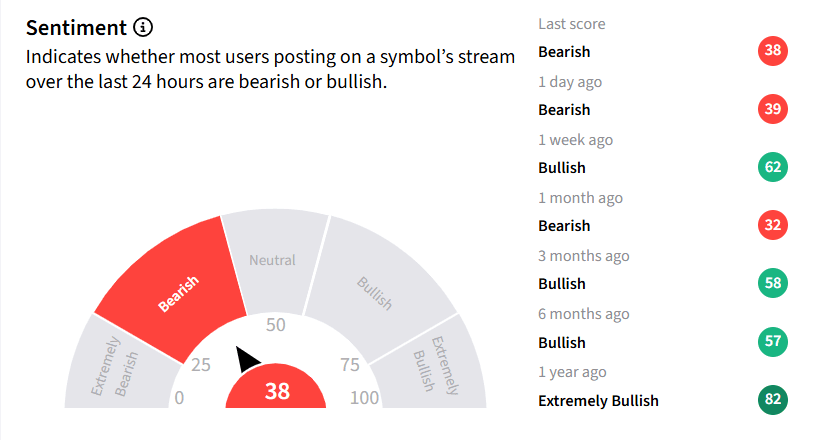
On Stocktwits, retail investors’ sentiment around AMD stock remained in the ‘bearish’ territory.
So far this year, AMD stock has nearly tripled, surging around 182%. In comparison, the iShares Semiconductor ETF (SOXX) and the Invesco QQQ Trust, Series 1 ETF (QQQ), which hold AMD shares, have risen around 88% and 23% over the same period.
Advertisement|Remove ads.
For updates and corrections, email newsroom[at]stocktwits[dot]com.
Comments posted here will also appear on symbol pages.

Latest News
/filters:format(webp)https://news.stocktwits-cdn.com/Getty_Images_2242292649_jpg_631e331f1a.webp)
/filters:format(webp)https://news.stocktwits-cdn.com/Harshita_3cfe02022c.jpg) Harshita Tyagi·12m ago
Harshita Tyagi·12m ago/filters:format(webp)https://news.stocktwits-cdn.com/large_cathiewood_OG_jpg_a3c8fddb3f.webp)
/filters:format(webp)https://news.stocktwits-cdn.com/vivekkrishnanphotography_58_jpg_0e45f66a62.webp) Arnab Paul·14m ago
Arnab Paul·14m ago/filters:format(webp)https://news.stocktwits-cdn.com/large_Getty_Images_2183604828_0179169ddb.jpg)
/filters:format(webp)https://news.stocktwits-cdn.com/Anushka_Basu_make_me_smile_in_the_picture_b92832aa_af59_4141_aacc_4180d2241ba8_1_2_png_1086e0ed8c.webp) Anushka Basu·50m ago
Anushka Basu·50m ago/filters:format(webp)https://news.stocktwits-cdn.com/large_Getty_Images_2169472761_c7ff971fc6.jpg) Harshita Tyagi·1h ago
Harshita Tyagi·1h ago/filters:format(webp)https://news.stocktwits-cdn.com/JBLU_180f320f7f.jpg)
/filters:format(webp)https://news.stocktwits-cdn.com/Heera_1_1c30cb0170.PNG) Heera Hari·1h ago
Heera Hari·1h ago/filters:format(webp)https://news.stocktwits-cdn.com/large_Getty_Images_2228875369_jpg_de1bdcdd3f.webp)
/filters:format(webp)https://news.stocktwits-cdn.com/Whats_App_Image_2026_05_11_at_09_45_43_1_jpeg_a08c0cf251.webp) Aveek Bhowmik·1h ago
Aveek Bhowmik·1h ago