


Advertisement|Remove ads.
IBM Stock Headed For Worst Week In Over 58 Years — Why Citi Cut Its Price Target By 32%


- Citi’s price cut on IBM shares came after the company warned of weaker-than-expected performance tied to its mainframe business.
- The firm also believes that IBM will not immediately recapture delayed mainframe deals and that its organic software business will remain largely flat in the near term.
- JPMorgan also reduced its price target to $250 from $291 while reiterating an ‘Overweight’ rating.
Advertisement|Remove ads.
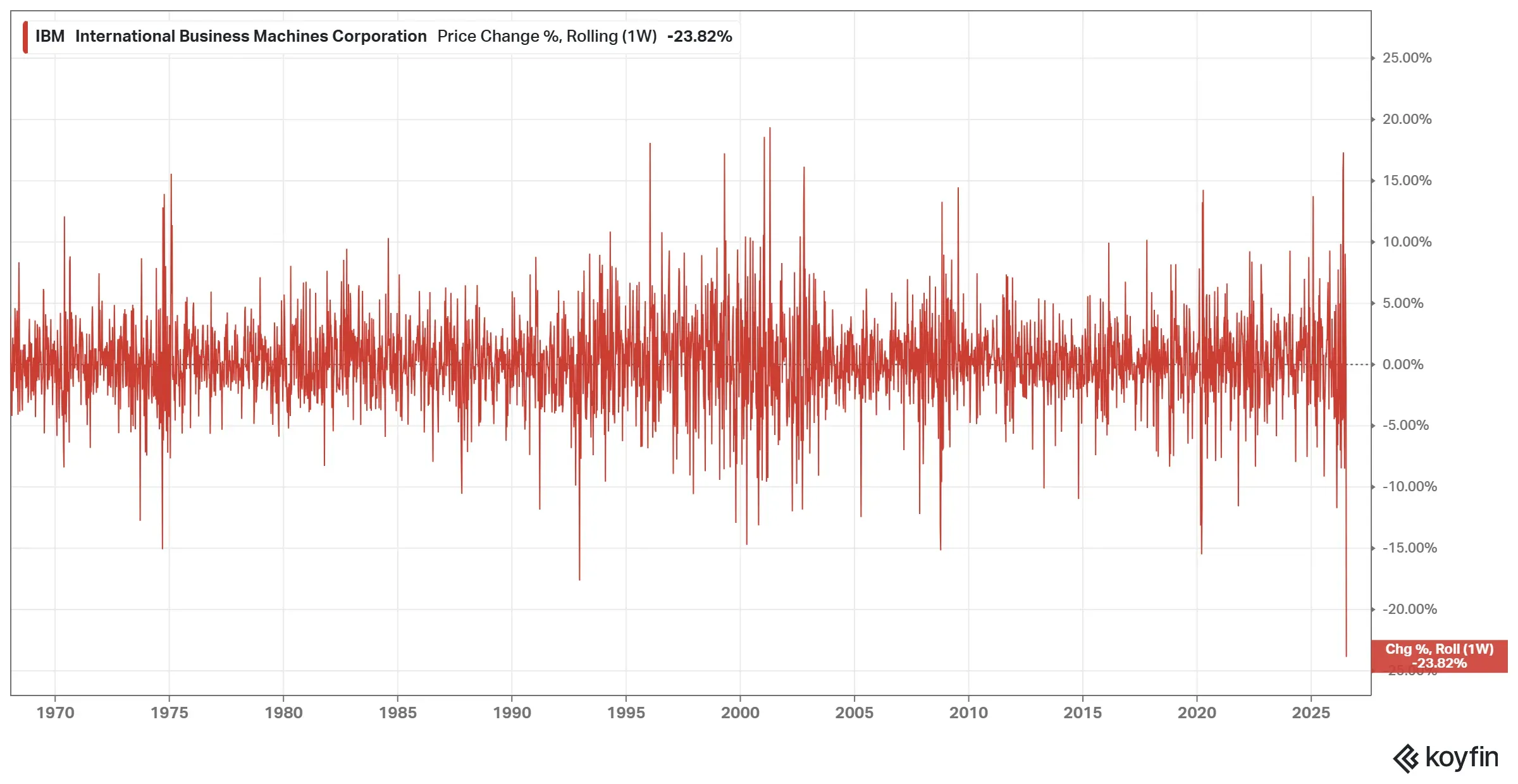
Shares of International Business Machines Corp. (IBM) are headed for their worst week in over 58 years after the company announced its preliminary second-quarter (Q2) results earlier this week.
IBM shares were down nearly 2% in Friday’s pre-market trade, with the stock now down nearly 24% for the week. If IBM shares maintain their current levels, this will be the company’s worst single-week decline since 1968.
Wall Street Trims Its Price Targets For IBM Shares
Wall Street turned cautious on IBM following CEO Arvind Krishna’s letter to the company’s investors.
Advertisement|Remove ads.
According to TheFly, Citi analyst Fatima Boolani cut her price target on IBM to $255 from $375 while maintaining a ‘Buy’ rating. The sharp reduction came after the company warned of weaker-than-expected performance tied to its mainframe business.
The firm also believes that IBM will not immediately recapture delayed mainframe deals and that its organic software business will remain largely flat in the near term.
JPMorgan also reduced its price target to $250 from $291 while reiterating an ‘Overweight’ rating. The firm described IBM's mainframe-driven preannouncement as disappointing but argued that much of the downside is already reflected in the stock price.
Advertisement|Remove ads.
According to the firm, IBM now trades at a discount to its sum-of-the-parts valuation, suggesting the market has largely priced in the incremental risks.
Looking ahead, JPMorgan expects IBM to take a more conservative approach when updating its guidance, resulting in lower fiscal 2026 growth expectations across its software, consulting and mainframe businesses.
However, the firm believes the company has levers to cushion the impact, including potential cost-cutting measures and its existing $2 billion share repurchase authorization, which it noted has remained largely unused in recent years.
Advertisement|Remove ads.
What IBM CEO Said In His Letter To IBM Investors
In a letter to investors accompanying the company's preliminary Q2 results, Krishna acknowledged that the quarter fell short of expectations, attributing the weakness primarily to its mainframe business.
He said clients shifted capital spending toward servers, storage and memory purchases late in the quarter to secure supply-constrained infrastructure ahead of anticipated price increases, while rapidly evolving cybersecurity concerns also disrupted customer buying patterns.
Those factors, combined with IBM's failure to close several large deals on schedule, hurt its Z mainframe business and the associated software stack, particularly Transaction Processing, driving the company's quarterly shortfall.
Advertisement|Remove ads.
He highlighted that IBM was not making excuses for the disappointing quarter, saying the company’s teams "did not adapt and move quickly enough" to changing market conditions.
“These conditions require our teams to execute perfectly, and this quarter we faltered. We did not adapt and move quickly enough, and numerous large deals failed to close on the timelines we expected, driving the majority of our shortfall,” Krishna said.
Despite the setback, he argued the broader business remains on solid footing, highlighting accelerating growth at Red Hat, strong performance from recent acquisitions including HashiCorp and Confluent, record growth in Distributed Infrastructure, continued momentum in AI-related consulting engagements and ongoing margin expansion driven by productivity initiatives.
Advertisement|Remove ads.
Looking ahead, Krishna reiterated IBM's long-term commitment to AI and quantum computing. He pointed to the launch of Lightwell, IBM's new $5 billion AI initiative aimed at helping enterprises address open-source software vulnerabilities, as well as the company’s plans to invest more than $10 billion in quantum computing over the next five years.
What Retail Traders Think Of IBM Stock
Retail sentiment on Stocktwits around IBM trended in the ‘extremely bullish’ territory, with message volumes at ‘extremely high’ levels at the time of writing.
IBM stock is down 26% year-to-date and 22% over the past 12 months. The S&P 500 ETF Trust (SPY) is up 20% over the past 12 months, while the Vanguard Total Stock Market Index Fund ETF (VTI) is up 21%.
Advertisement|Remove ads.
The iShares Semiconductor ETF (SOXX) is up 116% during this period, while the State Street Technology Select Sector SPDR ETF (XLK) is up 37%.
For updates and corrections, email newsroom[at]stocktwits[dot]com.
Advertisement|Remove ads.
Comments posted here will also appear on symbol pages.

Latest News
/filters:format(webp)https://news.stocktwits-cdn.com/Getty_Images_2237643016_jpg_17a9a7eb9d.webp)
/filters:format(webp)https://st-everywhere-cms-prod.s3.us-east-1.amazonaws.com/i_OS_App_Icon_1_8054f2a2fe.png) Stocktwits News Desk·1h ago
Stocktwits News Desk·1h ago/filters:format(webp)https://news.stocktwits-cdn.com/large_trump_putin_jpg_eb42a46830.webp) Stocktwits News Desk·2h ago
Stocktwits News Desk·2h ago/filters:format(webp)https://news.stocktwits-cdn.com/large_Getty_Images_2286326398_84fc8215c8.jpg)
/filters:format(webp)https://news.stocktwits-cdn.com/Prabhjote_DP_67623a9828.jpg) Prabhjote Gill·2h ago
Prabhjote Gill·2h ago/filters:format(webp)https://news.stocktwits-cdn.com/large_Getty_Images_2162497795_jpg_c07f3aa255.webp)
/filters:format(webp)https://news.stocktwits-cdn.com/vivekkrishnanphotography_58_jpg_0e45f66a62.webp) Arnab Paul·4h ago
Arnab Paul·4h ago/filters:format(webp)https://news.stocktwits-cdn.com/large_Getty_Images_2250139725_0ccee3701a.jpg)
/filters:format(webp)https://news.stocktwits-cdn.com/unnamed_jpg_9dff551b50.webp) Anan Ashraf·5h ago
Anan Ashraf·5h ago/filters:format(webp)https://news.stocktwits-cdn.com/large_Getty_Images_1390829031_d0ceb471aa.jpg) Anan Ashraf·5h ago
Anan Ashraf·5h ago