


Advertisement|Remove ads.
Iran Issues Six-Point Ultimatum For Peace As Strait Of Hormuz Tensions Heat Up
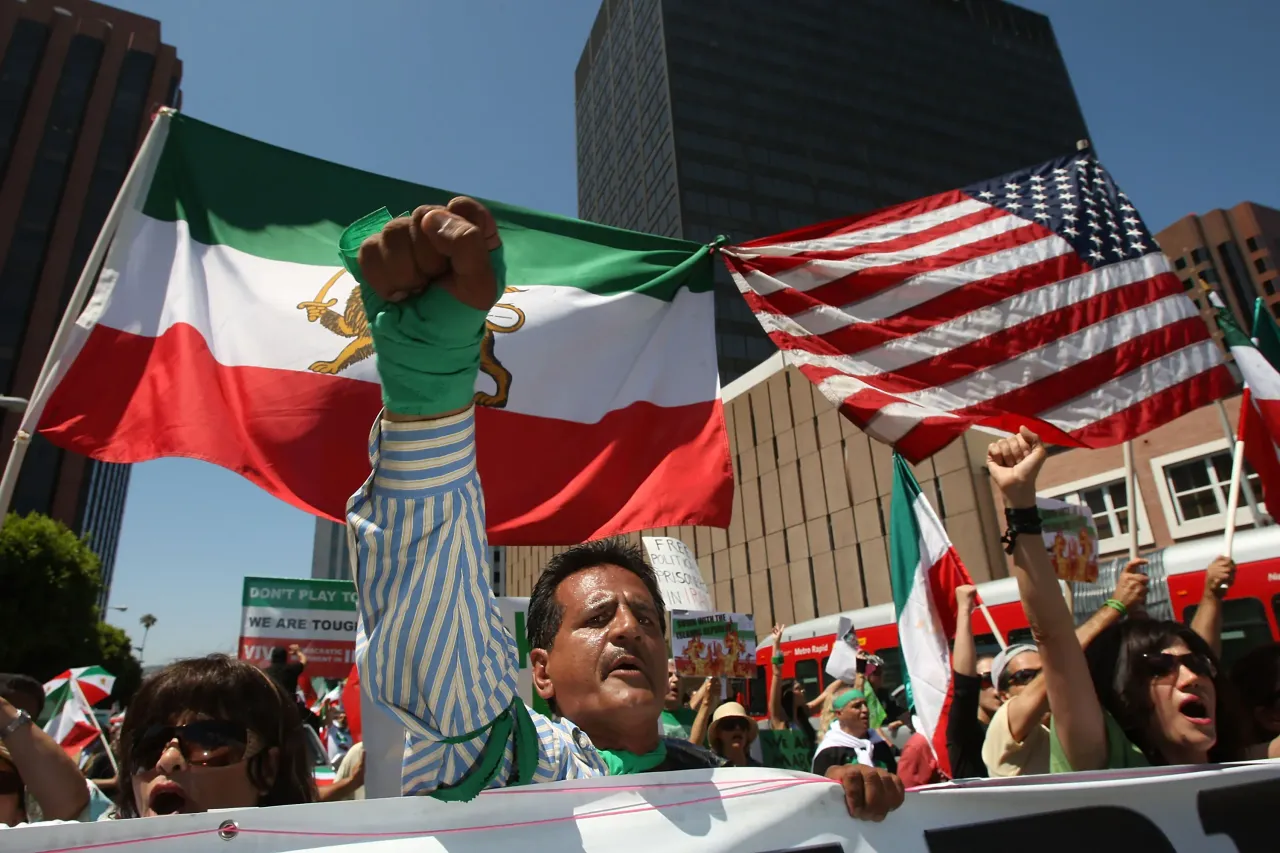


- Iranian officials reportedly proposed six conditions to end the conflict with the US and Israel.
- Iran’s former Prime Minister reportedly said the Strait of Hormuz was open under controlled access.
- The developments came as US President Donald Trump issued a 48-hour ultimatum warning of potential strikes if the waterway was not fully reopened.
Advertisement|Remove ads.
As the Israel-Iran war steps into its 23rd day, Iran has laid out six sweeping conditions to end its escalating conflict with the United States and Israel.
Iranian officials reportedly that they had proposed six conditions for ending the conflict with the United States and Israel, while Tehran continued to control access to the Strait of Hormuz.
Security officials indicated that any agreement would depend on specific guarantees and conditions being met. The reports said Iran’s conditions include guarantees to prevent future attacks, the closure of US military bases in the region, and compensation for damages caused during the conflict, Ilkha reported on Sunday Tehran has also called for an end to fighting across multiple fronts, alongside the creation of a new legal framework governing the Strait of Hormuz, which is a critical artery for global oil supply.
Advertisement|Remove ads.
The price of crude oil (WTI) is continuing to rally. The chart shows a clear breakout into a long-term bullish trend. The trend is still positive, but the rally seems to be going on longer than expected, which means there is a higher chance of a pullback or sideways movement in the near future. However, the trend could keep steady as long as prices stay above the $90 to $95 support zone. Resistance, for now, is near $100, and then $115 to $120 if geopolitical risks keep pushing prices up.
How Are Stocktwits Users Reacting?
United States Brent Oil Fund, LP (BNO) and United States Oil Fund, LP (USO) are both in the red after hours. On Stocktwits, retail sentiment around BNO improved from ‘bearish’ to ‘neutral’ territory, while chatter remained at ‘high’ levels over the past day. For USO, retail sentiment remained in a ‘bearish’ zone, with chatter levels at ‘high’ over the past day. Some users believe that oil prices could go as high as $200.
Advertisement|Remove ads.
Other Factors For De-escalation
According to Al Mayadeen, Mir Hossein Moussavi, Iran’s former Prime Minister, told the International Maritime Organization (IMO) that Iran was willing to cooperate to ensure safe navigation while restricting vessels linked to the United States and Israel. Ships from countries maintaining neutral or cooperative relations with Iran continue to pass through the waterway, which carries roughly 20% of global oil flows. In addition, Iranian authorities were seeking legal action against media entities they considered hostile. Officials said no agreement would be accepted unless these conditions are fulfilled.
Mousavi also warned that recent attacks on Iranian territory and infrastructure represented a serious escalation, adding that such actions are “crossing another red line” and could prompt further responses, even as Iran said diplomacy remains a priority if its conditions are met.
U.S. President Donald Trump gave an ultimatum to Iran on Saturday that if Iran did not fully reopen the Strait of Hormuz within 48 hours, the U.S. would destroy Iranian power infrastructure.
Advertisement|Remove ads.
Read also: Oil Shock From Middle East Tensions Is Squeezing Bitcoin Miners, Raising Risks For Selling
For updates and corrections, email newsroom[at]stocktwits[dot]com.
Comments posted here will also appear on symbol pages.

Latest News
/filters:format(webp)https://news.stocktwits-cdn.com/large_GEV_Vernova_resized_jpg_2fd59ac745.webp)
/filters:format(webp)https://news.stocktwits-cdn.com/Aashika_Suresh_Profile_Picture_jpg_2acd6f446c.webp) Aashika Suresh·4m ago
Aashika Suresh·4m ago/filters:format(webp)https://news.stocktwits-cdn.com/large_asts_a3f37696a9.jpg)
/filters:format(webp)https://news.stocktwits-cdn.com/IMG_8805_JPG_6768aaedc3.webp) Deepti Sri·21m ago
Deepti Sri·21m ago/filters:format(webp)https://news.stocktwits-cdn.com/large_qualcomm_jpg_bf257cee94.webp)
/filters:format(webp)https://news.stocktwits-cdn.com/IMG_9209_1_d9c1acde92.jpeg) Yuvraj Malik·22m ago
Yuvraj Malik·22m ago/filters:format(webp)https://news.stocktwits-cdn.com/large_BE_Bloom_faee9b1d61.webp) Aashika Suresh·46m ago
Aashika Suresh·46m ago/filters:format(webp)https://news.stocktwits-cdn.com/large_Getty_Images_915868956_jpg_408b387146.webp) Deepti Sri·59m ago
Deepti Sri·59m ago/filters:format(webp)https://news.stocktwits-cdn.com/large_Getty_Images_2249581920_jpg_e0f76b0419.webp)
/filters:format(webp)https://news.stocktwits-cdn.com/shivani_photo_jpg_dd6e01afa4.webp) Shivani Kumaresan·1h ago
Shivani Kumaresan·1h ago