


Advertisement|Remove ads.
JPMorgan’s Dimon Says US-Israel-Iran War Unlikely To Be Major Inflation Risk Unless Conflict Prolongs, Flags This Threat Instead
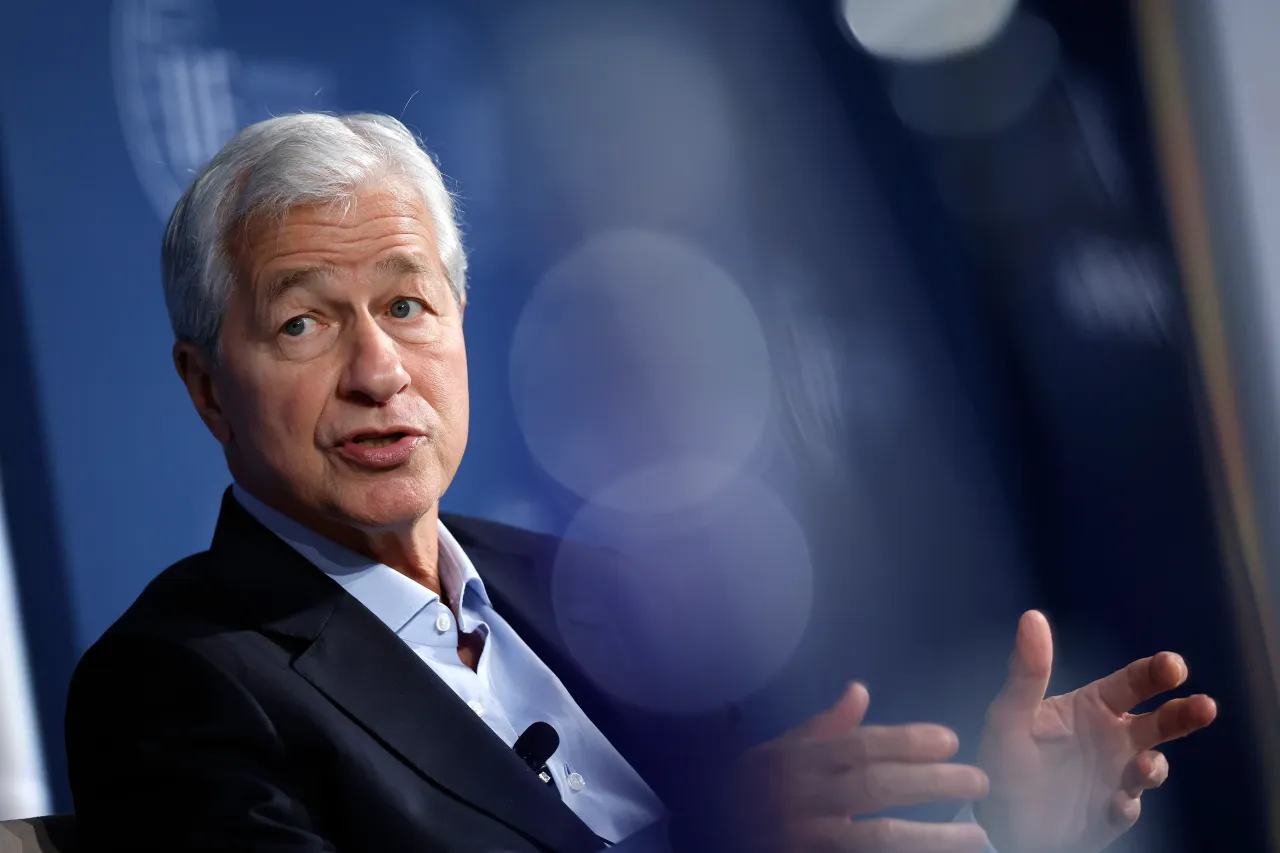


- Dimon said that the risk of inflation due to increasing oil prices from the U.S.-Israel-Iran war wasn’t isolated, but inflation “could be like a skunk at a party.”
- Dimon, however, flagged an increase in global cyber or terrorist attacks as a consequence of the ongoing war.
- He added that banks may be targets.
Advertisement|Remove ads.
Jamie Dimon, CEO at JPMorgan Chase & Co., said on Monday that inflation could become a bit like a “skunk at a party” for the U.S.
In a CNBC interview, Dimon replied to a question about the risk of inflation due to increasing oil prices from the U.S.-Israel-Iran war, saying that while it wasn’t isolated, “There’s some risk there’s more inflation than people think, and that could be like a skunk at a party if that ever happens,” he said.
The war had increased gas prices a little in the near-term, but if not prolonged, it would not be a major inflationary hit, Dimon said. “If it went on for a long time, that would be different,” he said.
Advertisement|Remove ads.
Dimon’s comments come amid rising geopolitical tensions in the Middle East after the U.S. and Israel attacked Iran over the weekend, which led to surging crude oil prices on Monday following the closure of the Strait of Hormuz.
Risk Of Cyber Attacks
Dimon, however, flagged an increase in global cyber or terrorist attacks as a consequence of the ongoing war.
In response to a question about other potential geopolitical risks of the conflict, Dimon said, “The most important thing is that we keep the Western world free and safe for democracy.”
Advertisement|Remove ads.
“But… as a corollary to that, you’ve got to expect there’ll be cyberattacks or terrorist attacks, either here or around the world,” he said. “Banks may be targets,” he added.
Dimon added that he was hopeful the war would lead to a long and lasting climate of peace in the Middle East. “Maybe it will be a catalyst to get that done,” he said.
Latest Updates
Iran's Revolutionary Guards commander officially confirmed that the Strait of Hormuz, which is a path for about a fifth of the world's total oil consumption, is closed and Iran will set on fire any ship trying to pass, according to a report from Reuters that cited Iranian media.
Advertisement|Remove ads.
U.S. President Donald Trump said earlier on Monday that the conflict was “substantially ahead" of time projections, but “but we have capability to go far longer than” the initial projections of four to five weeks.
Meanwhile, U.S. equities were mixed on Monday. At the time of writing, the SPDR S&P 500 ETF (SPY), which tracks the S&P 500 index, was trading up by 0.02%, the Invesco QQQ Trust ETF (QQQ) rose 0.06%, while the SPDR Dow Jones Industrial Average ETF Trust (DIA) declined 0.15%. The SPDR S&P Bank ETF (KBE), which tracks the financial sector in the U.S., was up 1.47% at the time of writing.
Retail sentiment around the S&P 500 ETF on Stocktwits was in the ‘bullish’ territory.
Advertisement|Remove ads.
For updates and corrections, email newsroom[at]stocktwits[dot]com.
Comments posted here will also appear on symbol pages.

Latest News
/filters:format(webp)https://st-everywhere-cms-prod.s3.us-east-1.amazonaws.com/large_tmus_starlink_musk_mike_sievert_resized_985bfa1ac2.jpg)
/filters:format(webp)https://news.stocktwits-cdn.com/Prabhjote_DP_67623a9828.jpg) Prabhjote Gill·22m ago
Prabhjote Gill·22m ago/filters:format(webp)https://news.stocktwits-cdn.com/large_Getty_Images_2289653156_2e76978249.jpg)
/filters:format(webp)https://news.stocktwits-cdn.com/Anushka_Basu_make_me_smile_in_the_picture_b92832aa_af59_4141_aacc_4180d2241ba8_1_2_png_1086e0ed8c.webp) Anushka Basu·24m ago
Anushka Basu·24m ago/filters:format(webp)https://news.stocktwits-cdn.com/gettyimages_2296155088_594x594_e8c6d1d489.jpg)
/filters:format(webp)https://news.stocktwits-cdn.com/Harshita_3cfe02022c.jpg) Harshita Tyagi·25m ago
Harshita Tyagi·25m ago/filters:format(webp)https://st-everywhere-cms-prod.s3.us-east-1.amazonaws.com/large_citibank_window_resized_c7f400c4f5.jpg)
/filters:format(webp)https://news.stocktwits-cdn.com/vivekkrishnanphotography_58_jpg_0e45f66a62.webp) Arnab Paul·37m ago
Arnab Paul·37m ago/filters:format(webp)https://st-everywhere-cms-prod.s3.us-east-1.amazonaws.com/large_paultudorjones_resized_9aad45543a.jpg) Prabhjote Gill·59m ago
Prabhjote Gill·59m ago/filters:format(webp)https://st-everywhere-cms-prod.s3.us-east-1.amazonaws.com/large_crown_b_IV_3_C8_Tjq_YA_unsplash_7145a9f395.jpg) Harshita Tyagi·1h ago
Harshita Tyagi·1h ago