


Advertisement|Remove ads.
LIME CEO Wayne Ting Explains How The Uber-Backed Bike Rental Firm Outlasted Competitors, Ahead Of IPO
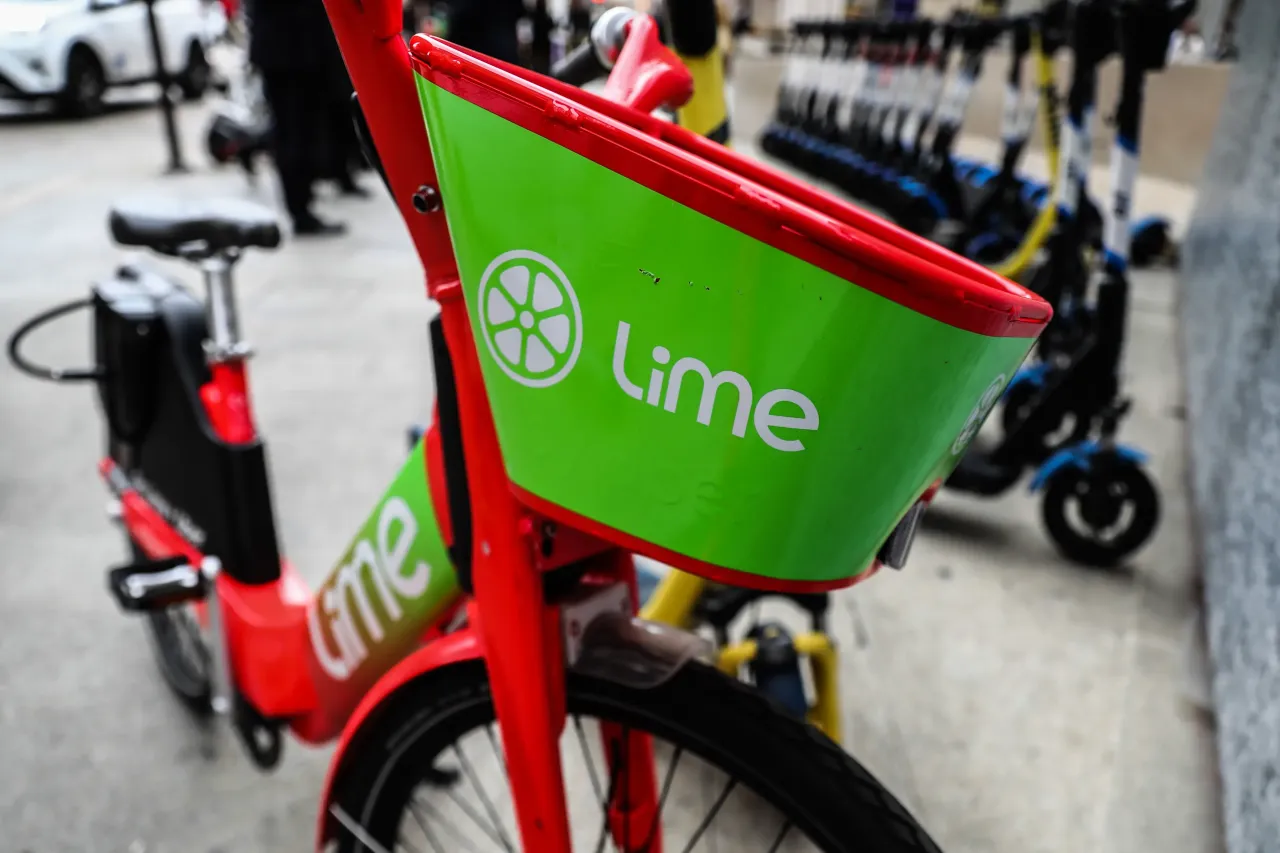


- Ting touted the company’s approach to vertical integration across various aspects of its business, including hardware, software, operations, and government relations, as another reason for its success.
- He said that Lime generates a gross margin of over 50%, with the remainder going toward spare parts, mechanics, and other operational costs associated with maintaining these bikes and scooters.
- The Uber-backed company is all set to debut on the Nasdaq on Wednesday.
Advertisement|Remove ads.
Neutron Holdings Inc. (LIME) CEO Wayne Ting on Wednesday explained what the bike rental firm did differently from its competitors to outlast them and go public as one of the few remaining companies in this space.
During an interview with CNBC, Ting said that Neutron Holdings, better known as Lime, focused on getting its economics and integration right.
“Getting the unit economics right for this business was a core part of what Lime did differently, making sure that we’re making money at the city level, at the scooter level,” he said.
Advertisement|Remove ads.
The Uber Technologies Inc. (UBER) backed company is all set to debut on the Nasdaq on Wednesday.
Ting Touts LIME’s Integration Approach
Ting also touted the company’s approach toward the vertical integration of various aspects of its business, including hardware, software, operations and government relations, as another reason for its success.
“I think a lot of our competitors were scaling before they actually figured out how to do the business well, and that only exacerbated the challenges,” he added.
Advertisement|Remove ads.
Lime was founded in 2017 and is currently operational in 230 cities worldwide, with a presence in 29 countries and across five continents.
Ting Explains LIME’s Unit Economics
Ting explained that Lime deploys bikes and scooters in cities around the world to tackle the challenges associated with urban transportation.
“On average, we pay back the vehicle in less than one year. These vehicles last five years plus, so we get four to five times the return on cash for every vehicle we deploy,” he added.
Advertisement|Remove ads.
Ting said that Lime generates a gross margin of over 50%, with the remainder going toward spare parts, mechanics, and other operational costs associated with maintaining these bikes and scooters.
The Lime CEO said the company generates about $7.5 per vehicle per day, adding that growth comes from larger deployments of its bikes and scooters across cities rather than from marketing.
LIME Raises $167M
Lime raised $167 million in its initial public offering (IPO) by selling 6.68 million shares at $25 per share.
Advertisement|Remove ads.
The company reported $887 million in revenue in 2025, up nearly 30% from the $687 million it generated the previous year. Its net loss stood at $59.3 million in 2025, up from $33.9 million in 2024.
Uber invested in the company in 2020 at a $510 million valuation, with its stake expected to be around 22%, according to Lime’s regulatory filings.
The Renaissance IPO ETF (IPO) is up 32% over the past 12 months.
Advertisement|Remove ads.
For updates and corrections, email newsroom[at]stocktwits[dot]com.
Comments posted here will also appear on symbol pages.

Latest News
/filters:format(webp)https://news.stocktwits-cdn.com/large_Getty_Images_2183604828_0179169ddb.jpg)
/filters:format(webp)https://news.stocktwits-cdn.com/Anushka_Basu_make_me_smile_in_the_picture_b92832aa_af59_4141_aacc_4180d2241ba8_1_2_png_1086e0ed8c.webp) Anushka Basu·15h ago
Anushka Basu·15h ago/filters:format(webp)https://news.stocktwits-cdn.com/large_Getty_Images_1244247217_jpg_900a48e334.webp) Anushka Basu·16h ago
Anushka Basu·16h ago/filters:format(webp)https://news.stocktwits-cdn.com/large_Getty_Images_2187781361_2f00b8c65a.jpg) Anushka Basu·18h ago
Anushka Basu·18h ago/filters:format(webp)https://news.stocktwits-cdn.com/large_arthur_hayes_2026_OG_jpg_9f3524f8b1.webp) Anushka Basu·18h ago
Anushka Basu·18h ago/filters:format(webp)https://news.stocktwits-cdn.com/large_Tom_Lee_BMNR_64157a5786.webp) Anushka Basu·20h ago
Anushka Basu·20h ago/filters:format(webp)https://news.stocktwits-cdn.com/large_Getty_Images_2194650023_jpg_2af2244b5a.webp)
/filters:format(webp)https://st-everywhere-cms-prod.s3.us-east-1.amazonaws.com/i_OS_App_Icon_1_8054f2a2fe.png) Stocktwits News Desk·21h ago
Stocktwits News Desk·21h ago