


Advertisement|Remove ads.
ORCL Vs IBM: Retail Traders Favor This Beaten-Down Big Tech Stock For Stronger Rebound


- IBM plunged a record 25.2% on Tuesday after reporting preliminary quarterly results.
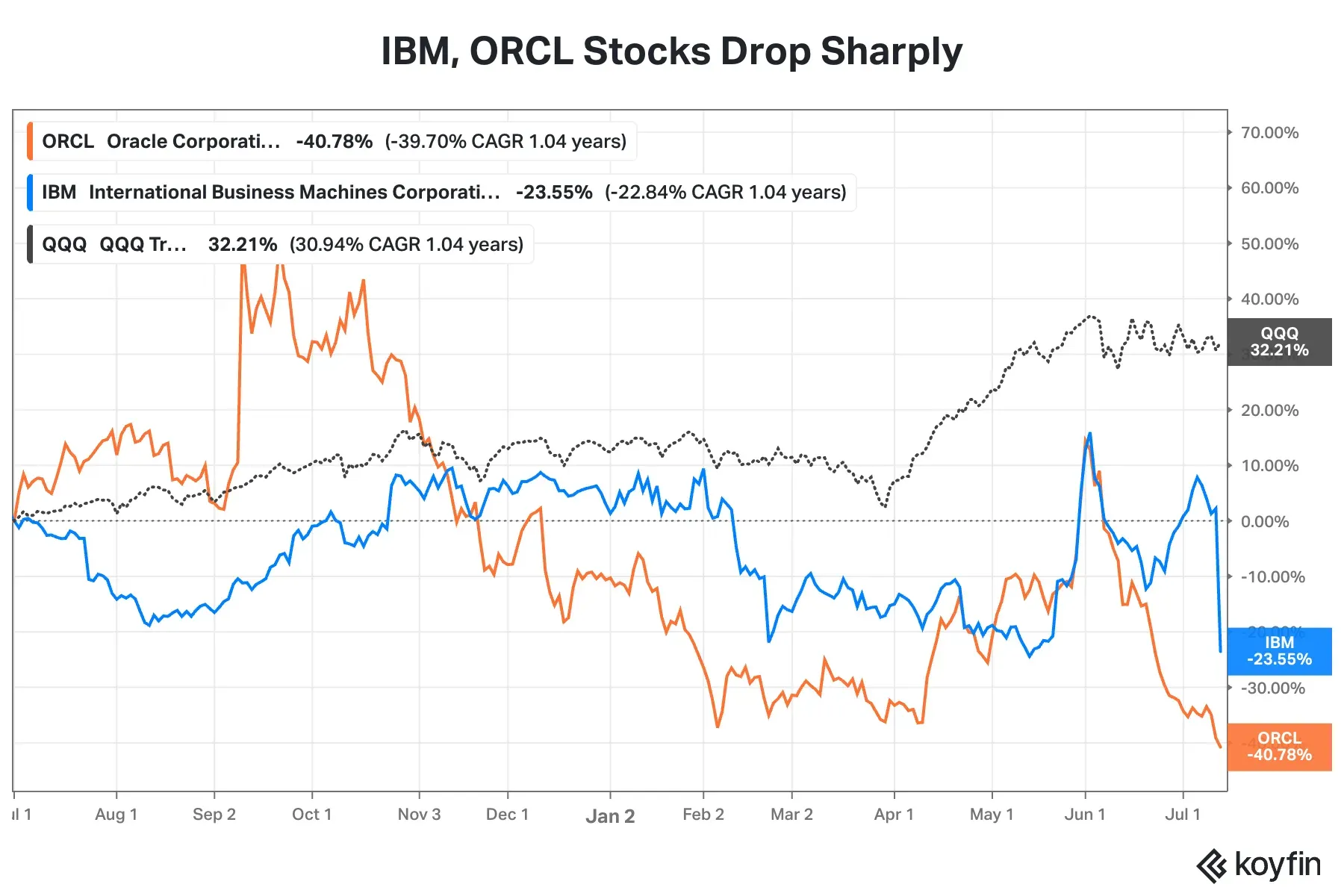
- Oracle is down 63% from its peak, while IBM has dropped 35%.
- The retail sentiment was ‘extremely bullish’ for both IBM and ORCL as of early Wednesday.
Advertisement|Remove ads.
Shares of Oracle and IBM, two companies deeply embedded in the enterprise market, have fallen sharply in recent months amid an increasingly fragile view of the software sector and company-specific triggers.
Traditionally viewed as a low-volatility stock, IBM plunged over 25% on Tuesday after reporting preliminary quarterly results that revealed acute weakness in its software business and warning that clients were shifting spending to AI servers from other technology budgets faster than anticipated.
Oracle’s stock fell off a cliff last month amid fresh concerns about its ability to successfully execute a debt-fueled cloud capacity expansion to meet record new orders from a handful of customers, such as OpenAI.
Advertisement|Remove ads.
Oracle is now down 63% from its peak last September and 34% year to date. Meanwhile, IBM has declined 35% from its peak in June and 26% year to date.
Retail Traders Favor Oracle
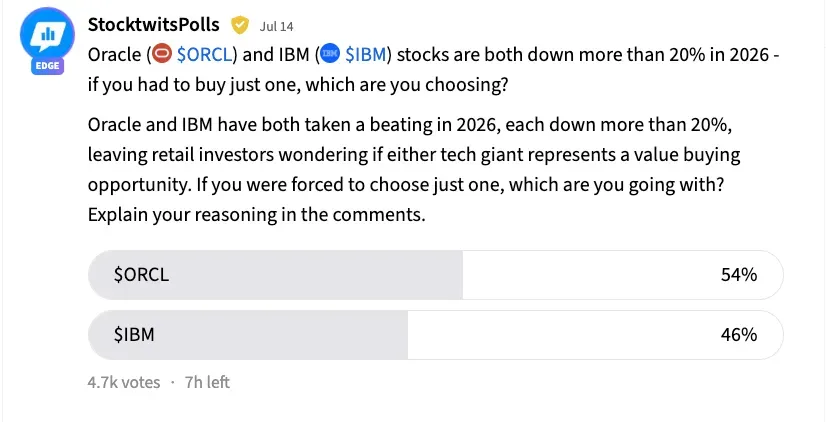
In a recent Stocktwits poll, retail traders appear to be leaning towards Oracle as their pick amongst the two as the second-quarter earnings season kicks off. About 53% of the 4,500 retail traders who voted believe the current ORCL price represents a buying opportunity, while 47% said IBM is a better pick.
“The more memory you buy the more money you will make,” argued a user. “$IBM does not have a lot of memory. $ORCL data centers have tons of memory. $ORCL SaaS will lose value but it will deliver customers to its memory so it does have value.”
Advertisement|Remove ads.
Another wrote: “If I must choose in this value trap fight? I’ll buy the dip and sleep uneasy at night… Oracle sells dreams with a glossy grin; IBM rebrands and calls losses a win. Pick your poison; both feel the same.”
Oracle Rides AI Cloud Wave
Oracle and IBM have long been fixtures of the enterprise technology industry, but their businesses have only a certain degree of overlap today.
Oracle has increasingly become a cloud and software company, with its fast-growing Oracle Cloud Infrastructure (OCI) driving most of its growth as companies ramp up AI spending.
Advertisement|Remove ads.
IBM, meanwhile, has a broader mix of businesses spanning software, consulting and infrastructure, with Red Hat anchoring its hybrid cloud strategy. Unlike Oracle, IBM still generates a significant share of its revenue from consulting services.
Still, the two companies compete for many of the same customers, including large corporations, banks, healthcare providers and government agencies that rely on their technology to run critical operations. To be sure, Oracle has pulled ahead in both market value and revenue growth in recent years.
Analysts’ View On ORCL Vs IBM
Analysts have a mixed view on both stocks; however, they see Oracle running higher. On average, they expect ORCL stock to nearly double from its current level, while they see IBM shares rising only 32%, according to analyst price targets from Koyfin.
Advertisement|Remove ads.
Oracle currently trades 15.9 times its forward earnings, lower than IBM’s 17.6, per Koyfin data.
| Stock | YTD Move | 12-month Forward P/E | Analyst Upside Projection |
| Oracle | -34% | 15.9 | 97% |
| IBM | -26% | 17.6 | 32% |
Source: Koyfin
Advertisement|Remove ads.
On Stocktwits, retail sentiment was ‘extremely bullish’ for both IBM and ORCL as of early Wednesday. IBM’s quarterly report is scheduled for July 22, while Oracle has not yet set a date for its announcement.
For updates and corrections, email newsroom[at]stocktwits[dot]com.
Read Next: SK Hynix, Samsung Shares Soar Amid Chip Rebound; Samsung Denies US Listing Plans
Advertisement|Remove ads.
Comments posted here will also appear on symbol pages.

Latest News
/filters:format(webp)https://news.stocktwits-cdn.com/large_Getty_Images_2277830109_jpg_8566757c70.webp)
/filters:format(webp)https://news.stocktwits-cdn.com/1707726834303_jpg_11f20a9aa9.webp) Shashank Nayar·36m ago
Shashank Nayar·36m ago/filters:format(webp)https://news.stocktwits-cdn.com/large_Getty_Images_1826874253_91fc8db60b.jpg)
/filters:format(webp)https://news.stocktwits-cdn.com/vivekkrishnanphotography_58_jpg_0e45f66a62.webp) Arnab Paul·2h ago
Arnab Paul·2h ago/filters:format(webp)https://news.stocktwits-cdn.com/large_Boeing_jpg_48e7f3f6e3.webp)
/filters:format(webp)https://news.stocktwits-cdn.com/Heera_1_1c30cb0170.PNG) Heera Hari·2h ago
Heera Hari·2h ago/filters:format(webp)https://news.stocktwits-cdn.com/large_Getty_Images_2213365850_jpg_470b9c6c06.webp) Arnab Paul·2h ago
Arnab Paul·2h ago/filters:format(webp)https://news.stocktwits-cdn.com/large_walll_street_trading_floor_resized_jpg_a607eff36e.webp)
/filters:format(webp)https://news.stocktwits-cdn.com/Prabhjote_DP_67623a9828.jpg) Prabhjote Gill·2h ago
Prabhjote Gill·2h ago/filters:format(webp)https://news.stocktwits-cdn.com/gettyimages_2299714910_612x612_6ae0a15d09.jpg) Shashank Nayar·2h ago
Shashank Nayar·2h ago