


Advertisement|Remove ads.
Rivian Unveils In-House AI Chip To Replace Nvidia And Challenge Tesla In The Autonomy Race
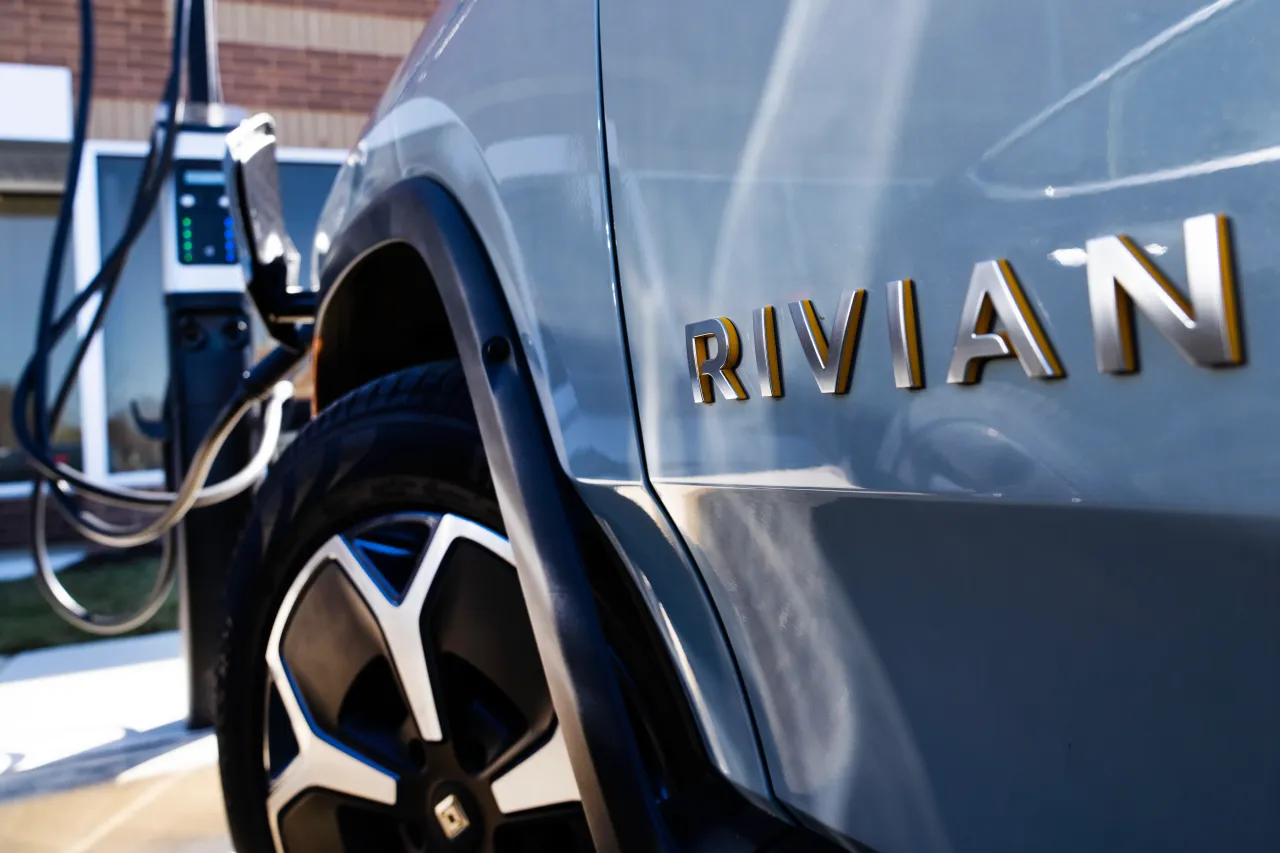


- The new in-house chip is called RAP1 or Rivian Autonomy Processor1 and is aimed at processing data from the new addition of LIDAR in addition to other visual-centric sensors including cameras.
- The company said that its decision to integrate LIDAR in future R2 models is aimed at improving real-time detection for the edge cases of driving where merely cameras fall short.
- The company also announced its driver-assistance package called Autonomy+ to rival Tesla’s FSD on Thursday.
Advertisement|Remove ads.
Shares of EV startup Rivian Automotive (RIVN) slid 7% on Thursday as the company’s big push to replace Nvidia chips with its own in-house AI hardware and advance its R2 platform failed to lift investor sentiment in its ongoing challenge to Tesla.
The company unveiled its own proprietary silicon chip at the company’s AI and autonomy event in Palo Alto, California. The CEO expressed optimism about the chip allowing the company to achieve level 4 vehicle autonomy. While Rivian currently offers advanced driver assistance features on its R1 vehicles, they require active driver supervision and do not make the vehicles autonomous.
New Compute Platform For Higher Autonomy
The new in-house chip is called RAP1 or Rivian Autonomy Processor1 and is aimed at processing data from the new addition of LIDAR in addition to other visual-centric sensors including cameras. It will be produced by Taiwan Semiconductor Manufacturing Co (TSMC).
Advertisement|Remove ads.
The company said that its next generation vehicle computers called Autonomy Compute Module 3 will have two RAP1 chips and will be capable of processing 5 billion pixels per second. “This computer achieves four times the peak performance of our gen two computer, while improving power efficiency by a factor of two and a half,” Rivian executive Vidya Rajagopalan said. The company’s previous generation computer used Nvidia Orin chips.
“Our updated hardware platform, which includes our in-house 1600 sparse TOPS inference chip, will enable us to achieve dramatic progress in self-driving to ultimately deliver on our goal of delivering L4. This represents an inflection point for the ownership experience – ultimately being able to give customers their time back when in the car,” Rivian CEO RJ Scaringe said.
R2 SUV To Boost Tesla Rivalry
EV giant Tesla also develops its own chips to enable its driver assistance software called full self driving or FSD. While Tesla is optimistic of the software enabling full vehicle autonomy in time with just cameras, they currently actively require driver supervision. Tesla’s chips are produced by Samsung and TSMC.
Advertisement|Remove ads.
Rivian is now looking forward to starting production of its R2 SUV in the first half of 2026. The vehicle is expected to expand the company’s total addressable market with its lower starting price, unlike the company’s pricier R1 offerings.
The company said that its decision to integrate LIDAR in future R2 models is aimed at improving real-time detection for the edge cases of driving where merely cameras fall short, such as in instances of low lighting. The company’s ACM3 and LIDAR are currently undergoing validation and will be integrated on R2 models starting at the end of 2026, the company said.
FSD Rival Autonomy+
The company also announced its driver-assistance package called Autonomy+ to rival Tesla’s FSD on Thursday. Autonomy+ will launch in early 2026 and will be priced at $2,500, below FSD’s $8000 sticker price.
Advertisement|Remove ads.
For its R1 vehicles, which are currently in production, the company said that it will expand its Universal Hands-Free (UHF) feature, allowing hands-free assisted driving on over 3.5 million miles of roads across the USA and Canada in the near term. The feature will also be capable of operating off-highway on roads with clearly painted lines.
Scaringe also expressed optimism for the company operating robotaxis like Tesla in the future. “Now, while our initial focus will be on personally owned vehicles, which today represent a vast majority of the miles to the United States, this also enables us to pursue opportunities in the rideshare space,” he added about the company’s autonomy advancements.
How Did Stocktwits Users React?
On Stocktwits, retail sentiment around RIVN jumped from ‘neutral’ to ‘bullish’ territory over the past 24 hours while message volume jumped from ‘normal’ to ‘high’ levels.
Advertisement|Remove ads.
RIVN stock has gained 23% this year and by about 19% over the past 12 months.
For updates and corrections, email newsroom[at]stocktwits[dot]com
Advertisement|Remove ads.
Comments posted here will also appear on symbol pages.

Latest News
/filters:format(webp)https://news.stocktwits-cdn.com/gettyimages_2267701500_594x594_1cfbb8b517.jpg)
/filters:format(webp)https://news.stocktwits-cdn.com/1707726834303_jpg_11f20a9aa9.webp) Shashank Nayar·1h ago
Shashank Nayar·1h ago/filters:format(webp)https://st-everywhere-cms-prod.s3.us-east-1.amazonaws.com/large_Fintech_stock_bef0de12ed.jpg) Shashank Nayar·1h ago
Shashank Nayar·1h ago/filters:format(webp)https://news.stocktwits-cdn.com/large_Getty_Images_2153399754_46a0047462.jpg)
/filters:format(webp)https://news.stocktwits-cdn.com/unnamed_jpg_9dff551b50.webp) Anan Ashraf·1h ago
Anan Ashraf·1h ago/filters:format(webp)https://news.stocktwits-cdn.com/large_Getty_Images_1358625659_b011ef9a83.jpg) Anan Ashraf·2h ago
Anan Ashraf·2h ago/filters:format(webp)https://news.stocktwits-cdn.com/large_Getty_Images_2295226888_dcdb8e346d.jpg) Shashank Nayar·4h ago
Shashank Nayar·4h ago/filters:format(webp)https://st-everywhere-cms-prod.s3.us-east-1.amazonaws.com/large_novartis_stock_resized_978faa13aa.jpg) Anan Ashraf·4h ago
Anan Ashraf·4h ago