


Advertisement|Remove ads.
Trump Claims Iran Agreed To Tough Nuclear Inspections, Touts Record Hormuz Oil Flows — 'The World Is A Much Safer Place'
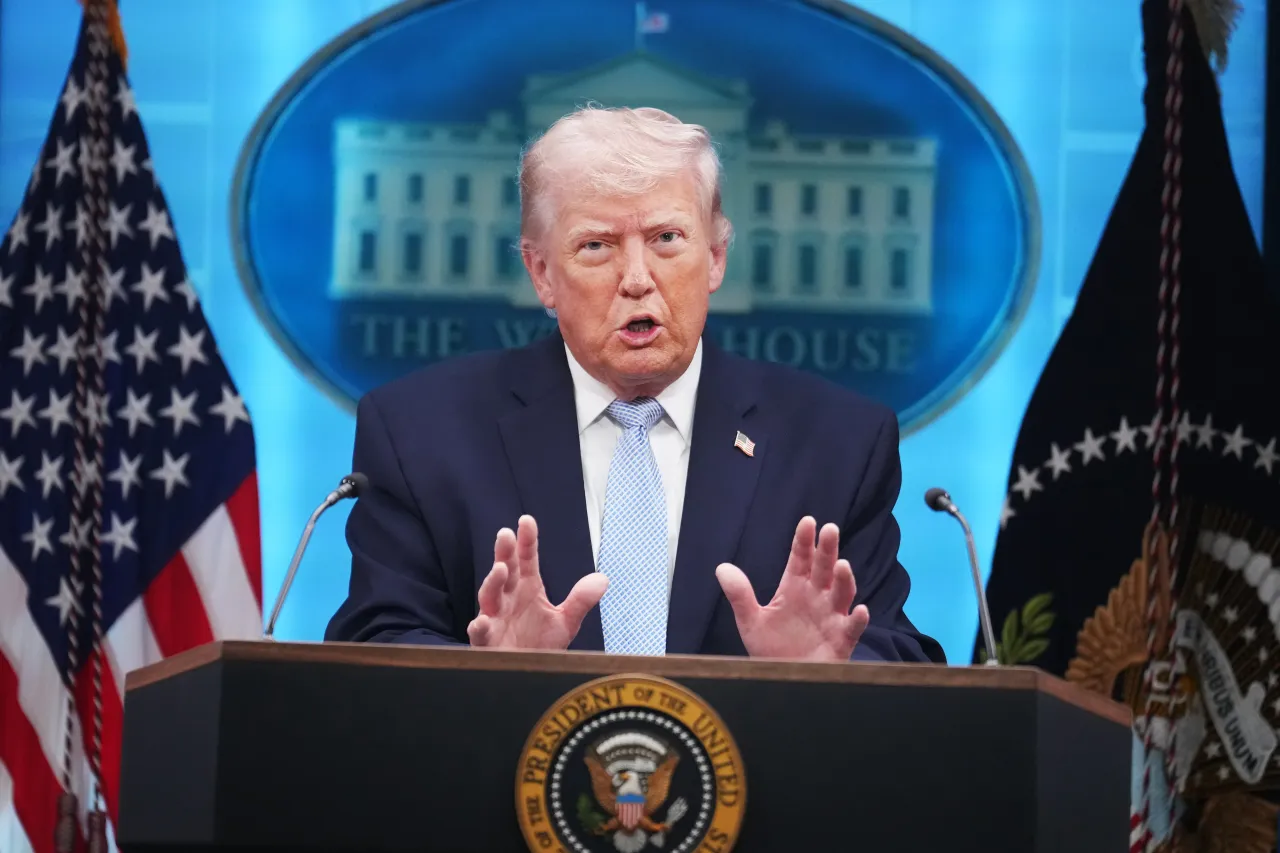


- Trump added that the United States’ Navy vessels will remain in place even though he has agreed to let the Strait of Hormuz remain open.
- He said that while he does not expect to block the critical waterway, the vessels will be on standby in case the U.S. decides to impose restrictions once again.
- Trump said the Iranian funds that will be released by the Treasury would be used to buy food, medical supplies, and American farm products.
Advertisement|Remove ads.
President Donald Trump on Tuesday claimed that Iran made “major concessions” in the peace deal talks that took place over the weekend in Switzerland.
He also added that a record 19 million barrels of oil flowed through the Strait of Hormuz on Monday, driving crude oil prices lower.

“Iran has fully and completely agreed to highest level Nuclear inspections long into the future (Infinity!!!). This will insure “Nuclear Honesty.” If they did not agree to this, there would be no further negotiations!” he said in another post on Truth Social.
Advertisement|Remove ads.
Trump Says US Navy Vessels Will Remain In Place
Trump added that the United States’ Navy vessels will remain in place even though he has agreed to let the Strait of Hormuz remain open.
He said that while he does not expect to block the critical waterway, the vessels will be on standby in case the U.S. decides to impose restrictions once again.
Trump also noted that the Iranian funds that the U.S. Treasury is going to release will go into escrow controlled by the United States. He added that these funds will be used to buy corn, wheat, and soybeans from American farmers, apart from medical supplies.
Advertisement|Remove ads.
“These are things that are desperately needed by Iran. This is a humanitarian crisis, and I feel it is necessary to help, NOW, before it is too late. Talks are going well!” he added.
Paul Krugman Warns Gas Prices Will Remain Elevated
Economist Paul Krugman argued that easing tensions in the Middle East and lower crude oil prices may not translate into immediate relief at the gas pump. He pointed to the well-known "rockets and feathers" effect, where gasoline prices rise quickly when oil prices spike but fall much more slowly when crude retreats.
“When there is a global shock that causes the price of crude oil to soar, gasoline prices rise like a rocket. But when the crisis is over and crude prices plunge, the price of gas declines only gradually — it drifts down like feathers,” he said.
Advertisement|Remove ads.
Krugman also said oil markets may take time to normalize even after the reopening of the Strait of Hormuz. He cited damaged energy infrastructure, disrupted shipping routes and the need for countries to rebuild oil inventories as factors that could keep fuel prices above pre-conflict levels for months.
Beyond gasoline, Krugman warned that higher diesel and energy costs have already filtered through supply chains and business operations, creating inflationary pressures that may continue to affect consumers even as crude prices decline.
Crude Oil Prices Continue To Edge Lower
Meanwhile, crude oil prices continued to edge lower on Tuesday. U.S. West Texas Intermediate (WTI) futures expiring in July were down 0.72%, hovering around $73.33 per barrel. Brent crude futures expiring in August were down 0.72%, hovering around $76.96 a barrel.
Advertisement|Remove ads.
The United States Oil Fund ETF (USO) and the ProShares Ultra Bloomberg Crude Oil ETF (UCO) declined about 1%.
At the time of writing, the SPDR S&P 500 ETF (SPY), which tracks the S&P 500 index, fell 1.34%; the Invesco QQQ Trust ETF (QQQ) tumbled 2.85%; and the SPDR Dow Jones Industrial Average ETF Trust (DIA) declined 0.44%. Retail sentiment on Stocktwits regarding the S&P 500 ETF was in the ‘bearish’ territory.
Also See: Nokia Rolls Out Agentic AI For Telecom Operators — But NOK Stock Heads Lower Premarket
Advertisement|Remove ads.
For updates and corrections, email newsroom[at]stocktwits[dot]com.
Comments posted here will also appear on symbol pages.

Latest News
/filters:format(webp)https://news.stocktwits-cdn.com/large_Getty_Images_2287813758_75a95ba088.jpg)
/filters:format(webp)https://news.stocktwits-cdn.com/Anushka_Basu_make_me_smile_in_the_picture_b92832aa_af59_4141_aacc_4180d2241ba8_1_2_png_1086e0ed8c.webp) Anushka Basu·8m ago
Anushka Basu·8m ago/filters:format(webp)https://news.stocktwits-cdn.com/large_Getty_Images_1245871996_jpg_767ab27f20.webp)
/filters:format(webp)https://news.stocktwits-cdn.com/Prabhjote_DP_67623a9828.jpg) Prabhjote Gill·9m ago
Prabhjote Gill·9m ago/filters:format(webp)https://news.stocktwits-cdn.com/resized_generic_power_image_jpg_865b0caf15.webp)
/filters:format(webp)https://news.stocktwits-cdn.com/vivekkrishnanphotography_58_jpg_0e45f66a62.webp) Arnab Paul·31m ago
Arnab Paul·31m ago/filters:format(webp)https://news.stocktwits-cdn.com/gettyimages_2235533867_612x612_ce52e59e39.jpg)
/filters:format(webp)https://news.stocktwits-cdn.com/Heera_1_1c30cb0170.PNG) Heera Hari·38m ago
Heera Hari·38m ago/filters:format(webp)https://news.stocktwits-cdn.com/large_Getty_Images_2301313277_e3deff1616.jpg) Prabhjote Gill·50m ago
Prabhjote Gill·50m ago/filters:format(webp)https://news.stocktwits-cdn.com/large_Getty_Images_2184298752_597d0bfcd2.jpg) Anushka Basu·2h ago
Anushka Basu·2h ago