


Advertisement|Remove ads.
Trump Warns Iran Of 'Very Strong Military Action' If Diplomatic Talks Collapse, Says Report
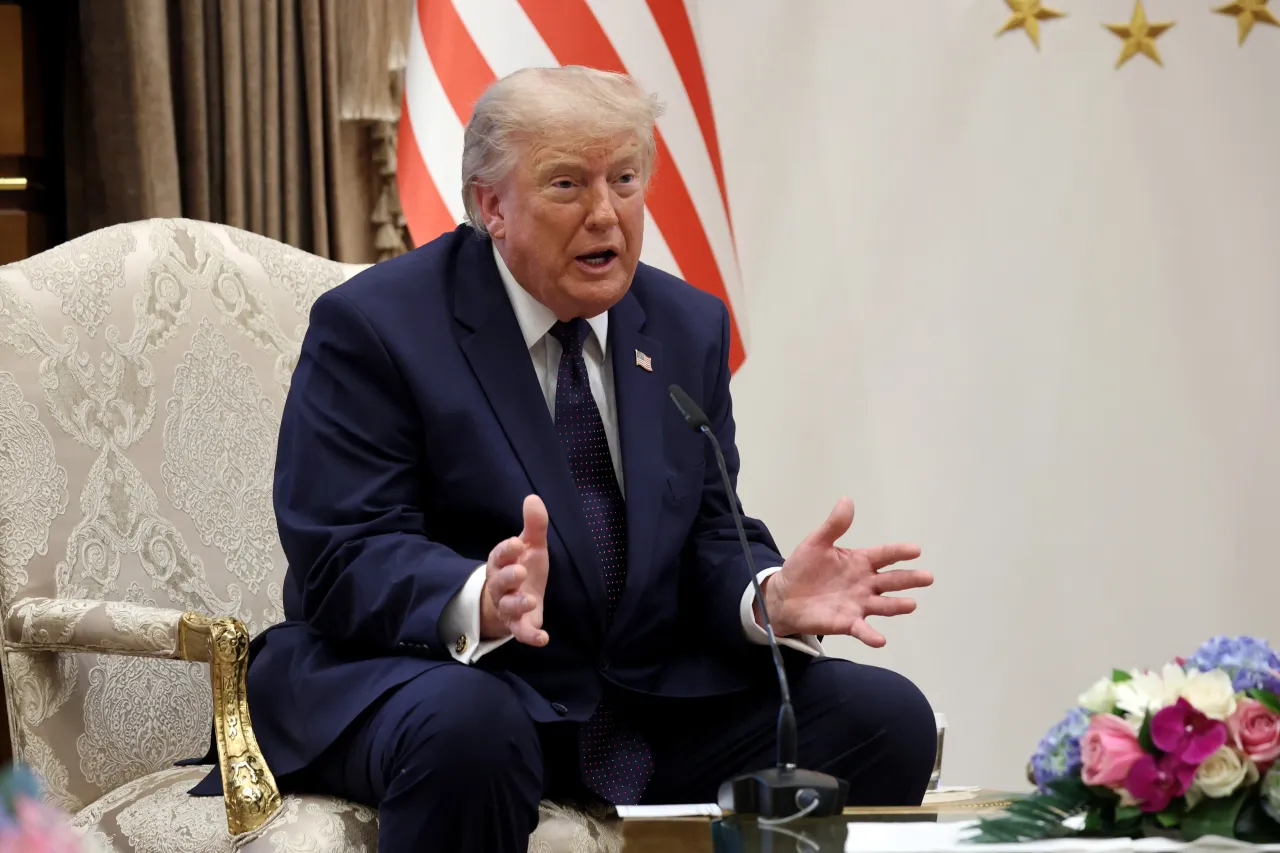


- President Trump ordered a halt to U.S. military strikes on Friday after regional mediators requested time to pursue a diplomatic solution, asserting there was "nothing gained, nothing lost" by granting the request.
- Trump emphasized that the U.S. remains engaged in "deep talks" with Tehran, but cautioned that the diplomatic window is brief and operations will resume if talks stall.
- Negotiations aim to secure a new agreement to reopen the Strait of Hormuz and revive broader talks on a comprehensive nuclear agreement.
Advertisement|Remove ads.
U.S. President Donald Trump on Monday warned that Washington is ready to resume "very strong military action" if diplomatic talks with Iran fail. The warning follows his decision on Friday to pause military strikes to give diplomatic negotiations a fair opportunity.
"We are in very deep talks with Iran. If they don't work out, we will go back to very strong military action," Trump told Axios in an interview.
Trump explained that he halted the airstrikes on Friday after being directly approached by regional intermediaries involved in the dialogue. “All of the people that deal with Iran asked me: 'Don't fire,'” Trump told Israeli broadcaster Channel 12, adding that he believed there was “nothing gained, nothing lost by granting the request”.
Advertisement|Remove ads.
Trump also addressed reporters from Air Force One, where he said negotiations are ongoing with Iran and mentioned the Strait of Hormuz was in “very good shape.”
Diplomacy Under Tight Window
The primary focus of the current negotiations centers on crafting a new agreement that would reopen the Strait of Hormuz—which Iran effectively blocked during recent hostilities—and restart discussions toward a broader nuclear agreement.
Speaking on the status of the discussions, Trump said Washington remains involved in "deep talks" with Iranian representatives. However, he stressed that the timeframe for reaching a breakthrough is narrow, asserting that progress must happen quickly "or not at all".
Advertisement|Remove ads.
"If they don't work out, we will go back to very strong military action," Trump warned, signaling that U.S. forces are prepared to restart expanded military operations at short notice if diplomatic channels collapse.
Weekend Developments And Regional Escalation
Over the weekend, regional instability continued across multiple fronts. Yemen's Iran-backed Houthi group launched drone strikes targeting critical oil transport and supply infrastructure in eastern Saudi Arabia running toward Yanbu.
Saudi Arabia intercepted and destroyed several drones launched from Iraqi territory aimed at energy infrastructure, prompting Riyadh to urge Baghdad to prevent its border areas from being used as staging grounds. Concurrently, the Jordanian military reported shooting down two drones heading into its airspace.
Advertisement|Remove ads.
Crude Oil Prices Tumble
Crude oil prices tumbled on Monday after the U.S. and Iran temporarily halted military strikes. U.S. West Texas Intermediate (WTI) crude fell 8.3% to around $82.92 a barrel, while Brent crude dropped 9% to about $89.13 a barrel.
The United States Oil Fund ETF (USO) was 8% down at the time of writing, while the ProShares Ultra Bloomberg Crude Oil ETF (UCO) declined about 9%.
At the time of writing, the SPDR S&P 500 ETF (SPY), which tracks the S&P 500 index, fell 0.1%; the Invesco QQQ Trust ETF (QQQ) fell 0.5%; and the SPDR Dow Jones Industrial Average ETF Trust (DIA) gained 0.4%. Retail sentiment on Stocktwits regarding the S&P 500 ETF was in the ‘extremely bearish’ territory.
Advertisement|Remove ads.
For updates and corrections, email newsroom[at]stocktwits[dot]com.
Comments posted here will also appear on symbol pages.

Latest News
/filters:format(webp)https://news.stocktwits-cdn.com/large_Getty_Images_2188532140_jpg_1eb152a875.webp)
/filters:format(webp)https://news.stocktwits-cdn.com/Anushka_Basu_make_me_smile_in_the_picture_b92832aa_af59_4141_aacc_4180d2241ba8_1_2_png_1086e0ed8c.webp) Anushka Basu·9h ago
Anushka Basu·9h ago/filters:format(webp)https://news.stocktwits-cdn.com/large_Getty_Images_2290360640_1ec7422bc6.jpg) Anushka Basu·10h ago
Anushka Basu·10h ago/filters:format(webp)https://news.stocktwits-cdn.com/large_Getty_Images_2184298752_597d0bfcd2.jpg) Anushka Basu·12h ago
Anushka Basu·12h ago/filters:format(webp)https://st-everywhere-cms-prod.s3.us-east-1.amazonaws.com/large_charles_schwab_resized_79fd4282b7.jpg) Anushka Basu·14h ago
Anushka Basu·14h ago/filters:format(webp)https://news.stocktwits-cdn.com/large_Getty_Images_1236413131_82e1a6f16e.jpg) Anushka Basu·15h ago
Anushka Basu·15h ago/filters:format(webp)https://news.stocktwits-cdn.com/large_Getty_Images_2255514431_jpg_95e96b4025.webp)
/filters:format(webp)https://st-everywhere-cms-prod.s3.us-east-1.amazonaws.com/i_OS_App_Icon_1_8054f2a2fe.png) Stocktwits News Desk·15h ago
Stocktwits News Desk·15h ago