


Advertisement|Remove ads.
US-Israel-Iran War: IAEA Chief Warns Of Evacuating Areas ‘Larger Than Major Cities’ As Nuclear Risks Loom


- The Middle East hosts a bunch of nuclear energy and research facilities.
- Iran’s ambassador to the IAEA said that the country’s Natanz nuclear complex was hit during the conflict.
- The United Arab Emirates operates four power reactors, while Jordan and Syria maintain research reactors.
Advertisement|Remove ads.
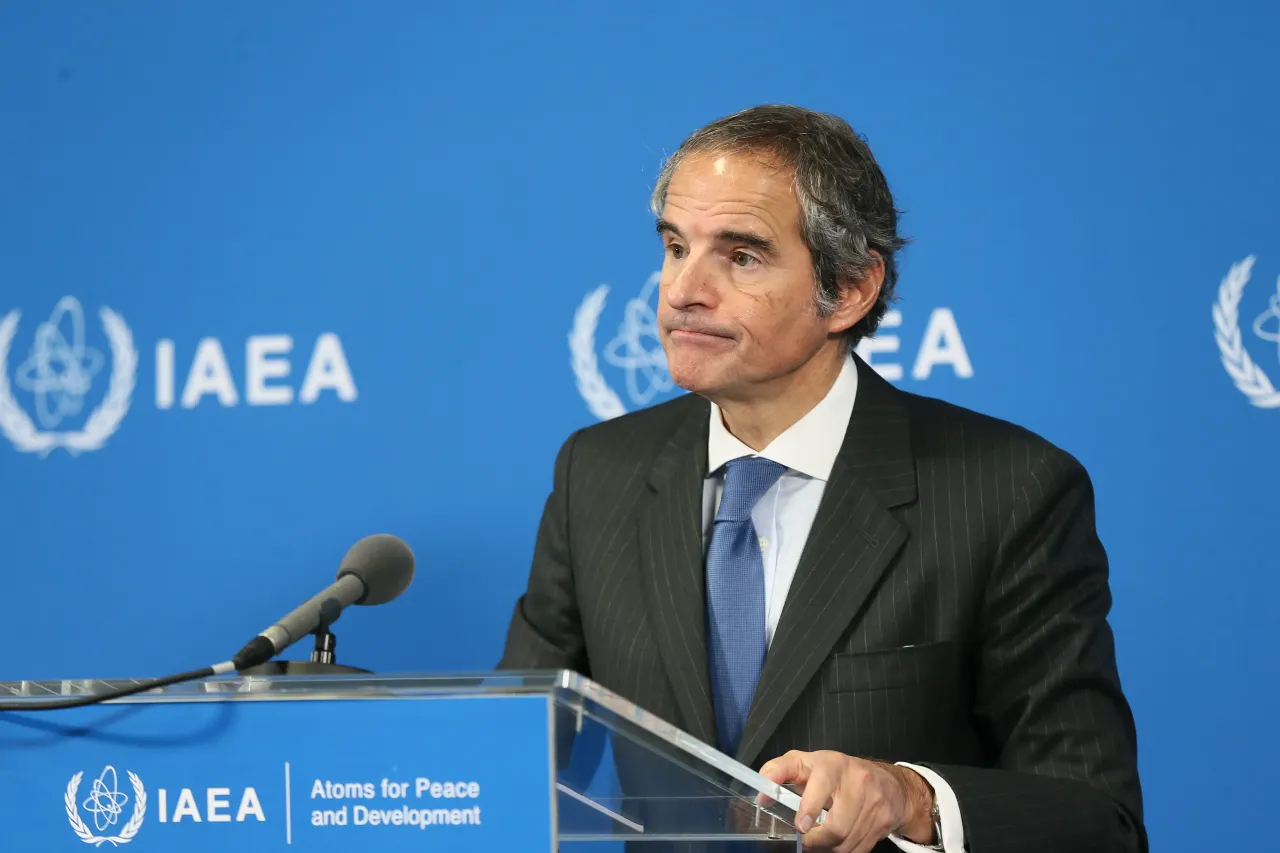
Rafael Mariano Grossi, Director General of the International Atomic Energy Agency (IAEA), on Monday said the nuclear watchdog is on high alert as military strikes ripple across Iran and parts of the Middle East, raising concerns about potential nuclear safety risks.
Speaking at the IAEA Board of Governors Meeting, Grossi warned that while no radiation spikes have been detected, continued hostilities could endanger facilities across the region.
“So far, no elevation of radiation levels above the usual background levels has been detected in countries bordering Iran.”
-Rafael Mariano Grossi, Director General, IAEA
Iran’s Nuclear Complex Under Attack
According to a Reuters report, Iran’s ambassador to the IAEA said that the country’s Natanz nuclear complex was hit during military actions carried out by the U.S. and Israel.
Advertisement|Remove ads.
"Again they attacked Iran's peaceful, safeguarded nuclear facilities yesterday.”
-Reza Najafi, Iranian Ambassador, IAEA
However, Grossi reiterated that the agency has not identified any harm to Iran’s nuclear infrastructure so far. The Middle East hosts a bunch of nuclear energy and research facilities. The United Arab Emirates (UAE) operates four power reactors, while Jordan and Syria maintain research reactors. Several other nations in the region use nuclear materials for civilian purposes.
The agency cautioned that any strike affecting such infrastructure could trigger cross-border consequences, recalling prior resolutions that condemn attacks on nuclear installations.
Call For Restraint
Grossi reiterated that armed assaults on nuclear facilities must be avoided, warning of potential radioactive releases that could force evacuations.
Advertisement|Remove ads.
“Let me underline that the situation today is very concerning. We cannot rule out a possible radiological release with serious consequences, including the necessity to evacuate areas as large or larger than major cities.”
He stressed that diplomacy remains the only sustainable path forward to ensure Iran does not develop nuclear weapons and to maintain the idea of global nonproliferation.
His comments follow a major military campaign called Operation Epic Fury carried out by the U.S. and Israel over the weekend, during which Iran’s Supreme Leader, Ayatollah Khamenei, was killed. In retaliation, Iran struck back with a series of attacks aimed at U.S. and Israeli targets across multiple countries in West Asia.
Advertisement|Remove ads.
U.S. equities declined in Monday’s pre-market trade. At the time of writing, the SPDR S&P 500 ETF (SPY), which tracks the S&P 500 index, was down 0.94%; the Invesco QQQ Trust ETF (QQQ) fell 1.32%.
Also See: NAT Stock Set For Best Day In 4 Years: Shipping Prices Could Soar On US-Iran Conflict
For updates and corrections, email newsroom[at]stocktwits[dot]com.
Advertisement|Remove ads.
Comments posted here will also appear on symbol pages.

Latest News
/filters:format(webp)https://news.stocktwits-cdn.com/large_bank_of_america_ATM_resized_jpg_74da346957.webp)
/filters:format(webp)https://news.stocktwits-cdn.com/1707726834303_jpg_11f20a9aa9.webp) Shashank Nayar·56m ago
Shashank Nayar·56m ago/filters:format(webp)https://news.stocktwits-cdn.com/large_Getty_Images_2208523880_jpg_5bfb5acfa2.webp)
/filters:format(webp)https://news.stocktwits-cdn.com/unnamed_jpg_9dff551b50.webp) Anan Ashraf·1h ago
Anan Ashraf·1h ago/filters:format(webp)https://news.stocktwits-cdn.com/Getty_Images_2237643016_jpg_f9dc6dcb97.webp) Anan Ashraf·1h ago
Anan Ashraf·1h ago/filters:format(webp)https://news.stocktwits-cdn.com/large_Getty_Images_2202862389_jpg_c0559f1ff4.webp) Shashank Nayar·3h ago
Shashank Nayar·3h ago/filters:format(webp)https://news.stocktwits-cdn.com/large_Getty_Images_2278739838_878876729c.jpg) Anan Ashraf·3h ago
Anan Ashraf·3h ago/filters:format(webp)https://news.stocktwits-cdn.com/large_Ray_Dalio_jpg_b51c171cd9.webp) Shashank Nayar·4h ago
Shashank Nayar·4h ago