


Advertisement|Remove ads.
EXCLUSIVE: Artemis II Sparks Next‑Gen Space Race – Rocket Lab, Intuitive Machines Will Outrun Boeing, Lockheed, Says NASA Fund Manager
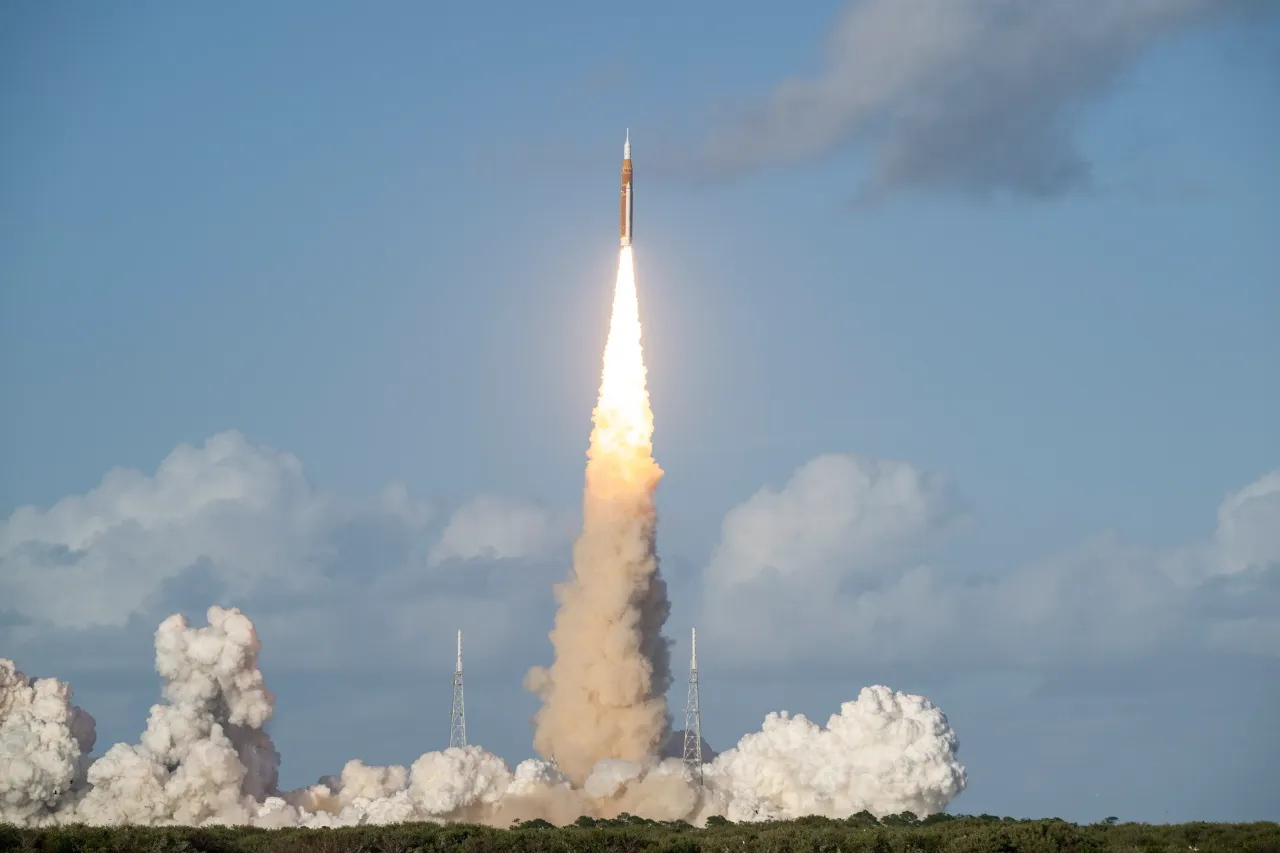


- Yuri Khodjamirian of Tema Space Innovators ETF told Stocktwits that legacy players such as Boeing and Lockheed Martin are less agile due to their reliance on government contracts and diversified business models.
- According to him, Rocket Lab is gaining attention for building reusable and reliable launch services as an alternative to SpaceX.
- Meanwhile, AST SpaceMobile represents a shift toward direct-to-device satellite connectivity, targeting global telecom integration and mass adoption.
Advertisement|Remove ads.
The next wave of space growth will come from names like Rocket Lab (RKLB), Intuitive Machines (LUNR), Planet Labs (PL), and AST SpaceMobile (ASTS), rather than legacy aerospace and defense giants, according to Yuri Khodjamirian of Tema Space Innovators ETF (NASA).
Companies like Boeing (BA) and Lockheed Martin (LMT) are part of the “old world of space exploration,” where programs are slow‑moving, over‑engineered, and tied to large government contracts, rather than commercial‑driven innovation. They are no longer “pure‑play” space stocks, Khodjamirian said in an exclusive interview with Stocktwits.
“And we felt that the defense primes, know, the Lockheed and Boeing, they have the United Launch Alliance together, are part of the kind of maybe the old world of space exploration and their culture and the way the businesses are set up are not there to innovate and build on the next generation,” he stated. “...They're not where we're seeing the opportunity in terms of the growing fundamentals.”
‘New Space’ Firms Gain Ground Over Legacy Aerospace
BA’s stock fell more than 1% on Friday, while LMT’s stock tumbled 1.65% amid broader weakness in the market, while newer names rallied ahead of NASA’s Artemis II Moon mission splashdown in the evening.
Advertisement|Remove ads.
LUNR’s stock led gains among the cohort, rising more than 7% on Friday. ASTS shares gained 3.57%, while RKLB’s stock moved nearly 2% higher, and PL’s stock rose 1.29%. NASA’s price edged 0.32% higher, ending the week with a gain of nearly 20% since its debut ahead of the Artemis II mission launch.
Launch, Don’t Blow Up, Repeat
Khodjamirian said that true space‑thematic exposure now lies with companies that have turned rockets into reusable assets, like Rocket Lab. According to him, it’s one of the few companies that has turned small‑satellite launch into a reliable service that’s attractive to governments and commercial customers looking for an alternative to SpaceX.
“Rockets, unfortunately, have a nasty tendency to blow up,” Khodjamirian told Stocktwits. “So what you want is to invest in the companies that have basically developed rockets that work. SpaceX has done that, and so has Rocket Lab.” The company is positioning its reusable Neutron medium-lift rocket as an alternative to SpaceX's workhorse Falcon 9.
Advertisement|Remove ads.
Khodjamirian added that ASTS is one of the largest providers of direct‑to‑device satellite connectivity, partnering with dozens of global mobile carriers and enabling billions of users to access satellite‑backed mobile networks. According to him, that fits a broader shift from expensive, geostationary‑orbit systems to low‑earth‑orbit, mass‑produced constellations that slash latency and cost, a commercial‑driven “new age” of space tech.
Parts Of An Emerging Lunar Economy
The Tema chief investment officer also highlighted Intuitive Machines as a pioneer of the lunar economy, with a growing NASA‑funded Artemis II‑linked backlog, a completed private Moon landing, and future revenue streams from lunar delivery and data‑transmission subscriptions.
By contrast, Khodjamirian views the defense‑oriented giants as over‑capitalized, less agile, and too diversified outside core space, which is why the NASA ETF deliberately excludes Boeing, Lockheed, and similar legacy primes to stay focused on faster‑growing, innovation‑driven space names.
Advertisement|Remove ads.
What Are Retail Traders Saying About Space Stocks?
On Stocktwits, retail sentiment across the newer and older names trended in ‘bearish’ territory except for AST SpaceMobile. It saw retail sentiment trending in ‘bullish’ territory over the past day, accompanied by ‘high’ levels of chatter.
According to one retail trader on Stocktwits, LUNR’s stock is the most undervalued among NASA’s picks for the fund.
Advertisement|Remove ads.
Others expressed more caution, anticipating the stocks to correct once the Artemis II splashdown hype wears off by Monday.
LUNR, PL, and ASTS shares have shown double-digit gains during the 10-day Artemis II mission to the Moon. Meanwhile, Boeing, which built the SLS rocket for the mission launch, has gained around 7% since April 1. Meanwhile, Lockheed Martin, which developed the Orion spacecraft for the Artemis mission, edged only 0.8% higher.
Advertisement|Remove ads.
Read also: NASA ETF Jumps Nearly 20% Since Launch Alongside Artemis II Mission – ASTS, PL, LUNR Drive Gains
For updates and corrections, email newsroom[at]stocktwits[dot]com.
Comments posted here will also appear on symbol pages.

Latest News
/filters:format(webp)https://news.stocktwits-cdn.com/gettyimages_1161631184_594x594_0063399eed.jpg)
/filters:format(webp)https://news.stocktwits-cdn.com/IMG_9209_1_d9c1acde92.jpeg) Yuvraj Malik·47m ago
Yuvraj Malik·47m ago/filters:format(webp)https://news.stocktwits-cdn.com/large_Getty_Images_2293730436_c31daad21d.jpg)
/filters:format(webp)https://news.stocktwits-cdn.com/shivani_photo_jpg_dd6e01afa4.webp) Shivani Kumaresan·52m ago
Shivani Kumaresan·52m ago/filters:format(webp)https://news.stocktwits-cdn.com/large_hims_logo_9ad9b7d21e.jpg)
/filters:format(webp)https://news.stocktwits-cdn.com/IMG_8805_JPG_6768aaedc3.webp) Deepti Sri·56m ago
Deepti Sri·56m ago/filters:format(webp)https://news.stocktwits-cdn.com/large_Rocketlab_resized_jpg_92c1a02a7f.webp) Deepti Sri·2h ago
Deepti Sri·2h ago/filters:format(webp)https://news.stocktwits-cdn.com/large_Getty_Images_2209012779_dc13f07008.jpg)
/filters:format(webp)https://news.stocktwits-cdn.com/unnamed_jpg_9dff551b50.webp) Anan Ashraf·3h ago
Anan Ashraf·3h ago/filters:format(webp)https://news.stocktwits-cdn.com/large_Getty_Images_2249581920_jpg_e0f76b0419.webp)
/filters:format(webp)https://news.stocktwits-cdn.com/1707726834303_jpg_11f20a9aa9.webp) Shashank Nayar·3h ago
Shashank Nayar·3h ago