


Advertisement|Remove ads.
MNTS, ASTC, RKTO Soar As NASA Ramps Up Moon Missions — But Isaacman Warns Orbital Economy Is ‘Grossly Overstated’
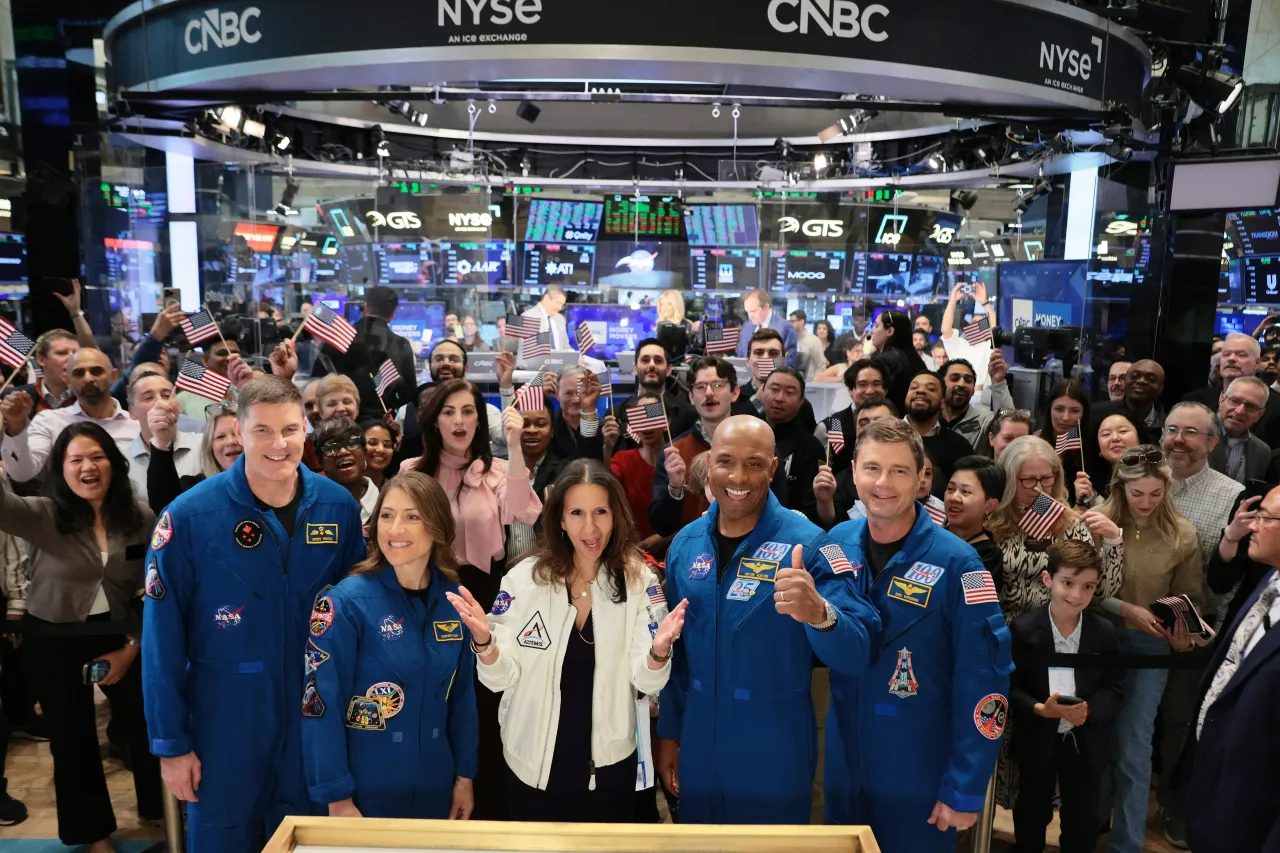


- NASA chief Jared Isaacman said the orbital economy “has been grossly overstated” and warned of commercial demand beyond government-backed programs.
- SpaceX IPO excitement also boosted sentiment, with investors betting that the company’s targeted $2 trillion valuation could spur interest in space stocks.
- ASTC and RKTO are gaining from moon-based computing, AI infrastructure, and space-chip ambitions, while MNTS highlighted NASA and defense-based orbital operations.
Advertisement|Remove ads.
Shares of smaller space stocks soared on Wednesday after NASA outlined plans for near-monthly lunar missions starting in 2027. However, the rally came with a reality check from NASA chief Jared Isaacman, who cautioned that commercial demand in orbit remains uncertain.
On Wednesday, Momentus (MNTS) jumped another 26% after more than doubling in the previous session, putting the stock on track for its best week since October 2023.
Rocket One, formerly Hoth Therapeutics and set to begin trading under the ticker RKTO on Thursday, surged 92%, heading for its strongest weekly performance since January 2025. Meanwhile, Astrotech (ASTC) skyrocketed 459%, with the stock poised to log its biggest weekly gain on record.
Advertisement|Remove ads.
NASA Moon Boom Faces Demand Concerns
In an interview with Bloomberg on Wednesday, NASA Administrator Jared Isaacman outlined a roadmap for expanding lunar operations, including near-monthly robotic missions to the Moon beginning in 2027 and long-term plans for permanent infrastructure on the lunar surface ahead of future Artemis astronaut landings.
NASA expects to spend $20 billion over seven years, alongside commercial partners such as SpaceX and Blue Origin, with future phases involving cargo systems, autonomous infrastructure, heavier equipment deployments and eventually astronaut stays lasting months at a time during the early 2030s.
However, Isaacman also warned that the orbital economy “has been grossly overstated,” saying that government agencies still remain the primary source of demand across much of the industry. He questioned whether enough sustainable commercial demand exists beyond government-backed programs, noting that NASA still cannot identify who would buy the “50th lunar lander” if not the government itself.
Advertisement|Remove ads.
SpaceX IPO Hype Adds Fuel To Sector Rally
Investor excitement around SpaceX’s expected IPO has also fueled momentum in the rally across space stocks. The Elon Musk-led company is reportedly targeting a $2 trillion valuation, potentially making it the first trillion-dollar IPO in U.S. history. Investors view SpaceX not only as a launch provider but as a long-term infrastructure and AI platform spanning satellite communications, defense systems, and orbital transportation.
Publicly traded space companies could see renewed investor interest if SpaceX sustains its targeted valuation, which appears to be driven more by expectations around future orbital infrastructure demand than near-term profitability.
Meanwhile, FTSE Russell also called for major changes to its IPO inclusion rules that would allow newly listed mega-cap companies to qualify for fast-track entry into major indexes after only five trading days. Based on current estimates, SpaceX would already qualify for rapid inclusion into several major benchmark indexes under the revised rules, potentially unlocking massive passive-fund inflows.
Advertisement|Remove ads.
MNTS Leans On NASA, Defense Contracts
Momentus has emerged as one of the market’s hottest recent space trades after former astronaut and Momentus director Chris Hadfield purchased 2,000 shares through his firm, Chris Hadfield Inc., at an average price of $7.19 per share last week. Hadfield, the former International Space Station commander widely known for recording David Bowie’s “Space Oddity” while in orbit, now holds 3,500 shares of the company.
The insider purchase came shortly after Momentus filed a shelf registration, allowing the company to potentially raise up to $200 million through future securities offerings. On Wednesday, the company separately announced agreements with existing institutional investors to raise $25 million through a private placement of nearly 2.94 million shares.
After the financing, Momentus said it expects to hold around $76 million in cash, cash equivalents and short-term investments. The company operates in-space logistics and orbital transportation systems through its Vigoride Orbital Service Vehicle platform, which recently supported missions tied to NASA, DARPA and U.S. defense organizations aboard SpaceX’s Transporter-16 launch.
Advertisement|Remove ads.
ASTC, RKTO Pitch Future Of Space Computing
On Wednesday, Astrotech said it is exploring future opportunities for moon-based resources and infrastructure, including extracting water from the lunar surface, processing rare materials such as helium-3 and silicon-28, and eventually supporting advanced chipmaking and quantum computing systems in space.
The company said it believes the moon’s environment, including lower gravity, constant solar energy in some regions and access to strategic raw materials, could one day make it suitable for building semiconductor, AI and computing infrastructure.
Meanwhile, Hoth Therapeutics completed its rebrand to Rocket One Inc., shifting its focus toward orbital computing and defense tech under the ticker RKTO beginning May 28. Rocket One said it holds rights to nanomagnetic AI chip tech for radiation-tolerant and energy-constrained environments such as satellites, low-Earth orbit systems and deep-space platforms. The company said future space systems will depend on onboard AI processing capabilities that can operate independently in harsh orbital environments.
Advertisement|Remove ads.
How Do Retail Traders Feel About MNTS, RKTO, ASTC?
On Stocktwits, retail sentiment for MNTS, RKTO, and ASTC was ‘extremely bullish’ amid ‘extremely high’ message volume.
One user said, “$ASTC actually the more I read on this stock the more it’s justifying the price, kinda low actually. This is insane future stuff!!!”
Advertisement|Remove ads.
Another user said, “$HOTH Space tech is so hot right now. This is going to be lit tomorrow. Sleep tight bears.”
Over the past year, ASTC soared 135%, RKTO, formerly HOTH, climbed 58%, while MNTS is still down 37% despite its recent rally.
Advertisement|Remove ads.
For updates and corrections, email newsroom[at]stocktwits[dot]com.
Read Next: SNOW Stock Rallies After-Hours On $6B Amazon AI Deal, Strong Earnings Beat
Comments posted here will also appear on symbol pages.

Latest News
/filters:format(webp)https://news.stocktwits-cdn.com/large_Getty_Images_1569415620_1ad6cfc5c6.jpg)
/filters:format(webp)https://news.stocktwits-cdn.com/Anushka_Basu_make_me_smile_in_the_picture_b92832aa_af59_4141_aacc_4180d2241ba8_1_2_png_1086e0ed8c.webp) Anushka Basu·26m ago
Anushka Basu·26m ago/filters:format(webp)https://news.stocktwits-cdn.com/large_Getty_Images_2295245703_1237d2403d.jpg)
/filters:format(webp)https://st-everywhere-cms-prod.s3.us-east-1.amazonaws.com/i_OS_App_Icon_1_8054f2a2fe.png) Stocktwits News Desk·32m ago
Stocktwits News Desk·32m ago/filters:format(webp)https://news.stocktwits-cdn.com/large_new_york_stock_exchange_jpg_e1f85c0d8c.webp) Stocktwits News Desk·2h ago
Stocktwits News Desk·2h ago/filters:format(webp)https://news.stocktwits-cdn.com/large_starlink_jpg_39bb7b2774.webp) Stocktwits News Desk·4h ago
Stocktwits News Desk·4h ago/filters:format(webp)https://news.stocktwits-cdn.com/large_cathiewood_OG_jpg_a3c8fddb3f.webp) Stocktwits News Desk·5h ago
Stocktwits News Desk·5h ago/filters:format(webp)https://news.stocktwits-cdn.com/Getty_Images_2237643016_jpg_17a9a7eb9d.webp) Stocktwits News Desk·6h ago
Stocktwits News Desk·6h ago