


Advertisement|Remove ads.
BIS Chief Says USDT, USDC Resemble ‘Securities’ More Than Money
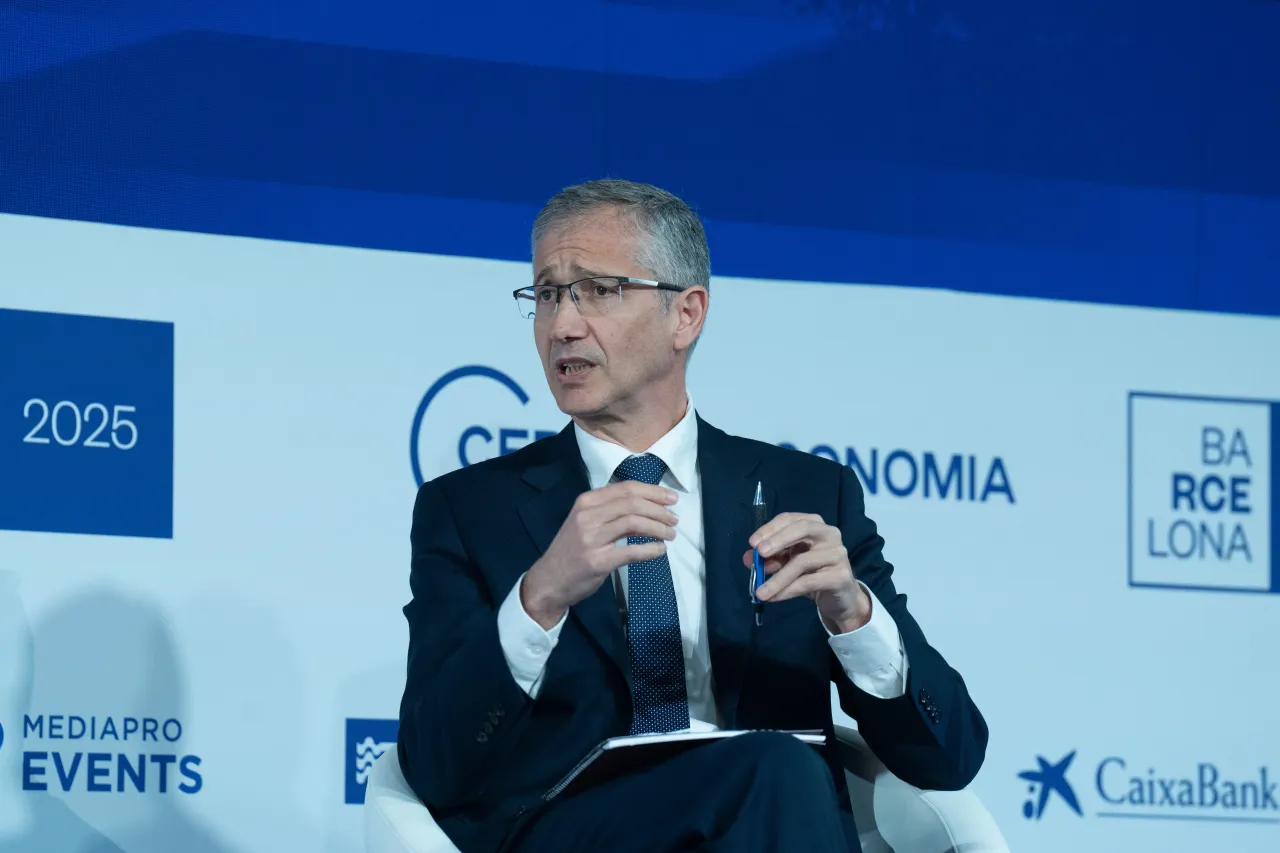


- Speaking at a seminar in Japan, BIS chief Pablo Hernandez de Cos said USDT and USDC function more like securities than money due to structural features.
- He stated that regulatory frameworks alone have not driven adoption, pointing to yen-pegged stablecoins in Japan, which remain a small fraction of the global market despite clear regulation.
- He compared them to Tether’s USDT, which continues to dominate growth, even while operating outside major regulatory regimes.
Advertisement|Remove ads.
Tether (USDT) and Circle’s (CRCL) USDC (USDC) function more like “securities” than money, said Bank of International Settlements chief Pablo Hernandez de Cos on Monday morning.
Speaking at a seminar in Japan, Hernandez de Cos said the two largest stablecoins exhibit characteristics closer to securities, citing redemption frictions that can lead to price deviations from their $1 peg in secondary markets. “They currently operate more like exchange-traded funds than like money,” he said, adding that their structure limits their effectiveness as a reliable means of payment.

The comments come amid ongoing debate over whether stablecoins can evolve into a core part of the financial system, with the U.S. passing the GENIUS Act last year and the CLARITY Act expected to pass in 2026.
Advertisement|Remove ads.
On Stocktwits, retail sentiment around Tether’s USDT trended in ‘extremely bullish’ territory over the past day, accompanied by ‘extremely high’ levels of chatter. Meanwhile, retail sentiment around Circle’s USDC trended in the ‘bearish’ zone with message volume at ‘low’ levels over the past day.


Can Regulation Drive Stablecoin Adoption?
Hernandez de Cos noted that regulatory frameworks alone have not been the primary driver of stablecoin adoption. He cited Japan as an example, where yen-pegged stablecoins account for less than 0.01% of the market value of U.S. dollar-linked tokens despite a well-defined regulatory regime.
Hernandez de Cos said growth has instead been led by Tether’s USDT, which operates outside major regulatory frameworks. According to him, this indicates how activity beyond regulatory oversight could undermine efforts to formalize the sector.
Advertisement|Remove ads.
He called for international cooperation on how stablecoins are used to prevent them from fragmenting the market. “Divergent regulator frameworks for stablecoins across jurisdictions could lead to server market fragmentation and enable harmful regulatory arbitrage,” Hernandez de Cos stated.
For updates and corrections, email newsroom[at]stocktwits[dot]com.
Advertisement|Remove ads.
Comments posted here will also appear on symbol pages.

Latest News
/filters:format(webp)https://news.stocktwits-cdn.com/large_Getty_Images_2294108581_678b1cf125.jpg)
/filters:format(webp)https://news.stocktwits-cdn.com/shivani_photo_jpg_dd6e01afa4.webp) Shivani Kumaresan·57m ago
Shivani Kumaresan·57m ago/filters:format(webp)https://news.stocktwits-cdn.com/large_Meta_jpg_0f17dacb20.webp) Shivani Kumaresan·2h ago
Shivani Kumaresan·2h ago/filters:format(webp)https://news.stocktwits-cdn.com/large_Getty_Images_2301241048_efc5b32b0a.jpg)
/filters:format(webp)https://news.stocktwits-cdn.com/IMG_8805_JPG_6768aaedc3.webp) Deepti Sri·2h ago
Deepti Sri·2h ago/filters:format(webp)https://news.stocktwits-cdn.com/large_william_li_nio_jpg_c26eaad557.webp) Deepti Sri·2h ago
Deepti Sri·2h ago/filters:format(webp)https://news.stocktwits-cdn.com/large_Getty_Images_2206295289_jpg_ad3874bcd3.webp) Shivani Kumaresan·3h ago
Shivani Kumaresan·3h ago/filters:format(webp)https://news.stocktwits-cdn.com/large_rocket_lab_peter_beck_jpg_4d8fc790a1.webp) Deepti Sri·3h ago
Deepti Sri·3h ago