


Advertisement|Remove ads.
Bitcoin Faces Inflation Test This Week: Bitfinex, Fidelity Flags $60K Support, CryptoQuant Warns Bear Cycle Is Not Over


- Bitfinex analysts called Bitcoin's on-chain structure a "late-stage bear," even though long-term holders accumulate every week.
- Bitfinex warned the $60,000-$63,000 shelf isn't flow-supported, a shock. ETF outflows the biggest risk before Tuesday's core CPI.
- Fidelity's Jurrien Timmer said Bitcoin may be entering an "accumulation zone," with his power-law model predicting support near $58,000 and $62,685.
Advertisement|Remove ads.
Bitcoin (BTC) heads into Tuesday's closely watched U.S. Consumer Price Index (CPI) report with analysts increasingly focused on whether the cryptocurrency can defend the $60,000-$63,000 range.
Long-term holders are still aggressively accumulating ahead of the CPI print, but Bitcoin’s on-chain structure is now reading as a “late-stage bear,” Bitfinex analysts said Monday in a signal echoed separately by Fidelity's Jurrien Timmer and CryptoQuant analyst Darkfost, both pointing to long-term indicators nearing historical bottom levels, though neither called a confirmed low.
Late-Stage Bear, But Course Correction Hinges On CPI
According to the latest on-chain analysis from Bitfinex, long-term holders are accumulating 50,000-100,000 BTC per week and hold a record 14.8 million BTC (75% of supply).
Advertisement|Remove ads.
Whales holding over 1,000 BTC are close to breakeven, while 10.7 million BTC across the market remain underwater. Bitfinex analysts added to the sentiment, saying, “In past bears, it takes five to six months to reclaim that level, and the realized price near $54,000 has never broken. On-chain, this reads a late-stage bear, with the clock running out on it.” However, Bitcoin’s course correction now heavily depends on the core CPI print due on Tuesday.
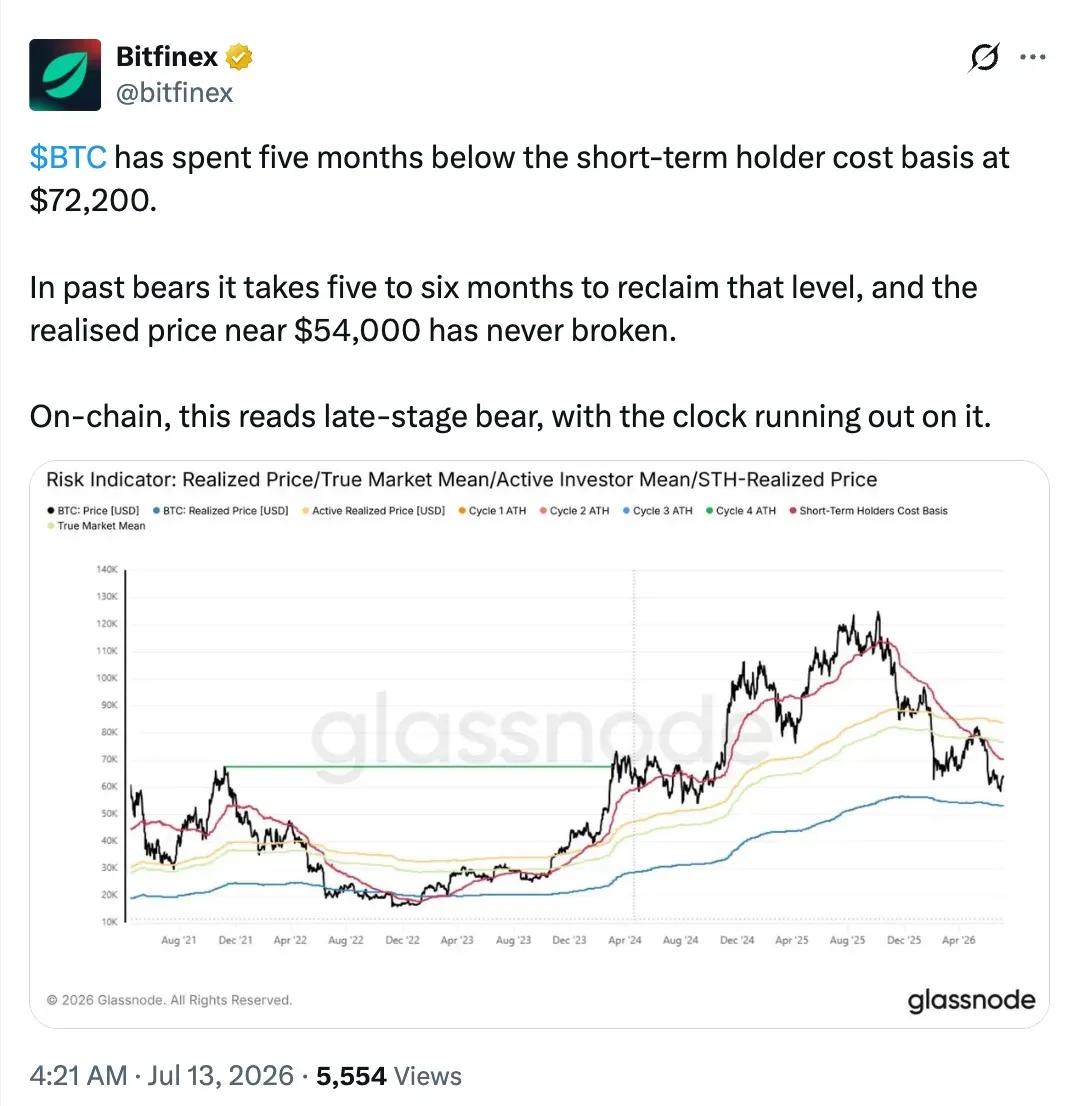
Analysts, however, warned against calling a bottom given thin institutional conviction. The 10-day streak of ETF outflows was broken on July 2, with $223.5 million flowing in, but the rally faltered amid geopolitical flare-ups. Whales holding over 1,000 BTC are close to breakeven, while 10.7 million BTC across the market are still underwater.
Bitcoin’s price was trading at $63,125, down over 1% in the last 24 hours. On Stocktwits, retail sentiment around BTC dropped to ‘bearish’ from the ‘neutral’ zone, accompanied by ‘low’ chatter levels.
Advertisement|Remove ads.
Fidelity's Power Law Model Signals Accumulation Zone
"As for Bitcoin, it too may be in an accumulation zone, in my view," Timmer, Fidelity's director of global macro, wrote on X. "At $60k it's getting ever closer to its power law support line."
In a logarithmic chart plotting Bitcoin’s entire price history, Timmer’s ‘power law’ model is bounded by an upper resistance line, a middle trendline and a lower support line which has aligned with previous major bottoms including 2018’s $3,204 low against a $2,521 support reading, and 2022’s $16,366 low against $15,006 support. The model is currently showing support near $58,000, while Bitcoin was recently trading at around $62,685.
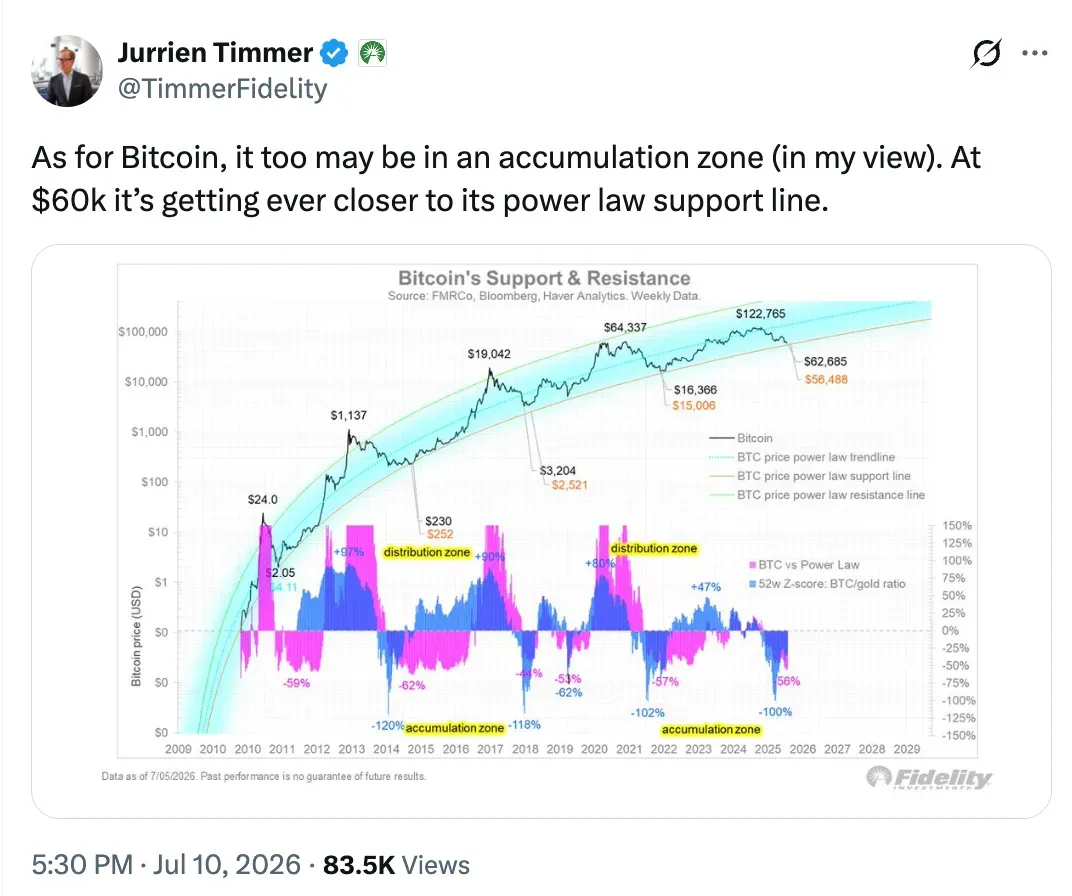
The Bitcoin power law model is built on a core assumption that the asset’s long-term price follows a mathematical power-law relationship with the time elapsed since its genesis block. The percentage growth rate of its price will gradually slow as the network matures, rather than remain constant.
Advertisement|Remove ads.
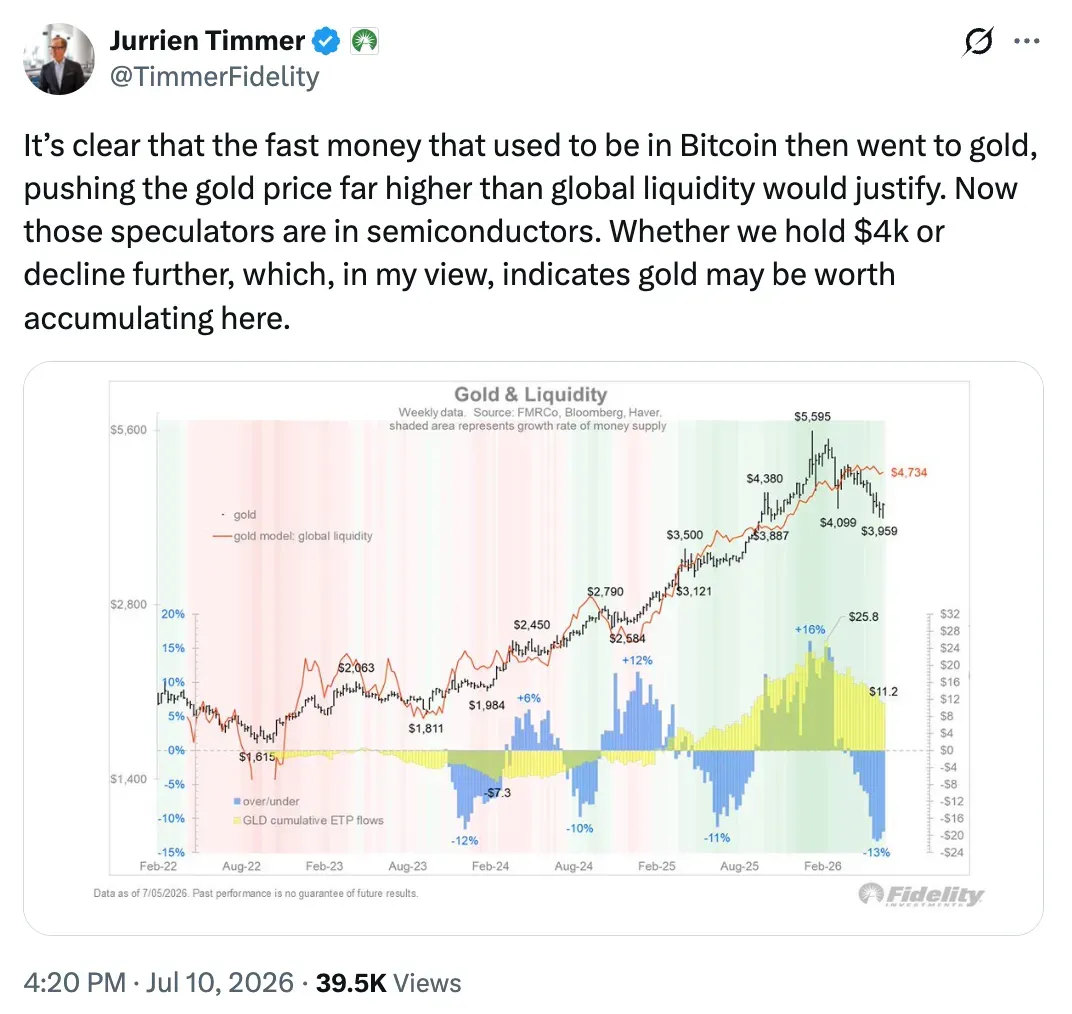
Separately, Timmer noted a broader rotation in speculative capital. "It's clear that the fast money that used to be in Bitcoin then went to gold, pushing the gold price far higher than global liquidity would justify," he wrote. "Now those speculators are in semiconductors."
CryptoQuant: Short-Term Holders Reflect Bear-Market Conditions
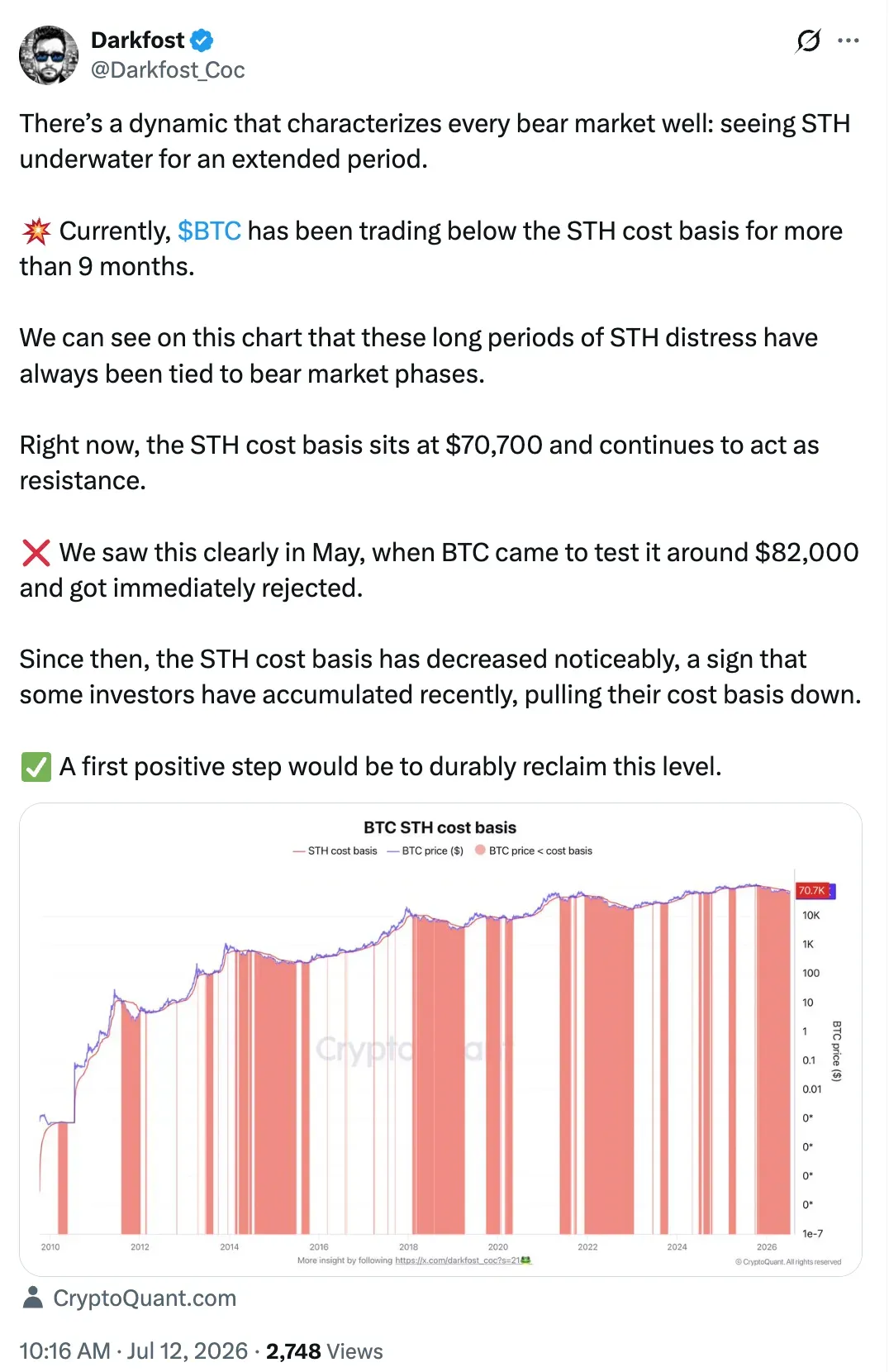
In a post on X, CryptoQuant analyst Darkfost also pointed out a different on-chain indicator: Bitcoin’s short-term holder (STH) cost basis, which was around $70,700. Darkfost wrote, "There's a dynamic that characterizes every bear market well: seeing STH underwater for an extended period." Bitcoin has been trading below that cost basis for over nine months, which he said has historically matched up with bear market cycles.
Why CPI Matters For Bitcoin
The CPI print provides direction on what the Federal Reserve will do next with interest rates. If inflation comes in hotter than expected, the Fed tends to keep rates higher for longer, making risk assets like Bitcoin less attractive, as investors can earn higher returns in fiat currencies and borrowing to invest becomes more expensive. In contrast, a cooler-than-expected inflation rate improves market liquidity, with investors more hopeful about a rate cut. This, in turn, leads to more capital flowing into risk assets.
Advertisement|Remove ads.
Bitfinex analyst said the $60,000-$63,000 shelf is not yet flow-supported and called “a shock outflow the biggest risk ahead” of Tuesday’s CPI print, with Bitcoin now tracking Treasury yields over oil or gold.
Read also: Michael Saylor's Bitcoin Credibility Splits Two Market Veterans Over ‘Buying Forever’ Pledge
For updates and corrections, email newsroom[at]stocktwits[dot]com
Advertisement|Remove ads.
Comments posted here will also appear on symbol pages.

Latest News
/filters:format(webp)https://news.stocktwits-cdn.com/large_Getty_Images_2183604828_0179169ddb.jpg)
/filters:format(webp)https://news.stocktwits-cdn.com/Anushka_Basu_make_me_smile_in_the_picture_b92832aa_af59_4141_aacc_4180d2241ba8_1_2_png_1086e0ed8c.webp) Anushka Basu·13h ago
Anushka Basu·13h ago/filters:format(webp)https://news.stocktwits-cdn.com/large_Getty_Images_1244247217_jpg_900a48e334.webp) Anushka Basu·14h ago
Anushka Basu·14h ago/filters:format(webp)https://news.stocktwits-cdn.com/large_Getty_Images_2187781361_2f00b8c65a.jpg) Anushka Basu·15h ago
Anushka Basu·15h ago/filters:format(webp)https://news.stocktwits-cdn.com/large_arthur_hayes_2026_OG_jpg_9f3524f8b1.webp) Anushka Basu·16h ago
Anushka Basu·16h ago/filters:format(webp)https://news.stocktwits-cdn.com/large_Tom_Lee_BMNR_64157a5786.webp) Anushka Basu·18h ago
Anushka Basu·18h ago/filters:format(webp)https://news.stocktwits-cdn.com/large_Getty_Images_2194650023_jpg_2af2244b5a.webp)
/filters:format(webp)https://st-everywhere-cms-prod.s3.us-east-1.amazonaws.com/i_OS_App_Icon_1_8054f2a2fe.png) Stocktwits News Desk·18h ago
Stocktwits News Desk·18h ago