


Advertisement|Remove ads.
CLARITY Act To Get Fast-Tracked, Says Senator Thom Tillis – Calls For 'Good Faith' On Stablecoin Yield
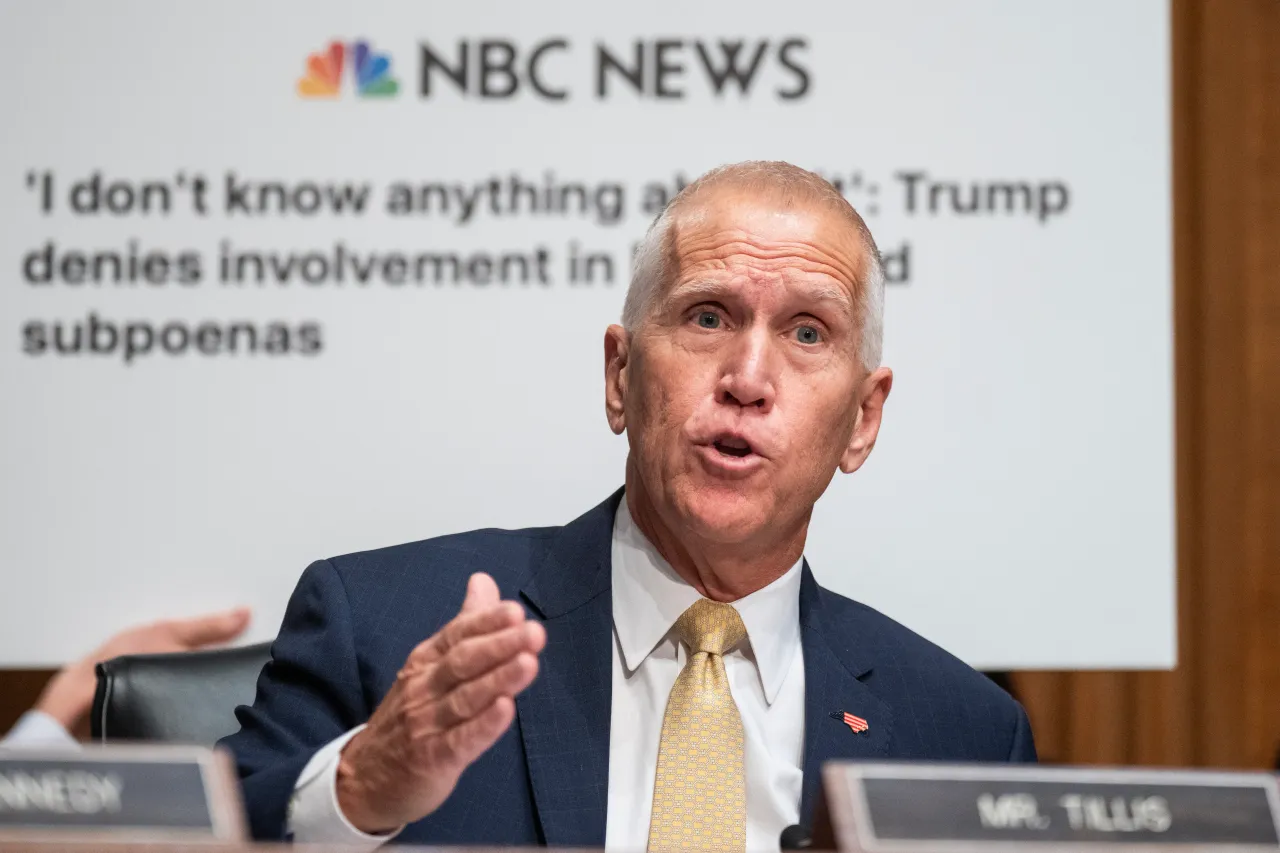


- Eleanor Terrett reported on Wednesday that Senator Thom Tillis is allegedly pushing to move the Crypto CLARITY Act toward a markup.
- Tillis said draft legislative text could be released days ahead of a markup to address remaining concerns around stablecoin yield
- Senator Cynthia Lummis and Securities and Exchange Commission Chair Paul Atkins have indicated the bill could advance as early as May, with potential passage by June
Advertisement|Remove ads.
Eleanor Terrett reported on Wednesday that Senator Thom Tillis was allegedly moving to push the Crypto CLARITY Act toward a markup, following recent progress on key provisions.
Speaking on Capitol Hill after the Warsh vote, Tillis told reporter Chase Williams that he plans to ask Senate leadership to schedule a markup when lawmakers return. The developments were shared by former Fox Business journalist Terrett on X.
“I’m going to ask the chair to move forward with scheduling a markup when we get back… I think we’ve made a lot of progress… and it’s time to get it before the committee to move it forward,” Tillis said, according to Terrett.
Advertisement|Remove ads.
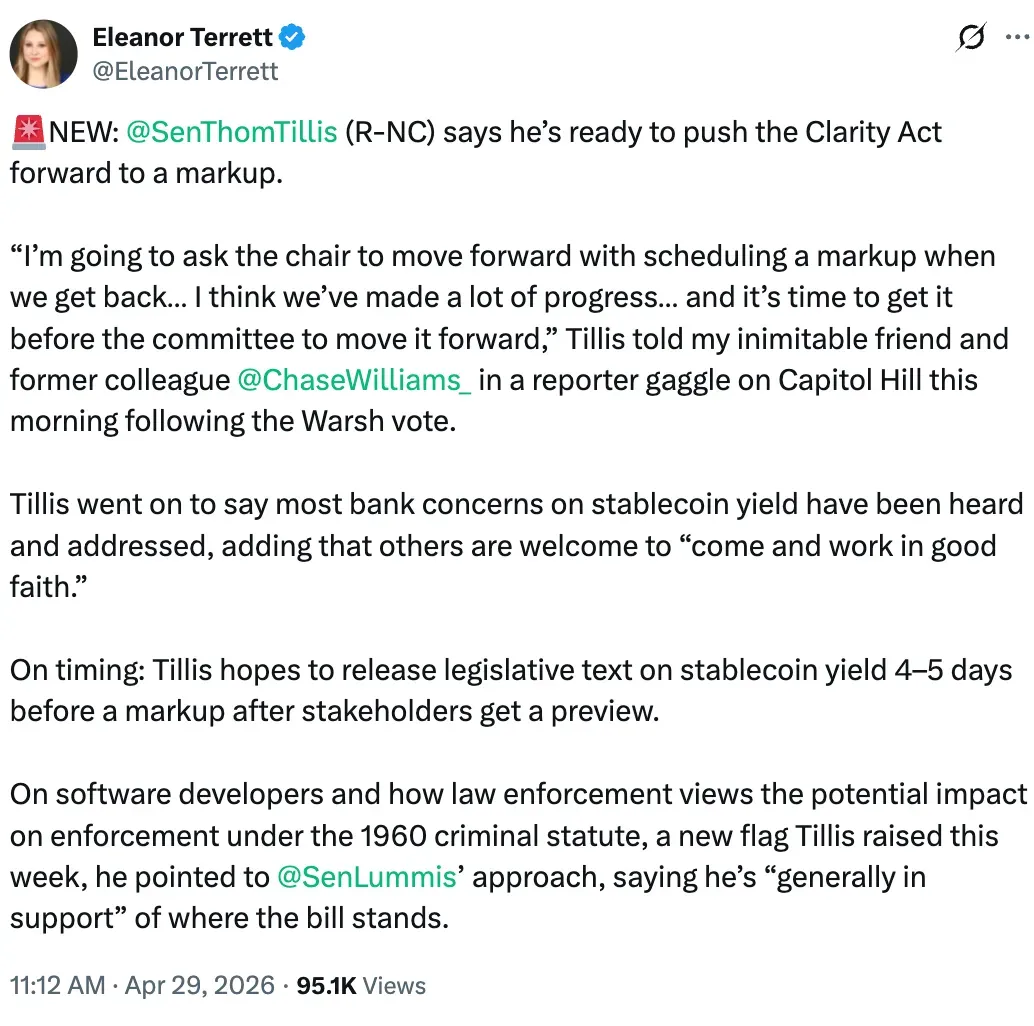
He added that most concerns from banks around stablecoin yield have been addressed, and that stakeholders are welcome to “come and work in good faith.”
Tillis also said draft legislative text on stablecoin yield could be released four to five days before a markup, giving participants time to review the proposal.
On enforcement and developer protections, Tillis pointed to an approach backed by Senator Cynthia Lummis, saying he is “generally in support” of the bill's current position.
Advertisement|Remove ads.
Timeline Points To May Markup
Momentum around the bill has been building recently. Speaking at the Bitcoin 2026 conference on Monday, Senator Cynthia Lummis said the CLARITY Act markup could take place in May, with the legislation potentially becoming law by June.
At the same conference, SEC Chair Paul Atkins agreed that the bill could advance in May, reinforcing expectations that lawmakers were attempting to move the legislation forward before the midterm cycle intensifies.
Political Risks Still Loom
Despite the progress, analysts have flagged ongoing political risks that could still derail the bill.
Advertisement|Remove ads.
Sander Lutz, the White House correspondent at Decrypt Media, noted that if the CLARITY Act fails to pass, it could trigger political fallout over who bears responsibility, particularly as crypto-related political spending has surged.
He added that Tillis, a key swing vote on the Senate Banking Committee, has raised concerns around stablecoin yield, ethics issues tied to political figures, and protections for decentralized finance developers.
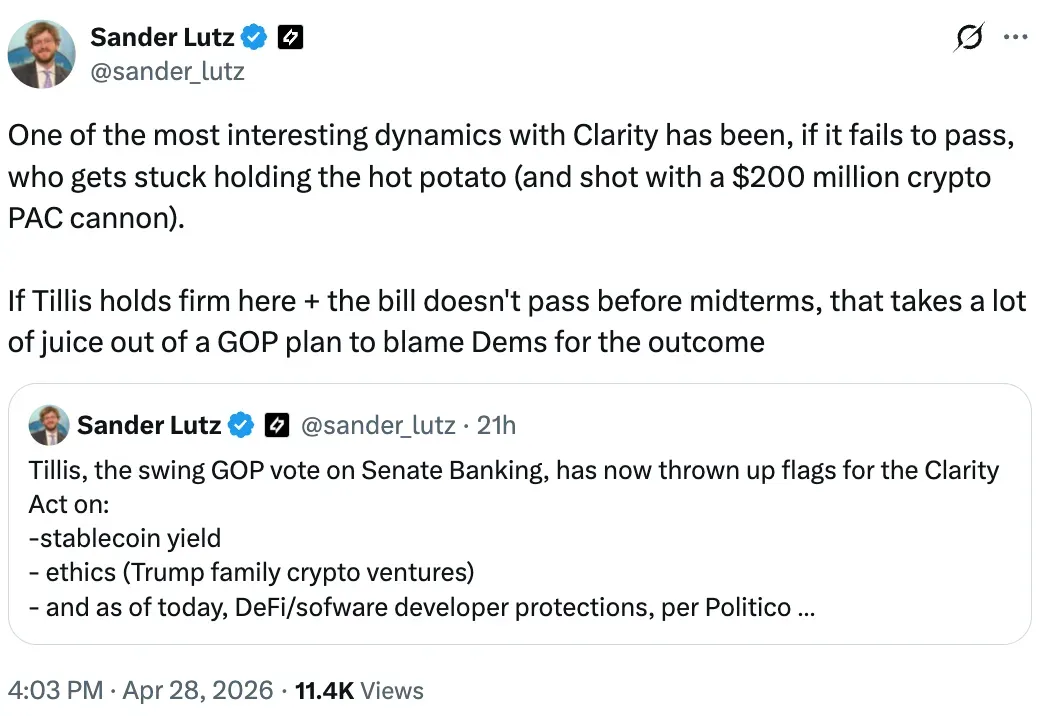
According to Lutz, delays beyond the midterms could complicate efforts to assign blame for the bill’s outcome, potentially weakening broader political narratives around crypto regulation.
Advertisement|Remove ads.
The CLARITY Act defines how stablecoins and digital assets are regulated in the United States, including setting rules for issuance, yield, and oversight.
A clearer framework could support the development of dollar-pegged tokens like Tether’s USAT. On Stocktwits, the retail sentiment around USAT remained in the ‘neutral’ zone, while chatter around it stayed ‘extremely high’ over the past day.
Advertisement|Remove ads.
For updates and corrections, email newsroom[at]stocktwits[dot]com.
Comments posted here will also appear on symbol pages.

Latest News
/filters:format(webp)https://news.stocktwits-cdn.com/large_omeros_jpg_4769b8d291.webp)
/filters:format(webp)https://news.stocktwits-cdn.com/unnamed_jpg_9dff551b50.webp) Anan Ashraf·3m ago
Anan Ashraf·3m ago/filters:format(webp)https://news.stocktwits-cdn.com/gettyimages_2300173669_612x612_7f6f3c187e.jpg)
/filters:format(webp)https://news.stocktwits-cdn.com/Prabhjote_DP_67623a9828.jpg) Prabhjote Gill·1h ago
Prabhjote Gill·1h ago/filters:format(webp)https://news.stocktwits-cdn.com/large_exxon_jpg_55190ae0a4.webp) Anan Ashraf·1h ago
Anan Ashraf·1h ago/filters:format(webp)https://news.stocktwits-cdn.com/large_Getty_Images_2290047142_95f9cf7d0a.jpg)
/filters:format(webp)https://news.stocktwits-cdn.com/vivekkrishnanphotography_58_jpg_0e45f66a62.webp) Arnab Paul·1h ago
Arnab Paul·1h ago/filters:format(webp)https://news.stocktwits-cdn.com/gettyimages_2290627519_594x594_c4b7c5070c.jpg)
/filters:format(webp)https://news.stocktwits-cdn.com/Harshita_3cfe02022c.jpg) Harshita Tyagi·2h ago
Harshita Tyagi·2h ago/filters:format(webp)https://news.stocktwits-cdn.com/large_Birkenstock_jpg_10714d2e24.webp)
/filters:format(webp)https://news.stocktwits-cdn.com/Heera_1_1c30cb0170.PNG) Heera Hari·2h ago
Heera Hari·2h ago