


Advertisement|Remove ads.
Crude Oil Is Crushing Ethereum Right Now – Tom Lee Says ETH’s ‘Biggest Headwind’ Is Sitting In The Persian Gulf
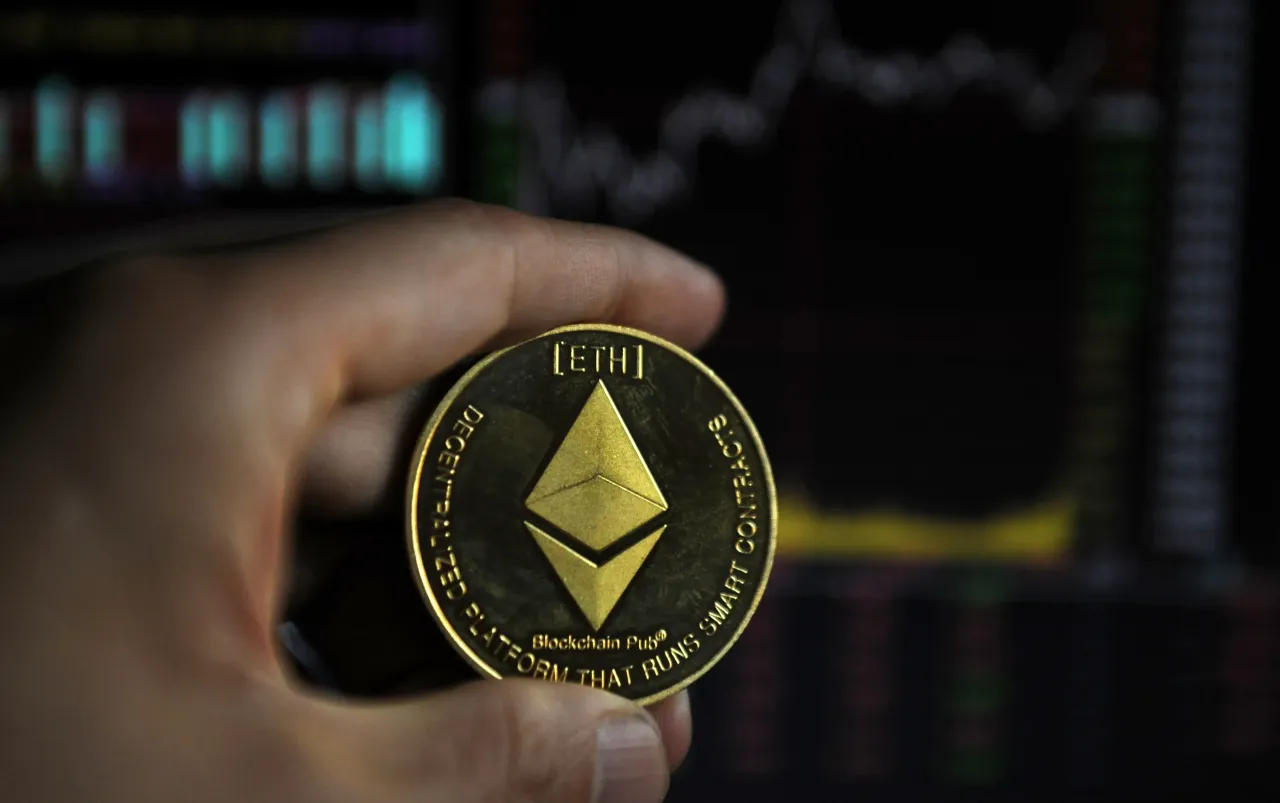


- Fundstrat co-founder Tom Lee said rising oil prices have become Ethereum’s “biggest headwind” in the near term as WTI crude surged above $106 per barrel.
- The comments came amid escalating geopolitical tensions and supply concerns over the Strait of Hormuz, as well as stalled US-Iran negotiations.
- Lee maintained a bullish long-term outlook on Ethereum, citing tokenization and artificial intelligence as the asset’s primary structural growth drivers.
Advertisement|Remove ads.
Fundstrat co-founder Tom Lee said on Sunday that surging oil prices have become Ethereum’s (ETH) “biggest headwind” in the near term as crude oil continued climbing amid escalating geopolitical tensions and supply concerns.
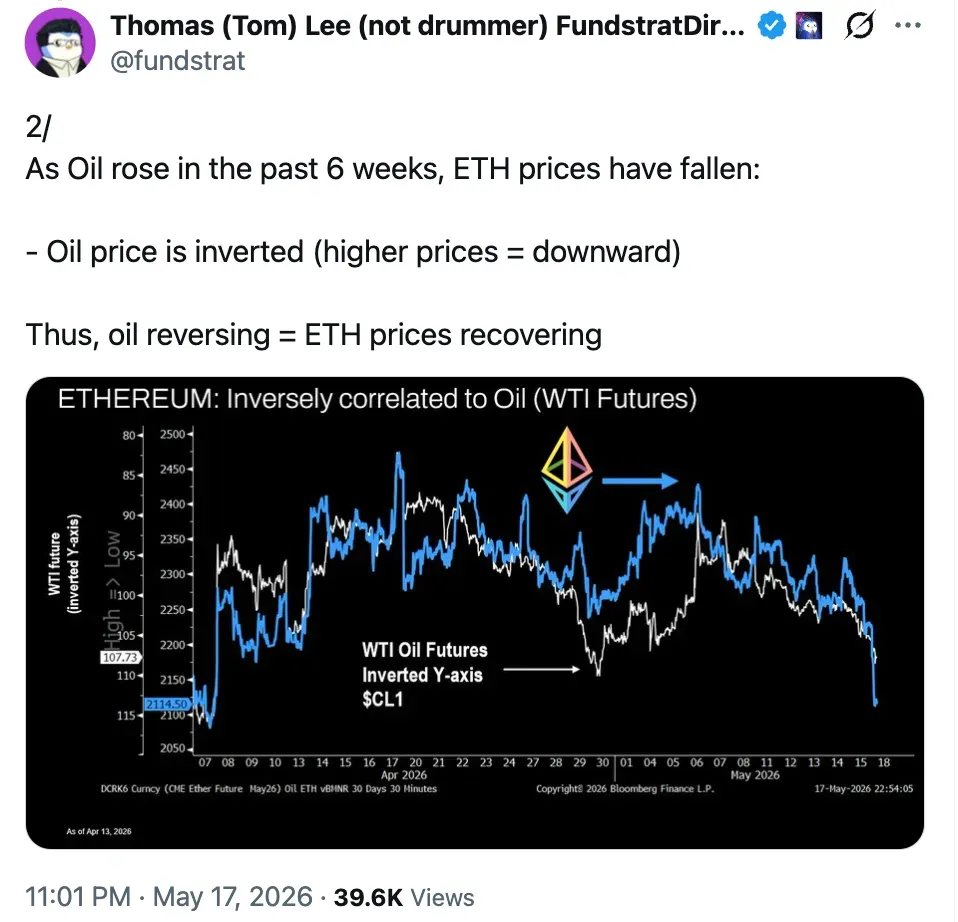
Lee pointed to what he described as the strongest inverse correlation ever recorded between Ethereum and oil prices. Charts shared by Lee showed Ethereum steadily declining over the past six weeks as WTI crude futures climbed, with the negative relationship becoming increasingly pronounced in recent sessions.
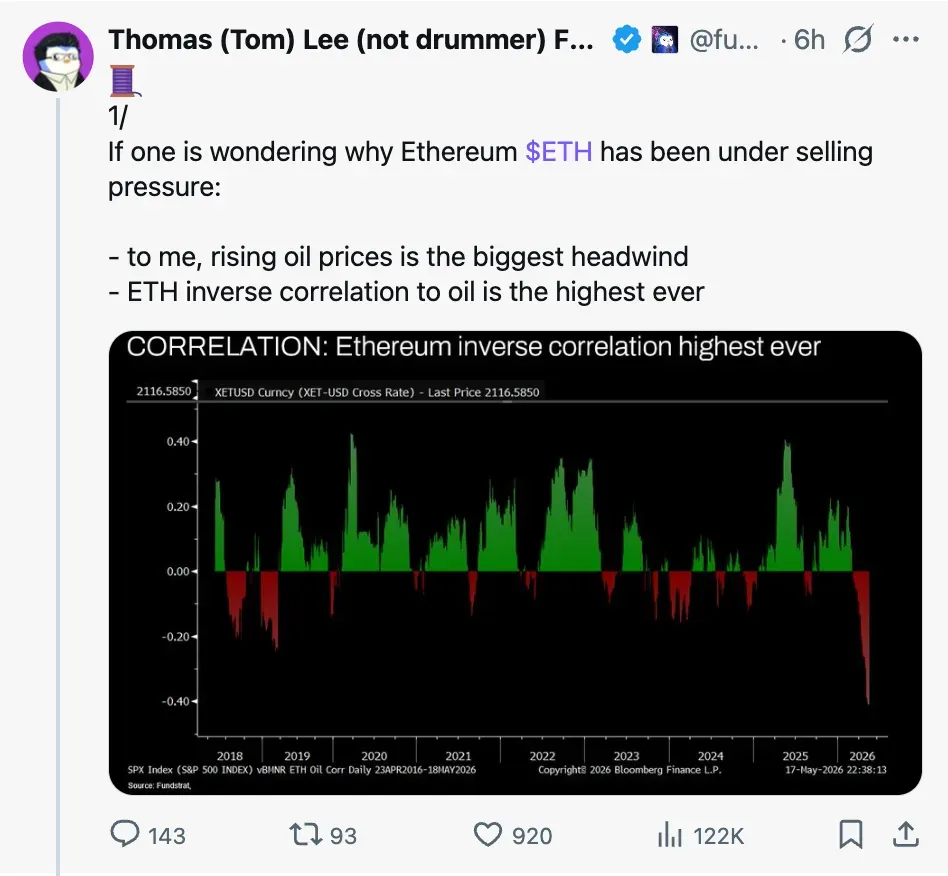
According to Lee, rising oil prices were weighing on Ethereum because higher energy costs tend to intensify inflation concerns and weaken appetite for risk assets such as cryptocurrencies. He added that Ethereum could begin recovering if oil prices reverse lower.
Advertisement|Remove ads.
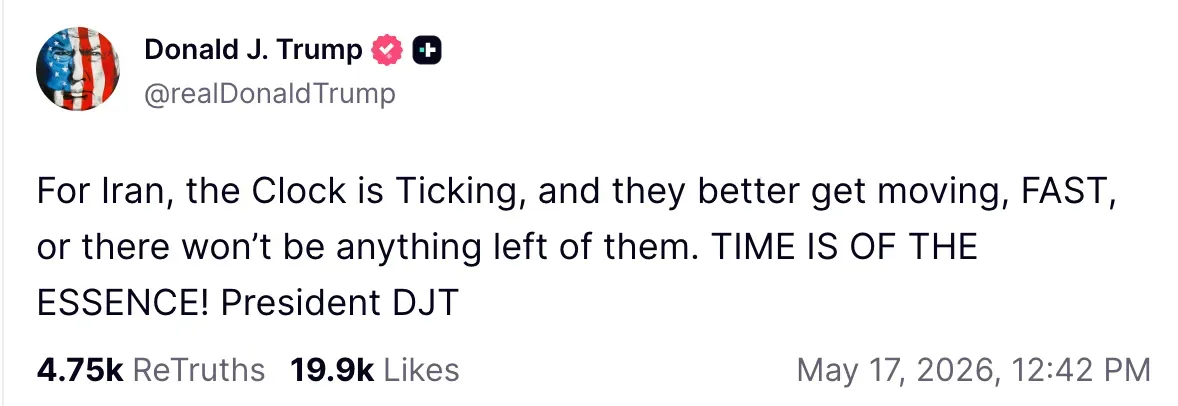
WTI crude futures rose above $106 per barrel on Monday, extending last week’s gains amid stalled US-Iran negotiations and continued concerns surrounding disruptions near the Strait of Hormuz, one of the world’s most important oil shipping routes. In a Truth Social post on Sunday, President Donald Trump wrote, “For Iran, the Clock is Ticking, and they better get moving, FAST, or there won’t be anything left of them.”
The latest geopolitical tensions followed reports of attacks on energy infrastructure across the Persian Gulf over the weekend, including a nuclear facility in the United Arab Emirates. At the same time, the Trump administration allowed a waiver permitting Russian crude sales to expire despite India’s request for an extension, adding further pressure on already-constrained global supplies.
Ethereum’s price was down almost 3% over the past 24 hours. Over the past week, the cryptocurrency has been down 9%. On Stocktwits, the retail sentiment around ETH remained in the ‘bearish’ zone, while chatter around it stayed at ‘normal’ levels over the past day.
Advertisement|Remove ads.
Tokenization And AI Remain Long-Term Drivers
Despite the near-term weakness, Lee maintained a ‘bullish’ longer-term outlook on Ethereum, describing the current move as “short-term tactical noise.” He explained that the “bigger driver for ETH is tokenization [and] agentic AI,” describing them as “structural drivers.”
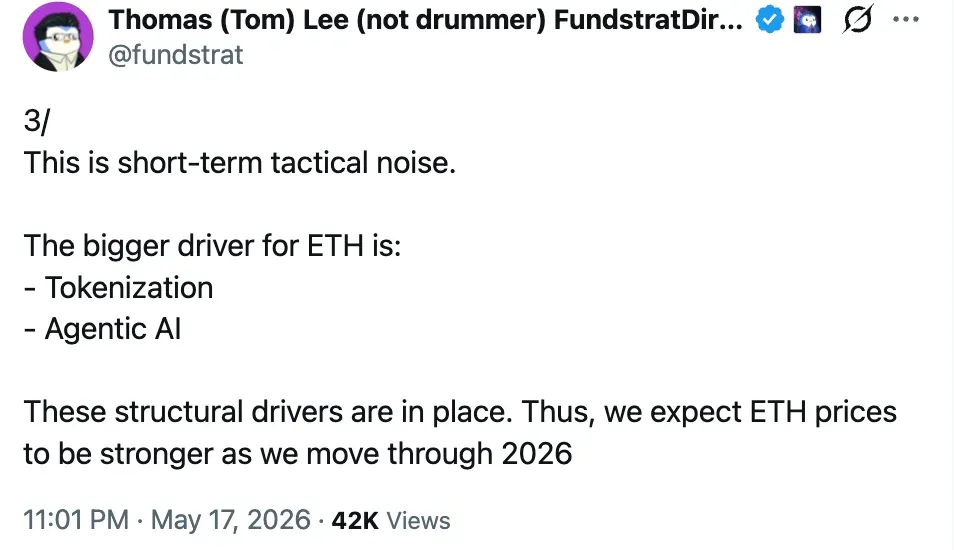
Lee has consistently framed these structural drivers in terms of bank adoption. Speaking on The Meb Faber Show last week, he argued that two core blockchain use cases are now pulling financial institutions onto Ethereum: the tokenization and instant settlement of real-world assets, covering real estate, artworks, and other illiquid instruments, enabling 24x7 trading, and AI agents that use blockchain for identity verification and wallet custody.
At the Consensys conference earlier this month, Lee projected ETH could end 2026 between $9,000 and $12,000, implying a gain of around 290% to 420% from current levels.
Advertisement|Remove ads.
![Ethereum (ETH) [03.45.35, 18 May, 2026].png](https://news.stocktwits-cdn.com/Ethereum_ETH_03_45_35_18_May_2026_png_2689c010ad.webp)
ETH’s last six months are an account of one violent volatility event, followed by a slow, low-conviction recovery that is now fading. The setup is for near-term volatility expansion; the direction will depend on whether $2,000-2,100 holds as support or breaks toward the Feb lows.
For updates and corrections, email newsroom[at]stocktwits[dot]com.
Advertisement|Remove ads.
Comments posted here will also appear on symbol pages.

Latest News
/filters:format(webp)https://news.stocktwits-cdn.com/large_Getty_Images_2279869782_8049b29afc.jpg)
/filters:format(webp)https://news.stocktwits-cdn.com/Aashika_Suresh_Profile_Picture_jpg_2acd6f446c.webp) Aashika Suresh·26m ago
Aashika Suresh·26m ago/filters:format(webp)https://news.stocktwits-cdn.com/large_Getty_Images_2300173637_79e4bae290.jpg)
/filters:format(webp)https://news.stocktwits-cdn.com/IMG_9209_1_d9c1acde92.jpeg) Yuvraj Malik·42m ago
Yuvraj Malik·42m ago/filters:format(webp)https://news.stocktwits-cdn.com/large_Getty_Images_2288509244_fc180e6aec.jpg)
/filters:format(webp)https://news.stocktwits-cdn.com/shivani_photo_jpg_dd6e01afa4.webp) Shivani Kumaresan·48m ago
Shivani Kumaresan·48m ago/filters:format(webp)https://news.stocktwits-cdn.com/large_patrick_soon_shiong_jpg_32b8924ac2.webp)
/filters:format(webp)https://news.stocktwits-cdn.com/IMG_8805_JPG_6768aaedc3.webp) Deepti Sri·2h ago
Deepti Sri·2h ago/filters:format(webp)https://news.stocktwits-cdn.com/large_Getty_Images_2203983775_jpg_74bdd5dd43.webp) Aashika Suresh·2h ago
Aashika Suresh·2h ago/filters:format(webp)https://news.stocktwits-cdn.com/gettyimages_1161631184_594x594_0063399eed.jpg)
/filters:format(webp)https://news.stocktwits-cdn.com/1707726834303_jpg_11f20a9aa9.webp) Shashank Nayar·3h ago
Shashank Nayar·3h ago