


Advertisement|Remove ads.
40% Of Crypto Holders Want Rewards — CLARITY Caps Them, Banks Want Them Killed


- A National Cryptocurrency Association survey found 40% of U.S. cryptocurrency holders say rewards and interest would make them more likely to use it.
- The report found 76% want their bank to embed crypto into their existing accounts.
- The Tillis-Alsobrooks compromise in the CLARITY Act already bans stablecoin interest that is “economically equivalent” to bank yield.
Advertisement|Remove ads.
A new National Cryptocurrency Association (NCA) survey, conducted with The Harris Poll, showed a stark divide between what U.S. cryptocurrency holders want and what Washington is about to deliver.
The NCA report, based on a survey of U.S. crypto holders, explores what could motivate greater adoption among the 67 million Americans who hold cryptocurrency. The leading answer, with 40% of the vote, was digital assets being an avenue to earn rewards and interest.
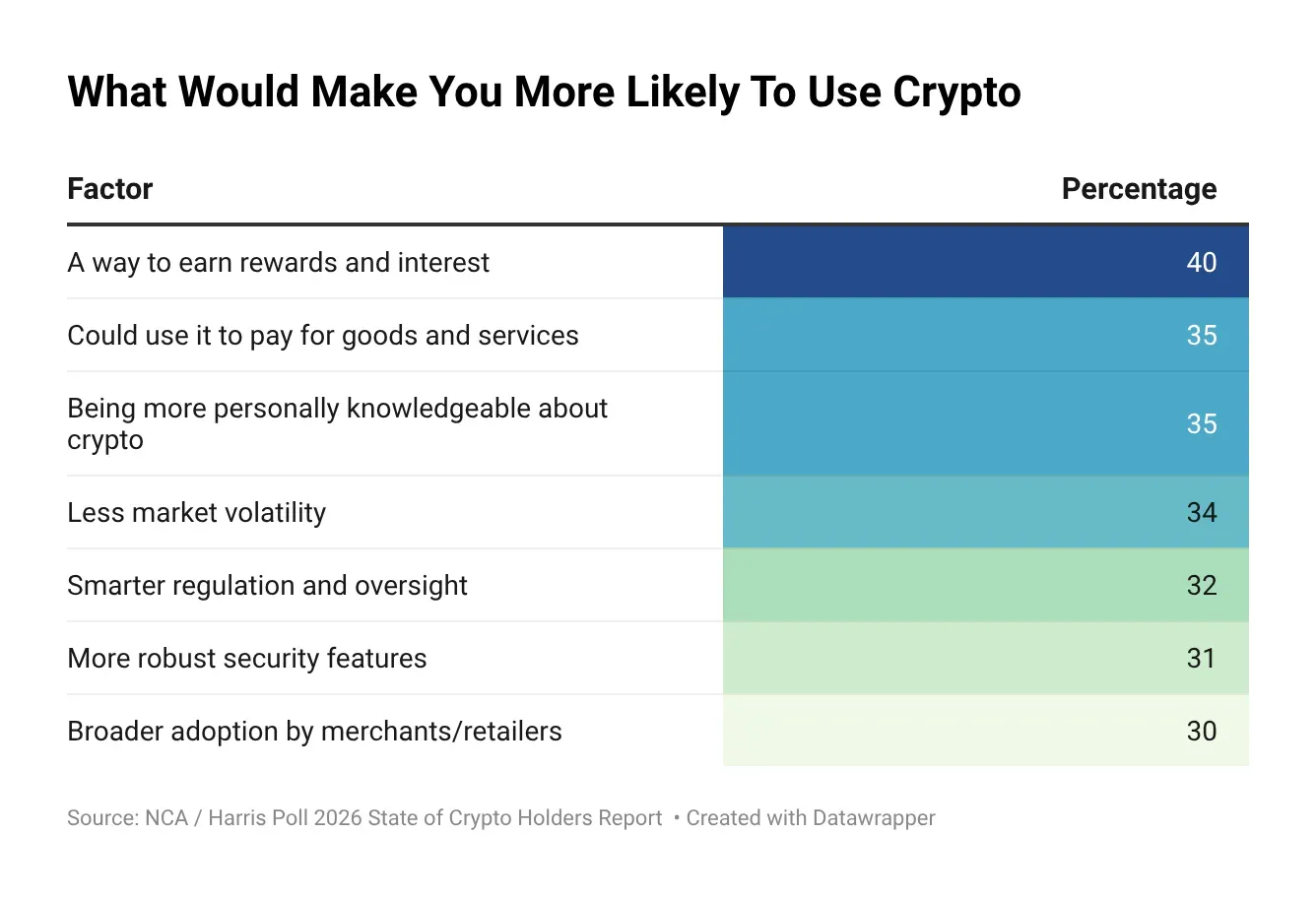
The remaining vote was split between the use of cryptocurrency to spend on everyday goods and services at 35%, greater personal knowledge at 35%, and less market volatility at 34%.
Advertisement|Remove ads.
Retail Traders Wants Banks More Involved In Crypto
Among existing holders of cryptocurrencies, data showed 76% of holders want their bank to be able to buy, hold, and manage cryptocurrency alongside traditional accounts, not replace them. Nearly one-third of holders said the most positive shift in their view of crypto came from seeing the technology built into systems they already trust, specifically PayPal (PYPL), Visa (V), and banks.
The top item for building additional trust was greater transparency from cryptocurrency companies at 49%, followed by real-world use cases and traditional-finance integration, both tied at 42%. “The U.S. is at a pivotal moment in shaping the future of digital assets," said Chris Giancarlo, former Chairman of the Commodity Futures Trading Commission (CFTC) and an NCA Advisory Board Member.
What The CLARITY Act Currently Allows
The Digital Asset Market Clarity Act, which is marching toward Thursday's Senate Banking Committee markup, would seek to provide activity-based rewards by cryptocurrency firms, but the banking lobby is trying to fold in even tighter restrictions.
Advertisement|Remove ads.
The current text prohibits stablecoin issuers and cryptocurrency companies associated with them from offering interest that is economically “equivalent" to bank interest rates.
Members of the American Bankers Association (ABA) have sent over 8,000 letters to Senate offices since Friday, urging a stricter standard for stablecoin yields. Additionally, the ABA has stated that yield-bearing stablecoins could exacerbate deposit outflows and expand the stablecoin market anywhere from $300 billion to as much as $2 trillion.
A poll of 3,700 retail traders on Stocktwits showed that 49% expect the CLARITY Act to clear both houses of Congress this year while 14% see the Senate advancing it only for the House stall and just 7% see it moving through the Senate Banking Committee only for the full Senate to pass. Approximately 30% of participants stated they do not anticipate any substantive crypto legislation to become law by 2026.
Advertisement|Remove ads.
Read also: Arthur Hayes Calls Zcash His Biggest Non-Bitcoin Bet On The 'Asymmetric' Privacy Trade
For updates and corrections, email newsroom[at]stocktwits[dot]com
Comments posted here will also appear on symbol pages.

Latest News
/filters:format(webp)https://st-everywhere-cms-prod.s3.us-east-1.amazonaws.com/large_bloom_energy_resized_d69c98fd7a.jpg)
/filters:format(webp)https://news.stocktwits-cdn.com/1707726834303_jpg_11f20a9aa9.webp) Shashank Nayar·27m ago
Shashank Nayar·27m ago/filters:format(webp)https://news.stocktwits-cdn.com/gettyimages_2257971883_594x594_1606ccd0ba.jpg)
/filters:format(webp)https://news.stocktwits-cdn.com/Heera_1_1c30cb0170.PNG) Heera Hari·2h ago
Heera Hari·2h ago/filters:format(webp)https://news.stocktwits-cdn.com/large_Amazon_10819d8d5b.jpg) Shashank Nayar·2h ago
Shashank Nayar·2h ago/filters:format(webp)https://news.stocktwits-cdn.com/gettyimages_2296155088_594x594_e8c6d1d489.jpg)
/filters:format(webp)https://news.stocktwits-cdn.com/Harshita_3cfe02022c.jpg) Harshita Tyagi·3h ago
Harshita Tyagi·3h ago/filters:format(webp)https://news.stocktwits-cdn.com/large_Getty_Images_550274689_9d7f31a128.jpg) Harshita Tyagi·3h ago
Harshita Tyagi·3h ago/filters:format(webp)https://news.stocktwits-cdn.com/large_Palantir_jpg_2306345ec4.webp)
/filters:format(webp)https://news.stocktwits-cdn.com/Prabhjote_DP_67623a9828.jpg) Prabhjote Gill·4h ago
Prabhjote Gill·4h ago