


Advertisement|Remove ads.
Ethereum’s ‘Ultrasound Money’ Narrative Is Dead, Analyst Says, While Calling David Hoffman’s ETH Exit Bullish



- Varys Capital’s Tom Dunleavy said on Wednesday that Ethereum’s “ultrasound money” narrative has broken down, calling rising pessimism around it a potential “bottom signal.”
- Dunleavy said Ethereum could continue underperforming even if the network itself remains successful.
- The analyst dismissed BlackRock’s $1.29 billion iShares Bitcoin Trust dark pool trade as “pretty worthless,” noting only $122 million in exchange-traded fund redemptions followed.
Advertisement|Remove ads.
Ethereum's (ETH) "ultrasound money" thesis has effectively broken down, Varys Capital's Head of Venture Capital Tom Dunleavy said on Wednesday, but he thinks the wave of skepticism washing over the network may be the bottom signal itself.
Speaking on Scott Melker’s Wolf Of All Streets podcast, Dunleavy zeroed in on recent comments from Bankless founder David Hoffman, who publicly questioned Ethereum's "ultrasound money" identity after years of championing it. Last week, Hoffman posted that he had sold off all of his Ethereum.
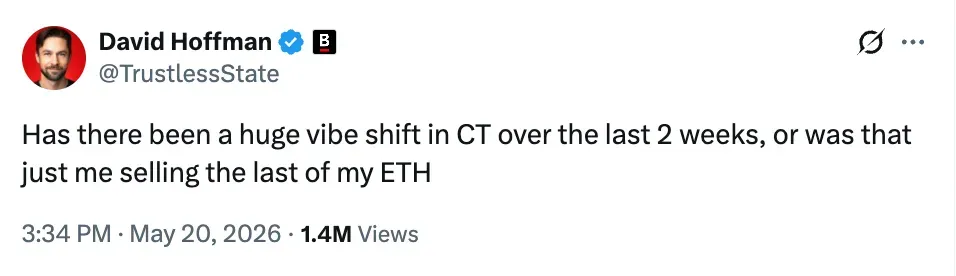
Dunleavy called Hoffman's change of tone a "classic bottom signal,” the kind of capitulation that tends to show up when one of an asset's loudest believers finally exits the position. In the interview, Melker and Dunleavy both discussed how “Bankless built their entire brand, their funds, their everything around Ethereum.”
Advertisement|Remove ads.
That said, he was careful to separate the network from the token. Ethereum, the network could still come out fine, he said. The asset is a different conversation and may continue to underperform other crypto narratives for a while, said Dunleavy.
Ethereum’s price was down by 0.8% during the past 24 hours, struggling to hold above $2,000. On Stocktwits, retail sentiment around ETH shifted to ‘bearish’ from ‘neutral’ zone, while chatter around it remained at ‘high’ levels over the past day.
Ethereum Faces ‘Ship Or Die’ Moment
Dunleavy warned that crypto as a whole was running thin on themes worth allocating to. Hedge funds and institutional buyers, he said, have crowded into just a handful of stories, most notably Hyperliquid (HYPE), which is generating real revenue, and Zcash (ZEC), riding the privacy trade.
Advertisement|Remove ads.
He described Ethereum as in a “ship or die” phase, as competition from newer networks and Wall Street-backed blockchain initiatives intensified. Dunleavy also pointed to a growing “brain drain” at the Ethereum Foundation (EF), noting that several key figures had left this year as the organization increasingly shifted toward privacy-focused initiatives.
Despite the criticism of Ethereum's narrative problem, Dunleavy didn't write off the network. He pointed to its dominance in decentralized finance (DeFi) activity, stablecoin issuance, and total value locked, areas where, he argued, the rest of crypto still leans on Ethereum's rails.
"If Ethereum fails, crypto fails full stop," he said. “Ethereum has dominated all these metrics consistently for that time period, despite the network activity growing, whatever metric you want to use as a huge pie overall, 5x plus, you know, across chain, so you know, I continue to think if you're betting against Ethereum, you're betting against crypto,” he added.
Advertisement|Remove ads.
The IBIT Block Trade
Dunleavy also pushed back hard on the framing around BlackRock’s iShares Bitcoin Trust’s (IBIT) $1.29 billion dark pool trade. He called the story "pretty worthless" in the context of Bitcoin (BTC) now trading as a macro asset.
According to him, only around $122 million in exchange-traded fund (ETF) redemptions followed the transaction, suggesting that most of the position was privately absorbed rather than triggering broader market stress.
Advertisement|Remove ads.
For updates and corrections, email newsroom[at]stocktwits[dot]com
Comments posted here will also appear on symbol pages.

Latest News
/filters:format(webp)https://news.stocktwits-cdn.com/large_Getty_Images_2290038559_c6f6528203.jpg)
/filters:format(webp)https://news.stocktwits-cdn.com/Whats_App_Image_2026_05_11_at_09_45_43_1_jpeg_a08c0cf251.webp) Aveek Bhowmik·50m ago
Aveek Bhowmik·50m ago/filters:format(webp)https://news.stocktwits-cdn.com/large_Getty_Images_2301241048_efc5b32b0a.jpg)
/filters:format(webp)https://news.stocktwits-cdn.com/shivani_photo_jpg_dd6e01afa4.webp) Shivani Kumaresan·2h ago
Shivani Kumaresan·2h ago/filters:format(webp)https://st-everywhere-cms-prod.s3.us-east-1.amazonaws.com/large_Crown_Castle_resized_jpg_1ddf452bb6.webp) Shivani Kumaresan·3h ago
Shivani Kumaresan·3h ago/filters:format(webp)https://news.stocktwits-cdn.com/large_space_stocks_2_6f2aa9bc90.jpg)
/filters:format(webp)https://news.stocktwits-cdn.com/IMG_8805_JPG_6768aaedc3.webp) Deepti Sri·3h ago
Deepti Sri·3h ago/filters:format(webp)https://news.stocktwits-cdn.com/large_michael_burry_cropped_b787ce89b4.jpg) Deepti Sri·4h ago
Deepti Sri·4h ago/filters:format(webp)https://news.stocktwits-cdn.com/large_Getty_Images_2286863020_e80075951f.jpg) Shivani Kumaresan·5h ago
Shivani Kumaresan·5h ago