


Advertisement|Remove ads.
Peter Schiff Says Whales Are Dumping Bitcoin On 'Bag Holders' — The On-Chain Data Says Otherwise


- Peter Schiff, who has used a Ponzi-style framing for the sixth time in five weeks, said Bitcoin is a “pyramid scheme” and “today’s buyers are tomorrow’s bag holders.”
- Large Bitcoin transactions over $100K are declining to a four-month low of 1,687, the opposite of what we would expect to see in a coordinated distribution.
- Only 61% of BTC’s supply is profitable, compared with 75% in healthy bull markets, indicating that recent buyers above $80,000 are underwater.
Advertisement|Remove ads.
Peter Schiff, a longtime critic of Bitcoin (BTC), turned his bearish focus on the asset on Saturday, calling it a “pyramid scheme” again. But the on-chain data paints a more complex picture than his framing suggests.
Schiff said, “Today’s buyers are tomorrow’s bag holders,” adding that the market structure of Bitcoin is a pyramid scheme. He called STRC “the largest Ponzi in the world” last month, called it “the most obvious Ponzi” the next day, repeated the “most obvious Ponzi in history” framing in early May, called it a “classic centralized Ponzi” on May 11, called Strategy (MSTR) itself a “Ponzi” tied to its $64 billion Bitcoin holdings- nearly six instances in roughly five weeks.

Schiff’s latest comment came after market commentator Vivek Sen asked why Bitcoin’s price continues to drop despite reported buying from Strategy founder Michael Saylor, sovereign nations, BlackRock (BLK), and major banks. Schiff had a blunt explanation for it: “Because whales who bought a long time ago are selling”, saying how “a pyramid scheme works.”
Advertisement|Remove ads.
The On-Chain Data Doesn't Match Schiff's Framing
However, Schiff’s reference is hard to reconcile with the current on-chain data. According to data from analytics firm Santiment, the number of large Bitcoin transactions worth more than $100,000 has been gradually declining since early February. That’s when the whale transaction count surged to over 14,000 in a single day.
![Bitcoin (BTC) [05.46.48, 24 May, 2026].png](https://news.stocktwits-cdn.com/Bitcoin_BTC_05_46_48_24_May_2026_png_575b6e5dbb.webp)
By May 23, that number had fallen again to 1,687, among the lowest levels in the past four months. A coordinated distribution event from long-term whales would typically show an increase in whale transaction count, not a sustained decline.
The total number of holders on Santiment has also continued to grow to 58.95 million addresses over the same period — a trend more in line with retail accumulation during a price decline than large holders dumping.
Advertisement|Remove ads.
Bull Markets Usually Run Above 75%, Bitcoin Is At 61%
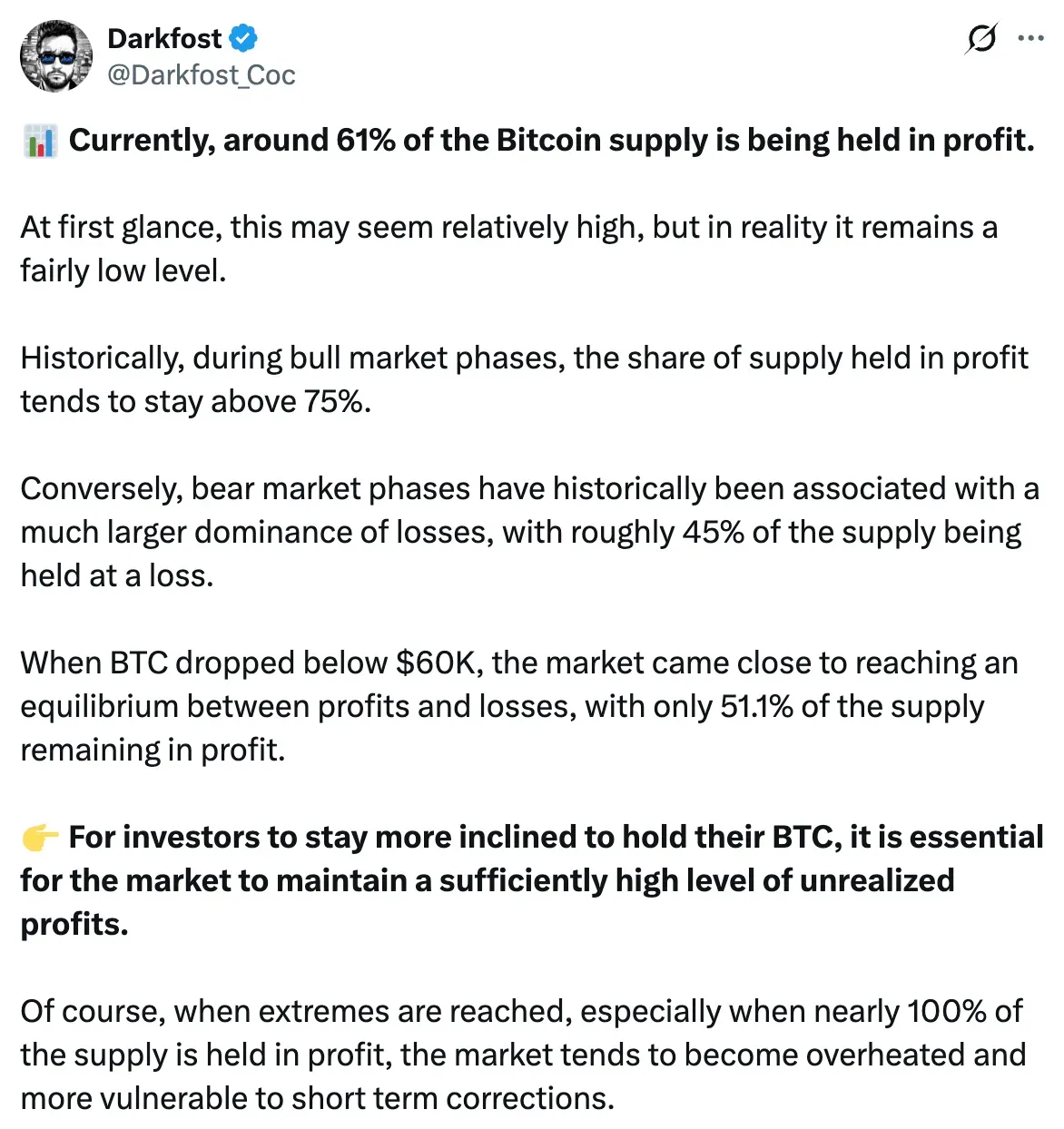
Other on-chain metrics are mixed in their support of Schiff’s broader worry. Analyst Darkfost said that bull markets have always stayed above 75%, which means a large percentage of recent buyers, especially those who bought above $80,000, are underwater. That number dropped to 51.1% when Bitcoin briefly dipped below $60,000 earlier this cycle, near an equilibrium between profits and losses.
Meanwhile, Bitcoin's annual inflation rate remains close to 0.85% after the halving in April 2024, lower than gold's annual mining inflation, which is around 1.5% to 2%, and structurally incompatible with the supply dynamics of pyramid schemes that rely on increasing issuance to pay earlier participants. That number will be cut even further in 2028, when the next Bitcoin halving is due to take place.
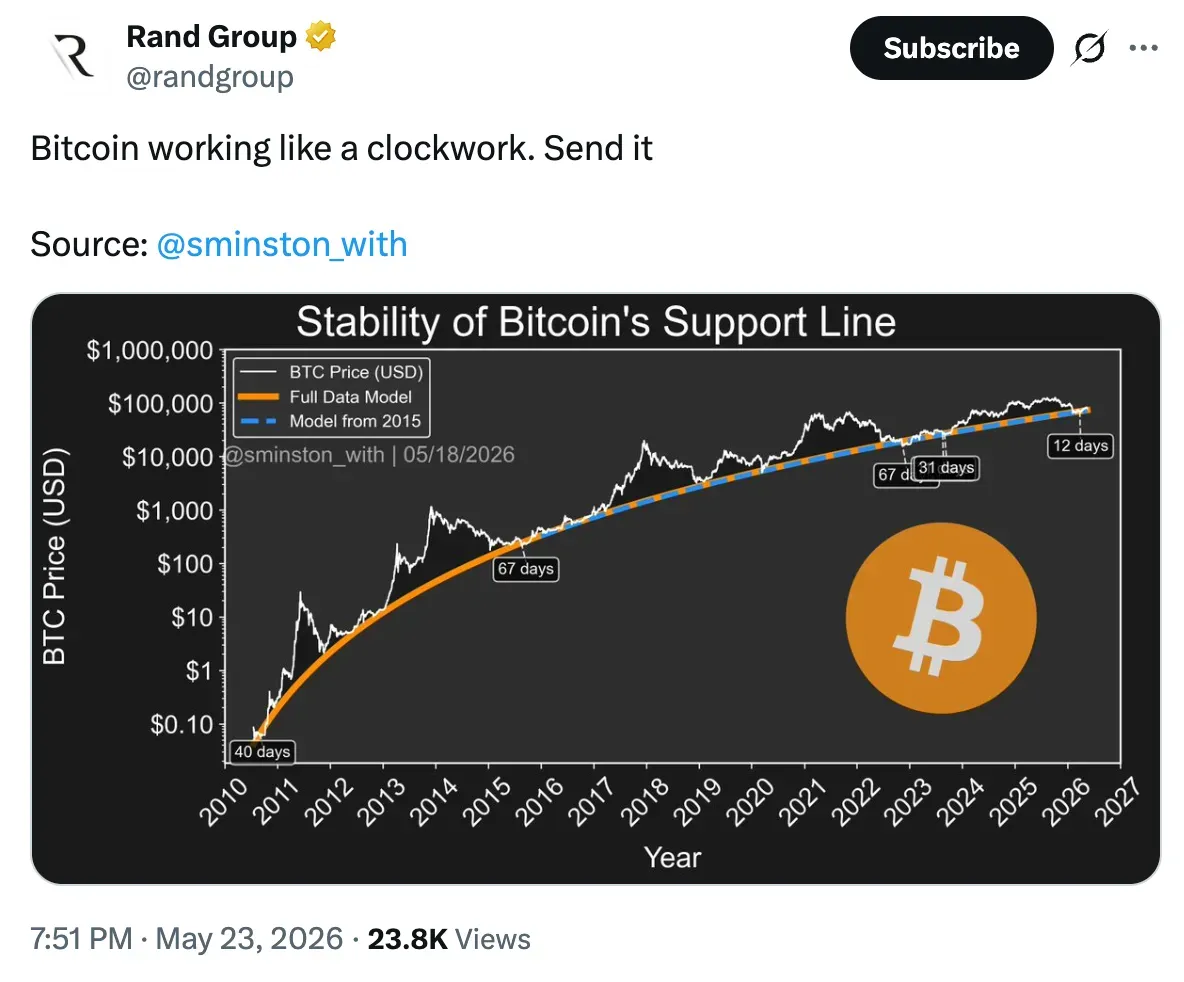
In the 16-year price history of Bitcoin, it has spent less than 220 days total below this long-term support, according to analytics firm Rand Group.
Advertisement|Remove ads.
Bitcoin’s price was trading at $76,904, up by 3% during the past 24 hours. On Stocktwits, the retail sentiment around BTC moved to ‘bearish’ from ‘extremely bearish’ while chatter around it stayed in the ‘normal’ levels during the past day.
Whether today's buyers end up being "bag holders," as Schiff suggests, depends on price action from here. What the data doesn’t support is his asserted mechanism – that whales are distributing to retail in real time.
Read also: AI Agent Drafts SpaceX IPO Memo For Just Over A Dollar, Circle CEO Wants You To Notice The Currency
Advertisement|Remove ads.
For updates and corrections, email newsroom[at]stocktwits[dot]com
Comments posted here will also appear on symbol pages.

Latest News
/filters:format(webp)https://news.stocktwits-cdn.com/large_Getty_Images_2169449321_719241c1ea.jpg)
/filters:format(webp)https://news.stocktwits-cdn.com/unnamed_jpg_9dff551b50.webp) Anan Ashraf·16m ago
Anan Ashraf·16m ago/filters:format(webp)https://news.stocktwits-cdn.com/large_Getty_Images_1688507143_jpg_27b19431c5.webp)
/filters:format(webp)https://news.stocktwits-cdn.com/1707726834303_jpg_11f20a9aa9.webp) Shashank Nayar·21m ago
Shashank Nayar·21m ago/filters:format(webp)https://news.stocktwits-cdn.com/large_Getty_Images_1477909777_206162a09d.jpg) Anan Ashraf·2h ago
Anan Ashraf·2h ago/filters:format(webp)https://news.stocktwits-cdn.com/large_Getty_Images_2264463340_81cfaeb1d1.jpg)
/filters:format(webp)https://news.stocktwits-cdn.com/Anushka_Basu_make_me_smile_in_the_picture_b92832aa_af59_4141_aacc_4180d2241ba8_1_2_png_1086e0ed8c.webp) Anushka Basu·2h ago
Anushka Basu·2h ago/filters:format(webp)https://news.stocktwits-cdn.com/large_Getty_Images_2245498775_8d071f7bc8.jpg) Shashank Nayar·3h ago
Shashank Nayar·3h ago/filters:format(webp)https://news.stocktwits-cdn.com/gettyimages_2281711644_612x612_afdda9ed16.jpg)
/filters:format(webp)https://news.stocktwits-cdn.com/Prabhjote_DP_67623a9828.jpg) Prabhjote Gill·3h ago
Prabhjote Gill·3h ago