


Advertisement|Remove ads.
Peter Schiff Says Michael Saylor's Strategy Is Running A Ponzi Scheme In Plain Sight — And The SEC Is Letting It Happen



- Peter Schiff renewed his criticism of Strategy and its preferred stock offering STRC, calling it a “classic centralized Ponzi.”
- Schiff questioned why the SEC has not intervened over comments made by Michael Saylor regarding STRC’s suitability for retirees.
- Schiff claimed retirees who lose money on STRC could potentially use Saylor’s public comments in lawsuits against Strategy.
Advertisement|Remove ads.
Peter Schiff returned to calling Strategy (MSTR) and its preferred ‘Stretch’ stock (STRC) a “ponzi scheme” on Monday morning in a volley of posts on X, this time asking why the Securities and Exchange Commission (SEC) isn’t taking a stand.
“How can the SEC let Saylor get away with public comments that STRC is suitable for retirees whose primary investment objectives are low-risk wealth preservation and income, and who don't want to risk losing principal?” he wrote in a post on X. “This is a violation of SEC antifraud and marketing rules.”

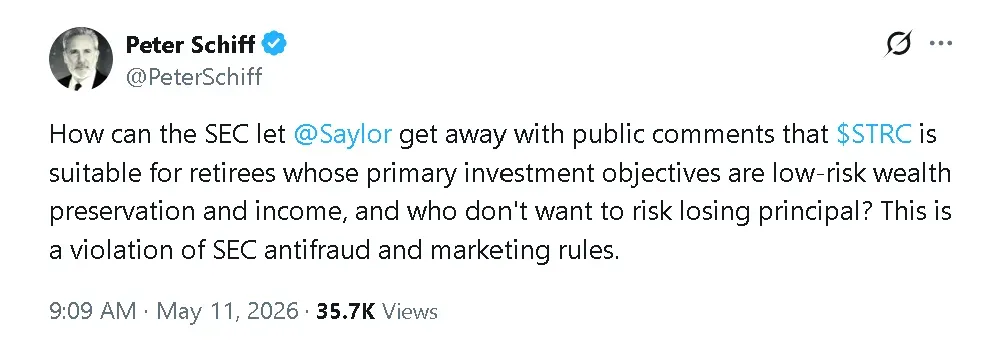
According to him, retirees purchasing STRC could eventually pursue legal action against the company if losses materialize. “Saylor admitted STRC is being bought by retirees whose primary objectives are low-risk wealth preservation and income, and who don't want to risk losing principal,” Schiff wrote. “But STRC is actually high-risk. Saylor's comments will help retirees who lose money win lawsuits against MSTR.”
Advertisement|Remove ads.
How Do Retail Traders Feel About MSTR?
MSTR’s stock gained over 2% in midday trade after the company announced it had bought 535 Bitcoin (BTC) over the past week for around $43 million. On Stocktwits, retail sentiment around the company remained in ‘bullish’ territory over the past day, accompanied by ‘high’ levels of chatter.

Retail traders on the platform forecast that MSTR’s share price could cross $200 this week, betting on Kevin Warch coming in to replace Jerome Powell as the Federal Reserve’s new chair and the CLARITY Act markup in the Senate to provide momentum.
Advertisement|Remove ads.
Bitcoin’s price traded flat in the last 24 hours, struggling to hold above $81,000. Retail sentiment around the apex cryptocurrency rose to ‘bullish’ from ‘neutral’ over the past day, while chatter stayed at ‘normal’ levels.

Schiff Says Saylor Is Marketing Risky Investments To Retirees
Schiff’s criticism focused less on Bitcoin, like in the past, and more on how Strategy is structuring and promoting its preferred securities tied to the company’s crypto holdings.
Advertisement|Remove ads.
Strategy has increasingly leaned on preferred share offerings and capital markets products to fund additional Bitcoin purchases while offering investors alternative ways to gain exposure to the company’s balance sheet strategy. Schiff stated that the issue is not hidden complexity, but rather what he sees as openly acknowledged risk being framed too conservatively.
“The fact that it isn’t hidden is exactly what makes it the most obvious Ponzi scheme ever constructed,” Schiff wrote in another post. He also pushed back against Saylor’s broader defense of Strategy’s approach.

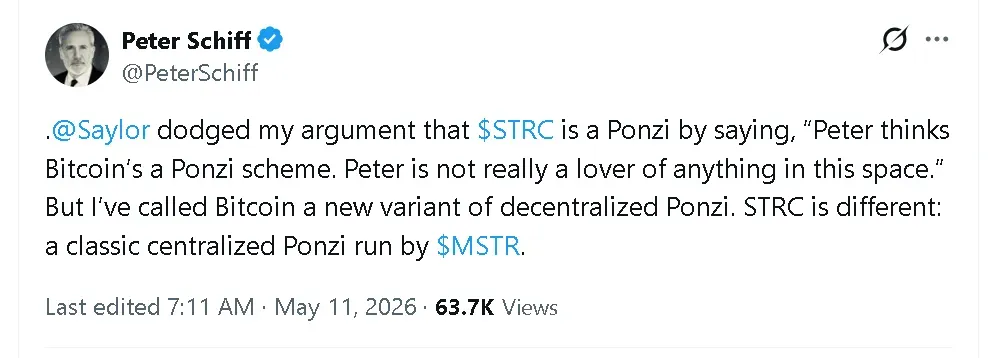
“Saylor dodged my argument that STRC is a Ponzi by saying, ‘Peter thinks Bitcoin’s a Ponzi scheme. Peter is not really a lover of anything in this space,” Schiff wrote, citing a recent podcast Saylor did with Scott Melker, who goes by the name 'The Wolf of All Street' online. “But I’ve called Bitcoin a new variant of decentralized Ponzi. STRC is different: a classic centralized Ponzi run by MSTR.”
Advertisement|Remove ads.
MSTR Stock Outperforms Bitcoin
Strategy remains the world’s largest corporate holder of Bitcoin, with more than 818,000 BTC on its balance sheet. The company has continued raising capital through debt, preferred stock, and equity-linked offerings to finance additional purchases.
Earlier this month, Saylor also stated during Strategy’s first-quarter earnings call that the company may eventually sell Bitcoin if doing so improves shareholder value or strengthens its capital structure. That marked a notable shift from his longstanding “never sell” rhetoric around Bitcoin holdings.
MSTR’s stock has gained over 20% this year, while Bitcoin's price has fallen over 7%.
Advertisement|Remove ads.
Read also: MARA, CLSK Stocks Face Earnings Test After Last Week’s AI-Fueled Rally: Retail Sentiment Diverges
For updates and corrections, email newsroom[at]stocktwits[dot]com
Comments posted here will also appear on symbol pages.

Latest News
/filters:format(webp)https://news.stocktwits-cdn.com/large_amzn_gsat_6c81fe2339.jpg)
/filters:format(webp)https://news.stocktwits-cdn.com/IMG_8805_JPG_6768aaedc3.webp) Deepti Sri·19m ago
Deepti Sri·19m ago/filters:format(webp)https://news.stocktwits-cdn.com/large_Getty_Images_1233526690_aefd63f087.jpg)
/filters:format(webp)https://news.stocktwits-cdn.com/shivani_photo_jpg_dd6e01afa4.webp) Shivani Kumaresan·21m ago
Shivani Kumaresan·21m ago/filters:format(webp)https://news.stocktwits-cdn.com/large_Getty_Images_2227231546_jpg_166eaa38da.webp)
/filters:format(webp)https://news.stocktwits-cdn.com/Aashika_Suresh_Profile_Picture_jpg_2acd6f446c.webp) Aashika Suresh·36m ago
Aashika Suresh·36m ago/filters:format(webp)https://news.stocktwits-cdn.com/large_Getty_Images_2294813618_32d1c72fa2.jpg) Aashika Suresh·1h ago
Aashika Suresh·1h ago/filters:format(webp)https://news.stocktwits-cdn.com/large_michael_burry_cropped_b787ce89b4.jpg)
/filters:format(webp)https://news.stocktwits-cdn.com/1707726834303_jpg_11f20a9aa9.webp) Shashank Nayar·2h ago
Shashank Nayar·2h ago/filters:format(webp)https://news.stocktwits-cdn.com/gettyimages_2267701500_594x594_1cfbb8b517.jpg) Shashank Nayar·2h ago
Shashank Nayar·2h ago