


Advertisement|Remove ads.
Ray Dalio Calls Bitcoin ‘Money,’ Then Lists The Reasons It Falls Short As A Store of Wealth
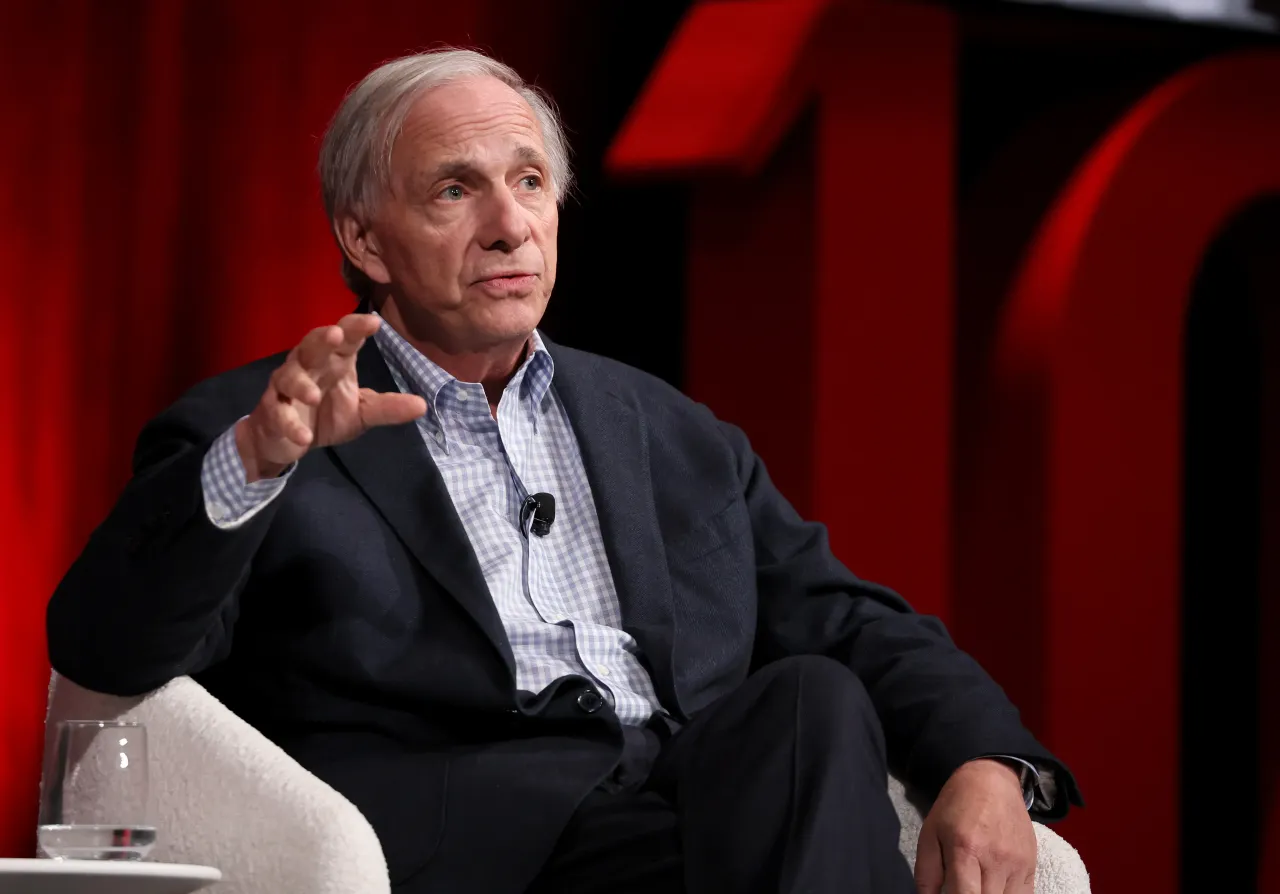


- Dalio said that Bitcoin’s transparency allows governments to monitor transactions, creating potential regulatory risks.
- He also warned that technological risks could compromise Bitcoin, comparing it to synthetic diamonds or gold substitutes.
- Despite his concerns, Dalio said holds a small amount of Bitcoin, primarily as a hedge rather than a core portfolio asset.
Advertisement|Remove ads.
Billionaire investor Ray Dalio, known for his gold-centric investment philosophy, acknowledged Bitcoin (BTC) as a form of money but outlined why it remains an imperfect substitute for gold in a weekend podcast conversation with Zerodha founder Nithin Kamath.
Dalio described Bitcoin as a limited-supply asset with growing perception as a store of value. “Bitcoin is limited in supply and its perception of money,” he said. “It is a form of money.” However, he noted several structural and practical drawbacks that, in his view, prevent Bitcoin from functioning as a fully reliable vehicle for storing wealth alongside gold.

Gold’s price hit a fresh record high of over $4,400 per ounce on Sunday night, according to TradingView. The SPDR Gold Share ETF (GLD) was the top trending ticker on Stocktwits, with retail sentiment trending in ‘neutral’ territory over the past day amid ‘high’ levels of chatter.
Advertisement|Remove ads.
Meanwhile, Bitcoin’s price on Sunday night was around 30% below its record high of over $126,000 seen in October. The apex cryptocurrency was trading at around $88,900, up 0.9% in the last 24 hours. Retail sentiment around BTC on Stocktwits was trending in the ‘extremely bearish’ zone over the past day, with chatter at ‘low’ levels.
Transparency And Regulatory Concerns
Dalio highlighted Bitcoin’s transparency as a potential vulnerability. Since blockchain transactions are publicly recorded, governments can monitor activity, which he argued could lead to interference. He added that gold does not face this issue.
“Gold is the only asset authorities can’t mess with and control.”
– Ray Dalio, Founder, Bridgewater Associates
He also raised concerns over technological risks, suggesting Bitcoin could theoretically be “cracked, broken, or controlled,” drawing parallels to synthetic diamonds or gold substitutes.
Advertisement|Remove ads.
Bitcoin As A Hedge, Not A Core Holding
Despite these concerns, Dalio reiterated he holds “a little bit” of Bitcoin, positioning it as a hedge rather than a central portfolio asset. He did not disclose exact allocations during the podcast, emphasizing that portfolio construction depends on the broader mix of assets and the role each plays.
In his framework, Bitcoin exists in a separate category designed to store wealth outside traditional financial systems. However, in an interview with CNBC earlier this year, Dalio had disclosed that around 1% of his portfolio is allocated to Bitcoin.
Gold, according to Dalio, remains the cornerstone of nontraditional wealth preservation. He reiterated that he generally considers a 5% to 15% allocation to gold appropriate. By contrast, stablecoins, which are often pegged to fiat currencies, serve primarily as transactional tools rather than reliable stores of value, due to their lack of inherent yield, Dalio said.
Advertisement|Remove ads.
Read also: Michael Saylor Puts ‘Green Dots’ Spin To Orange Dots Signal Ahead Of Possible Weekly Bitcoin Buy
For updates and corrections, email newsroom[at]stocktwits[dot]com.
Comments posted here will also appear on symbol pages.

Latest News
/filters:format(webp)https://news.stocktwits-cdn.com/gettyimages_2267701500_594x594_1cfbb8b517.jpg)
/filters:format(webp)https://news.stocktwits-cdn.com/1707726834303_jpg_11f20a9aa9.webp) Shashank Nayar·24m ago
Shashank Nayar·24m ago/filters:format(webp)https://news.stocktwits-cdn.com/large_Getty_Images_1503993596_8deb3f6bd9.jpg)
/filters:format(webp)https://news.stocktwits-cdn.com/unnamed_jpg_9dff551b50.webp) Anan Ashraf·26m ago
Anan Ashraf·26m ago/filters:format(webp)https://news.stocktwits-cdn.com/large_Getty_Images_2247481493_2752b5d809.jpg)
/filters:format(webp)https://news.stocktwits-cdn.com/Prabhjote_DP_67623a9828.jpg) Prabhjote Gill·1h ago
Prabhjote Gill·1h ago/filters:format(webp)https://news.stocktwits-cdn.com/large_Getty_Images_1411089032_84de9393bb.jpg) Shashank Nayar·1h ago
Shashank Nayar·1h ago/filters:format(webp)https://news.stocktwits-cdn.com/large_Getty_Images_507531870_jpg_6497bb5caf.webp)
/filters:format(webp)https://news.stocktwits-cdn.com/vivekkrishnanphotography_58_jpg_0e45f66a62.webp) Arnab Paul·1h ago
Arnab Paul·1h ago/filters:format(webp)https://news.stocktwits-cdn.com/large_Getty_Images_1358625679_989f4bbe75.jpg) Anan Ashraf·1h ago
Anan Ashraf·1h ago