


Advertisement|Remove ads.
Senator Calls For Ban On Insider Trading After US Strike On Iran Generated $1.2 Million
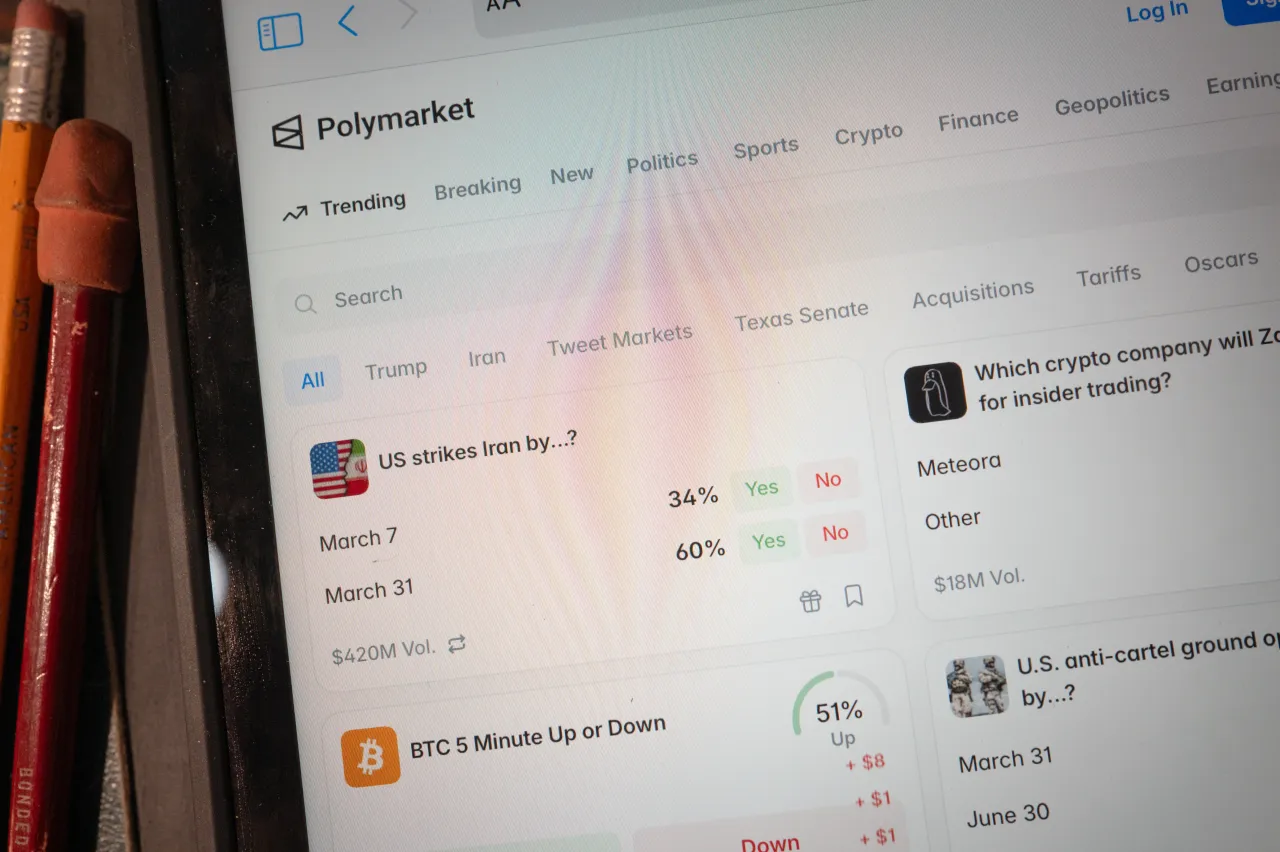


- Senator Chris Murphy said he will introduce legislation banning betting on military actions following suspicious trades in Iran strike contracts.
- Bubblemaps identified six wallets that collectively made about $1.2 million on Polymarket contracts tied to the strike.
- Public trading records show several accounts bought “Yes” shares shortly before the event and later redeemed large profits.
Advertisement|Remove ads.
Democrat Senator Chris Murphy said on Saturday that he would introduce legislation to ban betting on military actions after traders made significant profits on Polymarket ahead of a U.S. strike on Iran.
Murphy, who represents Connecticut, said on X that people were “profiting off war and death” and that he would be drafting a bill “ASAP” to prevent markets from allowing wagers tied to armed conflict.
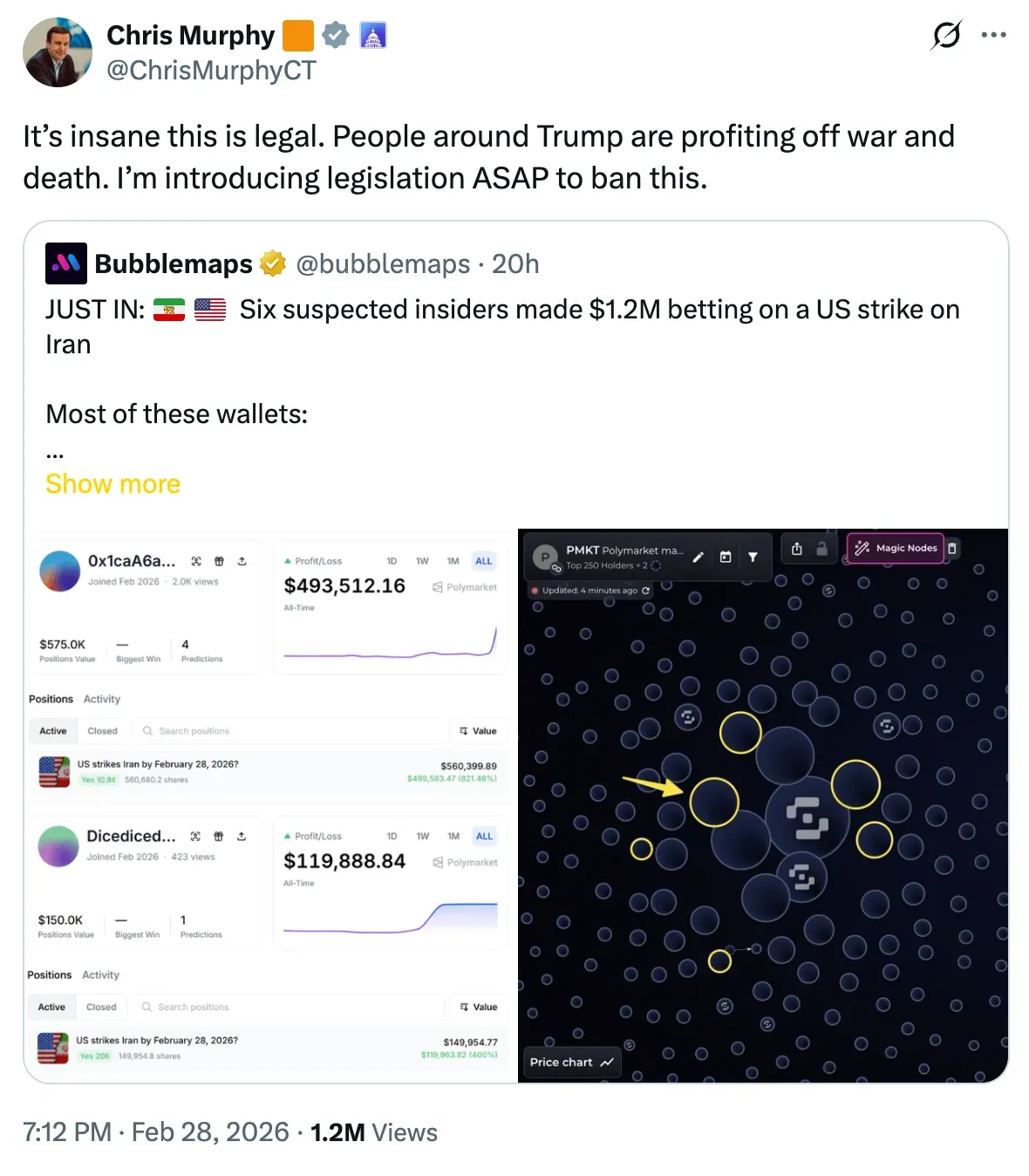
His comments came after Bubblemaps, a blockchain analytics firm, highlighted concentrated betting activity placed shortly before the strike.
Advertisement|Remove ads.
$1.2 Million In Polymarket Trades Flagged
Bubblemaps identified six wallets that collectively generated roughly $1.2 million betting on the Polymarket contract titled “US strikes Iran by February 28, 2026?” According to the firm, most of the wallets were funded within 24 hours and accumulated “Yes” positions hours before the strike occurred.
Public Polymarket profiles show detailed transaction histories. The account labeled “Anon” bought approximately $10,000 worth of “Yes” shares at around 18¢ and later redeemed about 55,555 shares for more than $55,000.
Another profile, "dicedicedice," showed nearly $150,000 redeemed from the same contract. Adding to this, a separate account displayed more than $119,000 in profit over the past month, with activity concentrated around the Iran strike market.
Advertisement|Remove ads.
Adding to the scrutiny, US Congress representative Mike Levin pointed to another Polymarket account called “Magamyman,” which made more than $515,000 in a single day betting on the strike. Levin wrote that the account’s first trade was placed 71 minutes before the news became public and that roughly $87,000 was turned into more than half a million dollars overnight.
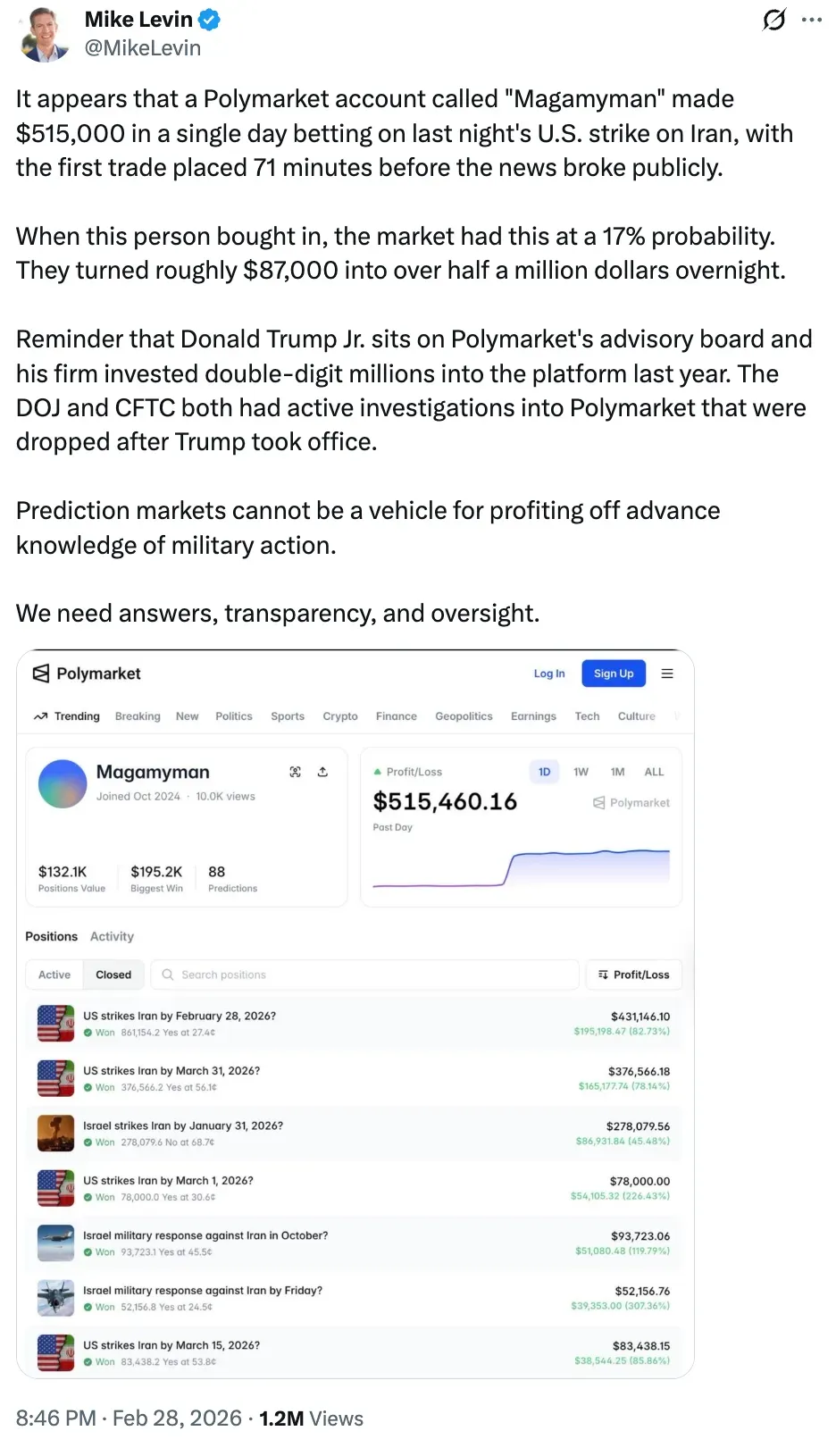
Levin also noted that President Trump was on Polymarket’s advisory board and that his firm invested double-digit millions into the platform last year. He further referenced prior DOJ and CFTC investigations into Polymarket that were later dropped.
Growing Scrutiny Of Prediction Markets
Murphy’s proposed legislation came amid increasing political attention on prediction markets, particularly those tied to sensitive geopolitical events.
Advertisement|Remove ads.
Last month, several Democratic lawmakers co-sponsored the Public Integrity in Financial Prediction Markets Act of 2026, which would prohibit elected officials from trading contracts tied to policies under their control.
The Polymarket contract centered on escalating tensions between the United States and Iran. The strike followed heightened rhetoric from former President Donald Trump, who had warned of potential military action if Iran did not curb its nuclear ambitions. Reports of coordinated U.S. and Israeli military activity intensified speculation in global markets, with crypto assets reacting sharply during the escalation.
CFTC Stands By Prediction Markets
Mike Selig of the CFTC said that the agency filed an amicus curiae brief in support of prediction markets to protect its unique regulatory power in the face of a rise in state-level lawsuits. Selig said that event contracts are not gambling laws, but rather federally regulated derivatives laws. He said that making federal oversight weaker could hurt the integrity of the market, make it harder to protect investors, and damage the United States' reputation as a global financial leader.
Advertisement|Remove ads.
For updates and corrections, email newsroom[at]stocktwits[dot]com.
Comments posted here will also appear on symbol pages.

Latest News
/filters:format(webp)https://st-everywhere-cms-prod.s3.us-east-1.amazonaws.com/large_beth_hammack_resized_645b41c5a8.jpg)
/filters:format(webp)https://news.stocktwits-cdn.com/1707726834303_jpg_11f20a9aa9.webp) Shashank Nayar·8m ago
Shashank Nayar·8m ago/filters:format(webp)https://news.stocktwits-cdn.com/large_Getty_Images_2245369615_jpg_bc439cb4c1.webp)
/filters:format(webp)https://news.stocktwits-cdn.com/Heera_1_1c30cb0170.PNG) Heera Hari·47m ago
Heera Hari·47m ago/filters:format(webp)https://news.stocktwits-cdn.com/gettyimages_2296214136_594x594_1_ed9bb6d607.jpg) Shashank Nayar·52m ago
Shashank Nayar·52m ago/filters:format(webp)https://st-everywhere-cms-prod.s3.us-east-1.amazonaws.com/boeing_777x_6236952182.jpeg) Heera Hari·1h ago
Heera Hari·1h ago/filters:format(webp)https://st-everywhere-cms-prod.s3.us-east-1.amazonaws.com/large_regeneron_logo_resized_ff9d5819f7.jpg)
/filters:format(webp)https://news.stocktwits-cdn.com/vivekkrishnanphotography_58_jpg_0e45f66a62.webp) Arnab Paul·1h ago
Arnab Paul·1h ago/filters:format(webp)https://news.stocktwits-cdn.com/large_Getty_Images_2279844042_ca48b68602.jpg)
/filters:format(webp)https://news.stocktwits-cdn.com/Anushka_Basu_make_me_smile_in_the_picture_b92832aa_af59_4141_aacc_4180d2241ba8_1_2_png_1086e0ed8c.webp) Anushka Basu·1h ago
Anushka Basu·1h ago