


Advertisement|Remove ads.
Tom Lee Said Crypto Winter Will End In April — Clock’s Ticking, Bitcoin Isn’t


- Bitcoin hovered near $66,000, down 24% year-to-date, as Tom Lee’s April “crypto winter” end prediction nears its deadline.
- Lee’s earlier call for a March rally in Bitcoin and Ethereum has not materialized, with both assets remaining under pressure.
- Bitcoin is on track for a rare three-month losing streak to start 2026, with risks of matching its longest downturn since 2018.
Advertisement|Remove ads.
Bitcoin (BTC) was trading around the $66,000 level on Sunday, down by 24% year-to-date, and with April just two days away, a key prediction by Fundstrat's Tom Lee is running out of time.
In February, Fundstrat co-founder Tom Lee had said in an interview that the “crypto winter” would end by April at the latest. In early March, when Bitcoin was trading near $65,000 and Ethereum (ETH) near $1,900, Lee also predicted that both assets would rally throughout the month.
However, with March ending in two days, neither prediction has played out. Bitcoin ended March close to where it started, and Ethereum remained under pressure.
Advertisement|Remove ads.
Bitcoin dropped over 6% last week alone, sliding from $72,000 to $66,000, as roughly $17 billion in digital asset options expired on Friday and approximately $300 million in long positions were liquidated in a single day.
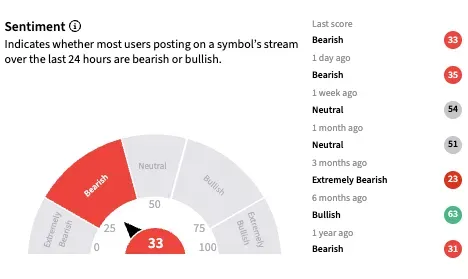
Bitcoin's price was trading at $66,504, down by 0.3% over 24 hours. On Stocktwits, the retail sentiment around Bitcoin moved from ‘extremely bearish’ to ‘bearish’ as chatter levels around it declined from ‘normal’ to ‘low’ over the past day.
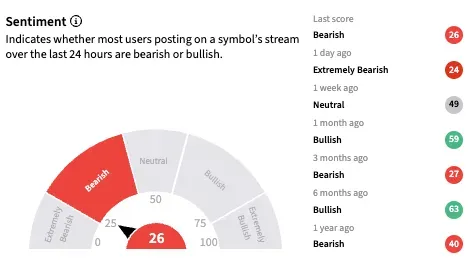
Ethereum's price was also trading down by 1.3% over 24 hours. On Stocktwits, the retail sentiment around Ethereum remained in the ‘bearish’ territory, as chatter levels around it remained ‘normal’ over the past day.
Advertisement|Remove ads.
Why This Cycle Is Different?
Crypto analyst Benjamin Cowen offered a different framework on Friday, in the debut episode of “Blockchain 100,” by Binance (BNB). Cowen said this cycle was the first in Bitcoin's four-year cycle history in which it “topped on apathy rather than euphoria,” meaning retail participation, speculative activity, and social engagement never reached historically elevated levels, even as Bitcoin made new highs.
He said the last time Bitcoin topped out on apathy was in 2019, and attributed the dynamic to monetary policies and macroeconomic conditions.
Bitcoin In Danger Of Its Longest Losing Streak In History
Bitcoin closed January down over 10%, February down over 14%, and March down 0.57%, according to Coinglass data, putting it on track for its first-ever three consecutive monthly losses at the start of a year. If the losing streak extended through April, Bitcoin would match its longest monthly losing streak in history, set between August 2018 and January 2019.
Advertisement|Remove ads.
The end of March also marked the close of the first quarter of 2026, Bitcoin's worst first quarter in recent memory, having fallen nearly 48% from its October 2025 peak above $126,000.
However, despite the difficult quarter, historical data offered some relief. Every year Bitcoin has posted a full-year loss since 2013, the recovery that followed was sharp. After 2014's decline, it rebounded 35% after 2018, it rallied 95% and after the 2022 bear market, it surged 156%, averaging a roughly 95% bounce.
Whether Lee's April prediction still has room to prove out remains to be seen.
Advertisement|Remove ads.
Read also: Peter Schiff Slams Bitcoin-Backed Mortgages As Coinbase, Better Roll Out New Product
For updates and corrections, email newsroom[at]stocktwits[dot]com.
Comments posted here will also appear on symbol pages.

Latest News
/filters:format(webp)https://news.stocktwits-cdn.com/large_Getty_Images_2188532140_jpg_1eb152a875.webp)
/filters:format(webp)https://news.stocktwits-cdn.com/Anushka_Basu_make_me_smile_in_the_picture_b92832aa_af59_4141_aacc_4180d2241ba8_1_2_png_1086e0ed8c.webp) Anushka Basu·6h ago
Anushka Basu·6h ago/filters:format(webp)https://news.stocktwits-cdn.com/large_Getty_Images_2290360640_1ec7422bc6.jpg) Anushka Basu·8h ago
Anushka Basu·8h ago/filters:format(webp)https://news.stocktwits-cdn.com/large_Getty_Images_2184298752_597d0bfcd2.jpg) Anushka Basu·10h ago
Anushka Basu·10h ago/filters:format(webp)https://st-everywhere-cms-prod.s3.us-east-1.amazonaws.com/large_charles_schwab_resized_79fd4282b7.jpg) Anushka Basu·12h ago
Anushka Basu·12h ago/filters:format(webp)https://news.stocktwits-cdn.com/large_Getty_Images_1236413131_82e1a6f16e.jpg) Anushka Basu·13h ago
Anushka Basu·13h ago/filters:format(webp)https://news.stocktwits-cdn.com/large_Getty_Images_2255514431_jpg_95e96b4025.webp)
/filters:format(webp)https://st-everywhere-cms-prod.s3.us-east-1.amazonaws.com/i_OS_App_Icon_1_8054f2a2fe.png) Stocktwits News Desk·13h ago
Stocktwits News Desk·13h ago