


Advertisement|Remove ads.
ABVX Stock Clocks Worst Day Ever On Malignancy Signal For Drug: ‘Pharma Bro’ Says ‘GLPs Are Doing Fine’ After Similar Fears



- Martin Shkreli noted that similar fears of cancer risk previously existed in association with GLP-1 class drugs.
- Abivax said on Monday that these cancer events were rare, consistent with expected age-related risks, and largely unrelated to the drug.
- Multiple analysts, including Jefferies and Wedbush, slashed their price targets on ABVX following the trial data.
Advertisement|Remove ads.
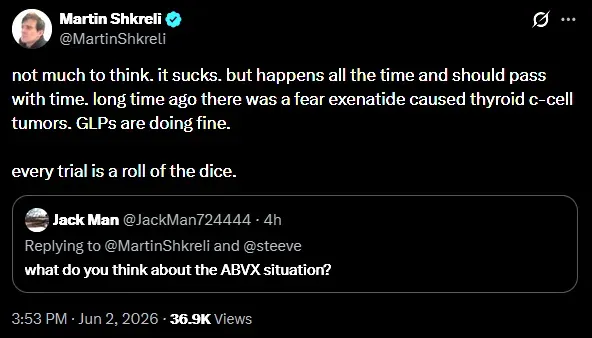
Martin Shkreli, popularly dubbed ‘Pharma Bro,’ on Tuesday dismissed concerns pertaining to cancer risks that led to a sharp decline in shares of Abivax SA (ABVX) following the release of late-stage trial data for its ulcerative colitis candidate obefazimod.
In a post on X, Shkreli shared his thoughts on the ‘ABVX situation’ and wrote, “not much to think. it sucks. but happens all the time and should pass with time. long time ago there was a fear exenatide caused thyroid c-cell tumors. GLPs are doing fine. every trial is a roll of the dice.”
Advertisement|Remove ads.
Exenatide, referenced by Shkreli, was the first GLP-1 class drug, marketed as Byetta. Shkreli was pointing to a historical precedent in which early safety signals involving thyroid C-cell tumors in animal studies raised concerns, yet the drug class ultimately gained broad acceptance and commercial success. Today, GLP-1s like Ozempic and Mounjaro are among the biggest blockbusters in obesity care.
Shkreli is a former hedge-fund manager and pharmaceutical executive who became known in 2015 as CEO of Turing Pharmaceuticals for raising the price of the antiparasitic drug Daraprim by more than 5,000%.
ABVX’s Downward Slump
Shares of ABVX closed down 44% on Tuesday, clocking its worst day ever, after it reported top-line results from the 580-patient late-stage ulcerative colitis trial showing that roughly 51% of patients on either the 25 mg or 50 mg dose of obefazimod achieved clinical remission at week 44, compared with 10.4% on placebo. The drug also met all key secondary endpoints, including endoscopic healing, histologic improvement, and sustained symptom relief without steroids.
Advertisement|Remove ads.
The stock dropped on reports of a number of non-melanoma skin cancers and other malignancies, primarily in patients over age 60 in the higher-dose arm. Abivax stated that these events were rare, consistent with expected age-related risks, and largely unrelated to the drug. The company said safety was otherwise favorable and that it remains on track to file for FDA approval of obefazimod in ulcerative colitis by late 2026.
Wall Street Weighs In
Jefferies responded to the trial data by downgrading Abivax to ‘Hold’ from ‘Buy’ and slashing the price target to $90 from $160, a 30% potential downside from the stock’s closing price on Monday.
Analyst Faisal Khurshid noted that while the study delivered the best-in-class efficacy, the cancer signal “complicates matters,” according to The Fly.
Advertisement|Remove ads.
Khurshid noted that the “overhang will be real” and investor concerns could persist since no major data catalysts are expected over the next year.
Meanwhile, Wedbush upgraded Abivax to 'Neutral' from 'Underperform' with a price target of $90, down from $110. Wedbush views the cancer cases observed in the trial as increasing the risk of an eventual black box warning and as creating hurdles to FDA approval. A black box warning on drugs indicates that the product carries a significant risk of severe, life-threatening, or permanently disabling adverse effects.
How Did ABVX Retail Traders React?
On Stocktwits, retail sentiment around ABVX stayed within the ‘extremely bullish’ over the past 24 hours, while message volume remained at ‘extremely high’ levels.
Advertisement|Remove ads.
ABVX stock has soared nearly 1000% over the past 12 months.
Read More: VKTX Eyes Worst Week Since November As Trial Data Looms — Wall Street Still Sees 200% Upside
For updates and corrections, email newsroom[at]stocktwits[dot]com.
Advertisement|Remove ads.
Comments posted here will also appear on symbol pages.

Latest News
/filters:format(webp)https://news.stocktwits-cdn.com/large_nio_stock_62c18a2276.jpg)
/filters:format(webp)https://news.stocktwits-cdn.com/IMG_8805_JPG_6768aaedc3.webp) Deepti Sri·23m ago
Deepti Sri·23m ago/filters:format(webp)https://news.stocktwits-cdn.com/large_cathiewood_OG_jpg_a3c8fddb3f.webp)
/filters:format(webp)https://news.stocktwits-cdn.com/shivani_photo_jpg_dd6e01afa4.webp) Shivani Kumaresan·25m ago
Shivani Kumaresan·25m ago/filters:format(webp)https://news.stocktwits-cdn.com/large_Getty_Images_2285062936_jpg_bdb92d3f40.webp)
/filters:format(webp)https://news.stocktwits-cdn.com/Aashika_Suresh_Profile_Picture_jpg_2acd6f446c.webp) Aashika Suresh·29m ago
Aashika Suresh·29m ago/filters:format(webp)https://news.stocktwits-cdn.com/large_musk_jpg_a119402ac5.webp) Deepti Sri·1h ago
Deepti Sri·1h ago/filters:format(webp)https://news.stocktwits-cdn.com/large_Getty_Images_2252639150_jpg_443c4f690e.webp)
/filters:format(webp)https://news.stocktwits-cdn.com/IMG_9209_1_d9c1acde92.jpeg) Yuvraj Malik·1h ago
Yuvraj Malik·1h ago/filters:format(webp)https://news.stocktwits-cdn.com/large_Getty_Images_2275396018_jpg_a205b2aecb.webp) Aashika Suresh·2h ago
Aashika Suresh·2h ago