


Advertisement|Remove ads.
Arm CEO Haas Reportedly Says Blocking AI CPU Shipments To China Would Be Difficult – ‘CPUs Are Kind Of Like Oil Relative To The Application Space’
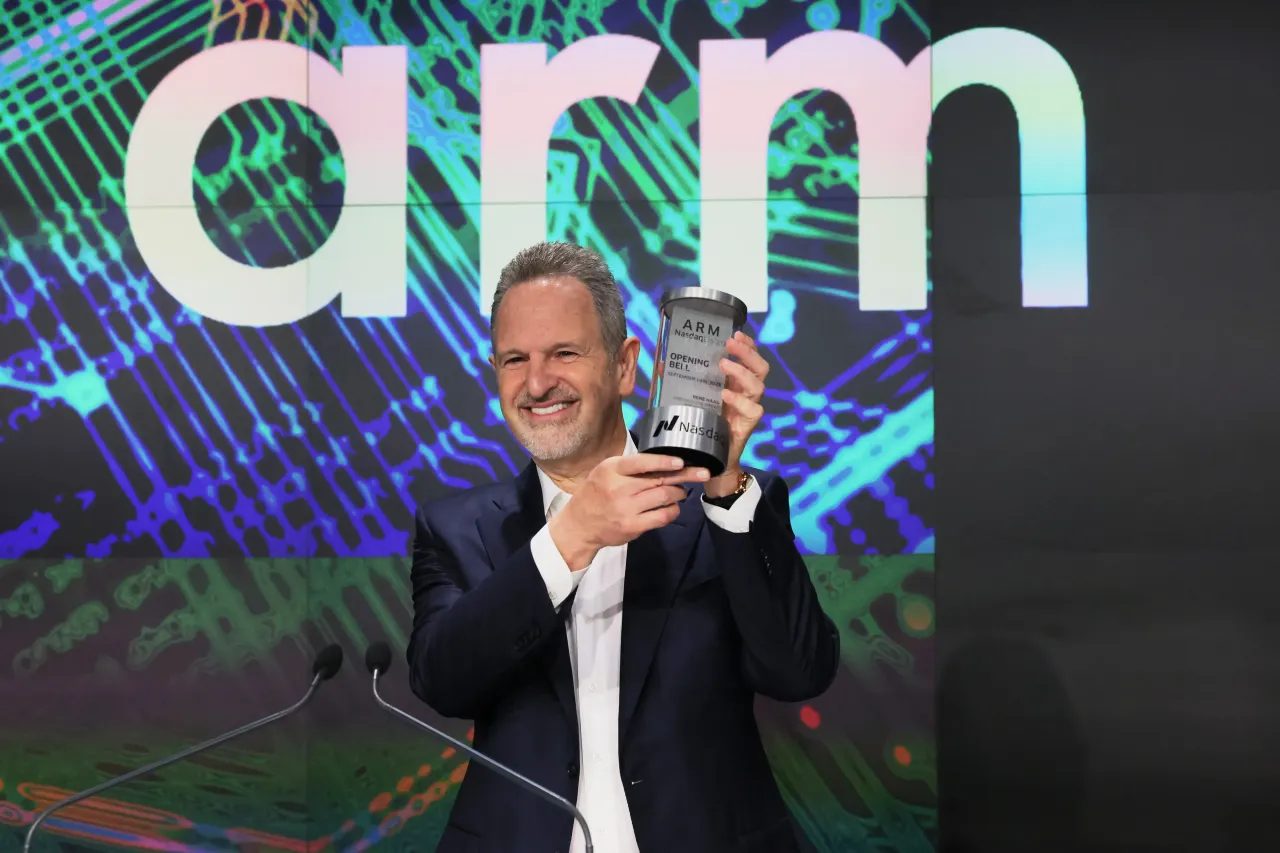


- Haas said the U.S. would have to limit “everything," and that although the country could attempt to do so, it was a harder area to control than AI chips.
- While the U.S. seeks to curb chip exports, China aims to reduce dependence and ramp up local production.
- Arm expects annual revenue from data center chips to be about $15 billion in about five years, the report said.
Advertisement|Remove ads.
Rene Haas, the CEO of chip designer and manufacturer Arm Holdings (ARM), reportedly said it would be tough to restrict exports of artificial intelligence CPUs to China because of their widespread use.
His commentary comes amid Arm’s significant AGI CPU deals with ByteDance and Oracle on Tuesday. "CPUs are kind of like oil relative to the application space," Haas said in an interview with Reuters. "That's a pretty hardcore cut.”
He noted that banning AI CPUs would be nearly impossible due to the challenge of setting precise performance and memory bandwidth limits, which are possible with graphics processing units (GPUs) made by Nvidia (NVDA), according to the report.
Advertisement|Remove ads.
"They would have to limit everything," he said, adding that the U.S. could attempt to do so, but it was a harder area to control than AI chips.
Arm expects annual revenue from data center chips to be about $15 billion in about five years, the report said.
National Security Concerns
The United States and China are highly skeptical of each other, especially regarding artificial intelligence and semiconductor technology, due to national security concerns. While the U.S. seeks to curb chip exports, China aims to reduce dependence and ramp up local production by supporting chipmakers such as Huawei and Cambricon.
Advertisement|Remove ads.
Ahead of the recently held Trump-Xi summit, Beijing restricted Chinese firms from using throttled-down versions of flagship Nvidia gaming chips, even though they were cleared for sale by the U.S.
What Do Retail Traders Think About ARM
On Stocktwits, retail sentiment about ARM stock turned ‘bullish’ from ‘neutral’ over the last 24 hours.
ARM stock has nearly quadrupled in value so far this year and has more than tripled over the past 12 months, outperforming the benchmark S&P Index, the VanEck Semiconductor ETF (SMH), and the iShares Semiconductor ETF (SOXX).
Advertisement|Remove ads.
For updates and corrections, email newsroom[at]stocktwits[dot]com.
Comments posted here will also appear on symbol pages.

Latest News
/filters:format(webp)https://news.stocktwits-cdn.com/large_rocketlab_jpg_fcfa5bb73e.webp)
/filters:format(webp)https://news.stocktwits-cdn.com/IMG_8805_JPG_6768aaedc3.webp) Deepti Sri·42m ago
Deepti Sri·42m ago/filters:format(webp)https://news.stocktwits-cdn.com/large_Getty_Images_2271642541_ab87f34621.jpg)
/filters:format(webp)https://news.stocktwits-cdn.com/shivani_photo_jpg_dd6e01afa4.webp) Shivani Kumaresan·52m ago
Shivani Kumaresan·52m ago/filters:format(webp)https://news.stocktwits-cdn.com/large_Getty_Images_2287935617_5bb7464608.jpg)
/filters:format(webp)https://news.stocktwits-cdn.com/IMG_9209_1_d9c1acde92.jpeg) Yuvraj Malik·1h ago
Yuvraj Malik·1h ago/filters:format(webp)https://news.stocktwits-cdn.com/large_cybercab_1e0d2cc35c.jpg) Deepti Sri·2h ago
Deepti Sri·2h ago/filters:format(webp)https://st-everywhere-cms-prod.s3.us-east-1.amazonaws.com/large_Devon_resized_c7feccfbce.jpg)
/filters:format(webp)https://news.stocktwits-cdn.com/Aashika_Suresh_Profile_Picture_jpg_2acd6f446c.webp) Aashika Suresh·2h ago
Aashika Suresh·2h ago/filters:format(webp)https://news.stocktwits-cdn.com/large_Getty_Images_2212802248_6a6b0f346d.jpg) Yuvraj Malik·2h ago
Yuvraj Malik·2h ago