


Advertisement|Remove ads.
Coinbase CEO Calls AWS Outage ‘Never Acceptable’ — Exposes Infrastructure Gaps After Data Center Overheats
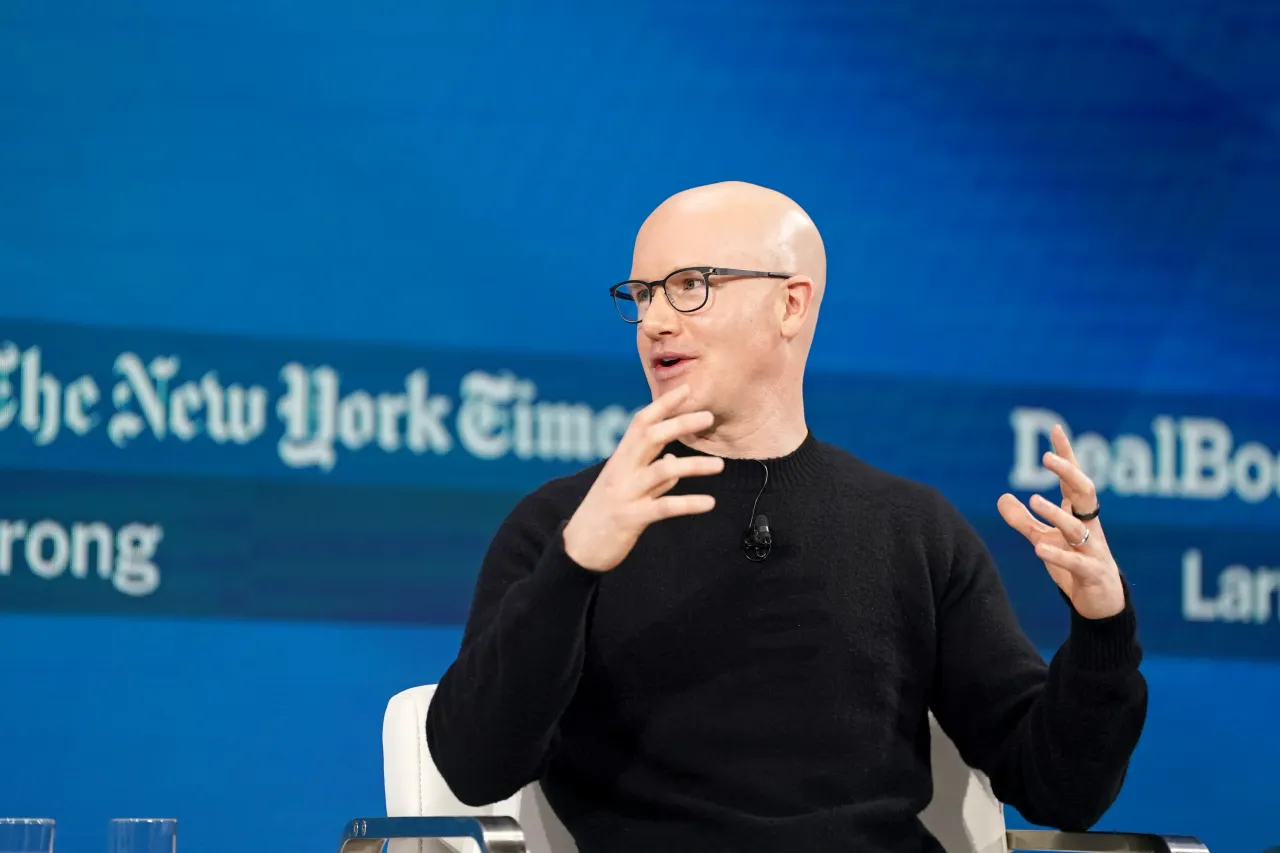


- Brian Armstrong said on Friday that failed Amazon Web Services chillers triggered the Coinbase outage.
- Coinbase said some systems failed to withstand a disruption in an Amazon Web Services Availability Zone.
- The outage came days after Coinbase cut roughly 700 jobs and expanded artificial intelligence automation efforts.
Advertisement|Remove ads.
Coinbase (COIN) Chief Executive Officer (CEO) Brian Armstrong said on Friday that an overheating incident at an Amazon Web Services (AWS) data center exposed limitations in parts of the company’s exchange infrastructure, after a major outage disrupted trading activity.
“The root cause was a room overheating in an AWS datacenter when multiple chillers failed,” Armstrong said on X, adding that while Coinbase designs systems to remain operational during a single AWS Availability Zone failure, “most of our systems worked this way last night, but not all.”
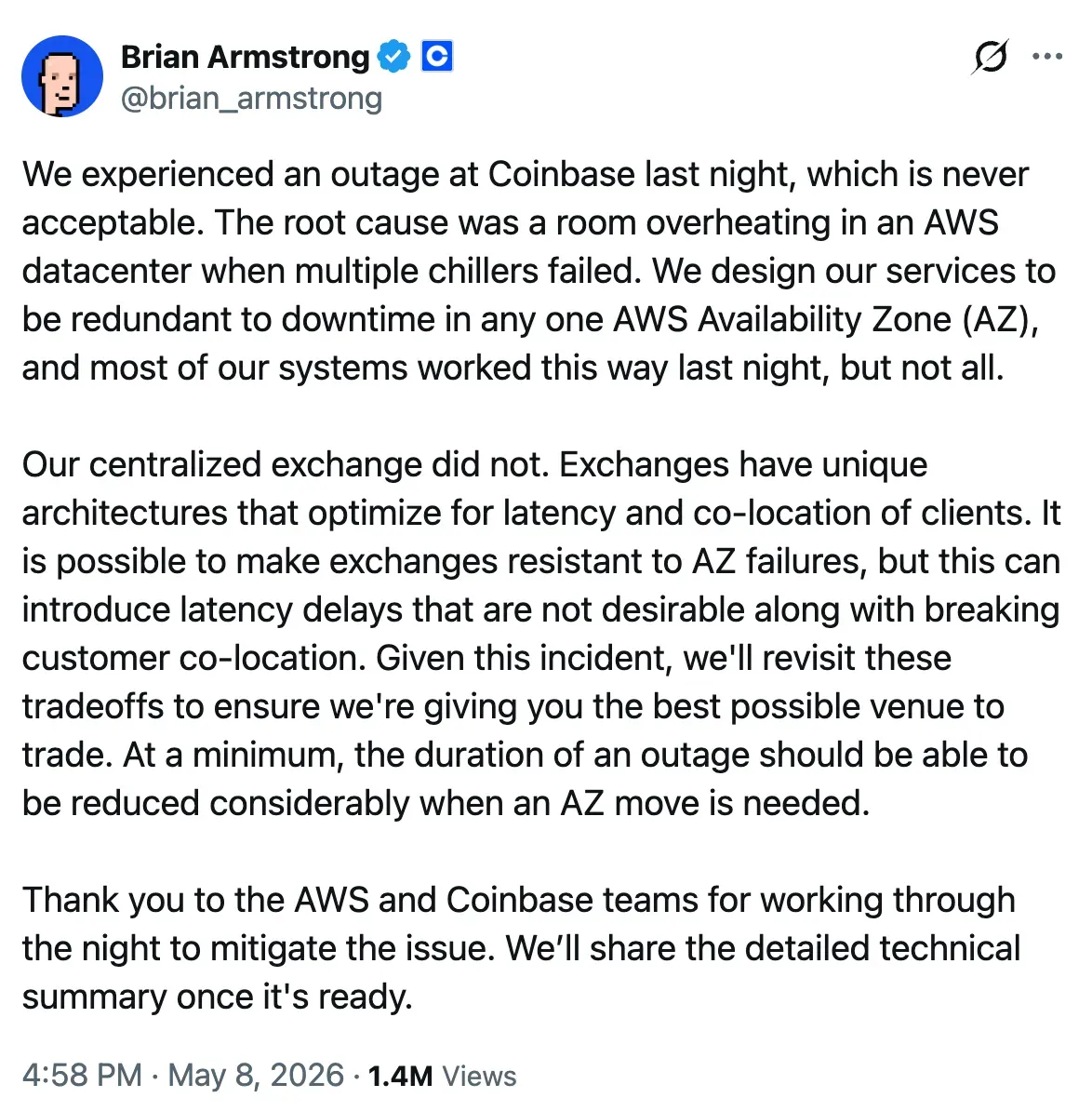
Armstrong said Coinbase’s centralized exchange infrastructure relies on architectures optimized for latency and customer co-location, noting that fully insulating exchange systems from Availability Zone failures can introduce “latency delays that are not desirable” and disrupt customer co-location setups. He said the company would revisit those trade-offs following the incident and work to reduce the duration of future outages associated with Availability Zone migrations.
Advertisement|Remove ads.
COIN’s stock was down by 0.18% during after-hours trading, after closing up over 4% on Friday. On Stocktwits, the retail sentiment around COIN stayed in the ‘bullish’ zone, while chatter around it moved to ‘extremely high’ from ‘high’ levels during the past day.
Layoffs And Q1 Earnings Add To Pressure
The disruption came days after Coinbase announced cuts affecting 14% or roughly 700 employees as part of a broader push toward automation and artificial intelligence (AI)-focused operations. Armstrong said earlier this week that non-technical teams were increasingly shipping production code internally while more workflows became automated.
Coinbase also reported first-quarter revenue of $1.41 billion on Thursday, down 31% year-over-year, while posting a net loss of $394 million as softer crypto markets weighed on trading activity, or $1.49 per share, compared with analyst expectations of a 27-cent profit.
Advertisement|Remove ads.
Transaction revenue fell 40% to $755.8 million, while subscription and services revenue came in at $583.5 million. The earnings miss was largely driven by a $482 million unrealized loss on crypto assets held for investment, tied to Bitcoin's slide during the quarter.
The outage put a spotlight on the strain on existing cloud infrastructure as artificial intelligence (AI) workloads continue to expand, a situation that has led major Bitcoin (BTC) mining firms such as Hut 8 Corp (HUT) and IREN Limited (IREN) to look into AI and high-performance computing (HPC) infrastructure, utilizing their existing power and cooling capabilities to satisfy rising demand.
Advertisement|Remove ads.
For updates and corrections, email newsroom[at]stocktwits[dot]com
Comments posted here will also appear on symbol pages.

Latest News
/filters:format(webp)https://news.stocktwits-cdn.com/large_Getty_Images_2272104605_jpg_736f4d886d.webp)
/filters:format(webp)https://news.stocktwits-cdn.com/shivani_photo_jpg_dd6e01afa4.webp) Shivani Kumaresan·38m ago
Shivani Kumaresan·38m ago/filters:format(webp)https://st-everywhere-cms-prod.s3.us-east-1.amazonaws.com/large_nvidia_jensen_huang_ces_2025_resized2_406c6b4943.jpg)
/filters:format(webp)https://news.stocktwits-cdn.com/IMG_8805_JPG_6768aaedc3.webp) Deepti Sri·56m ago
Deepti Sri·56m ago/filters:format(webp)https://news.stocktwits-cdn.com/large_Getty_Images_2263970718_jpg_6eee003c20.webp)
/filters:format(webp)https://news.stocktwits-cdn.com/Aashika_Suresh_Profile_Picture_jpg_2acd6f446c.webp) Aashika Suresh·2h ago
Aashika Suresh·2h ago/filters:format(webp)https://news.stocktwits-cdn.com/large_elon_musk_f04806b648.jpg) Deepti Sri·2h ago
Deepti Sri·2h ago/filters:format(webp)https://news.stocktwits-cdn.com/large_Getty_Images_2295800057_fd745de575.jpg) Shivani Kumaresan·2h ago
Shivani Kumaresan·2h ago/filters:format(webp)https://news.stocktwits-cdn.com/large_Bloom_Energy_jpg_de9372f92d.webp) Aashika Suresh·2h ago
Aashika Suresh·2h ago