


Advertisement|Remove ads.
DAL Leads Airline Stocks In Turbulent Year — But Elon Musk Warns Of Passenger Loss By Picking Amazon Leo Over Starlink



- U.S. airlines are under pressure from higher fuel costs, delivery delays, and disruptions in the Middle East.
- Delta has reduced the impact by growing revenue from premium seats, loyalty programs and other services.
- Elon Musk criticized Delta on X, saying the airline is making in-flight Wi-Fi harder and less convenient.
Advertisement|Remove ads.
Delta Air Lines (DAL) has emerged as one of the sector’s strongest performers so far this year, while many peers continue grappling with economic and geopolitical challenges.
Industry Pressure And DAL’s Strategy
Industry-wide turbulence has intensified this year because of higher fuel expenses, aircraft delivery delays and disruptions tied to the prolonged U.S.-Iran conflict, which has shaken the Middle East oil economy. Those pressures have squeezed margins across the airline industry, particularly for carriers that rely on lower-priced ticket sales.
Delta has partially shielded itself from those headwinds by expanding revenue streams beyond airfare. Premium seating, loyalty partnerships, cargo operations, and maintenance services now account for a large share of company revenue.
Advertisement|Remove ads.
Delta Air Lines’ stock is the only one among other major airlines to have gained over 3% year-to-date.
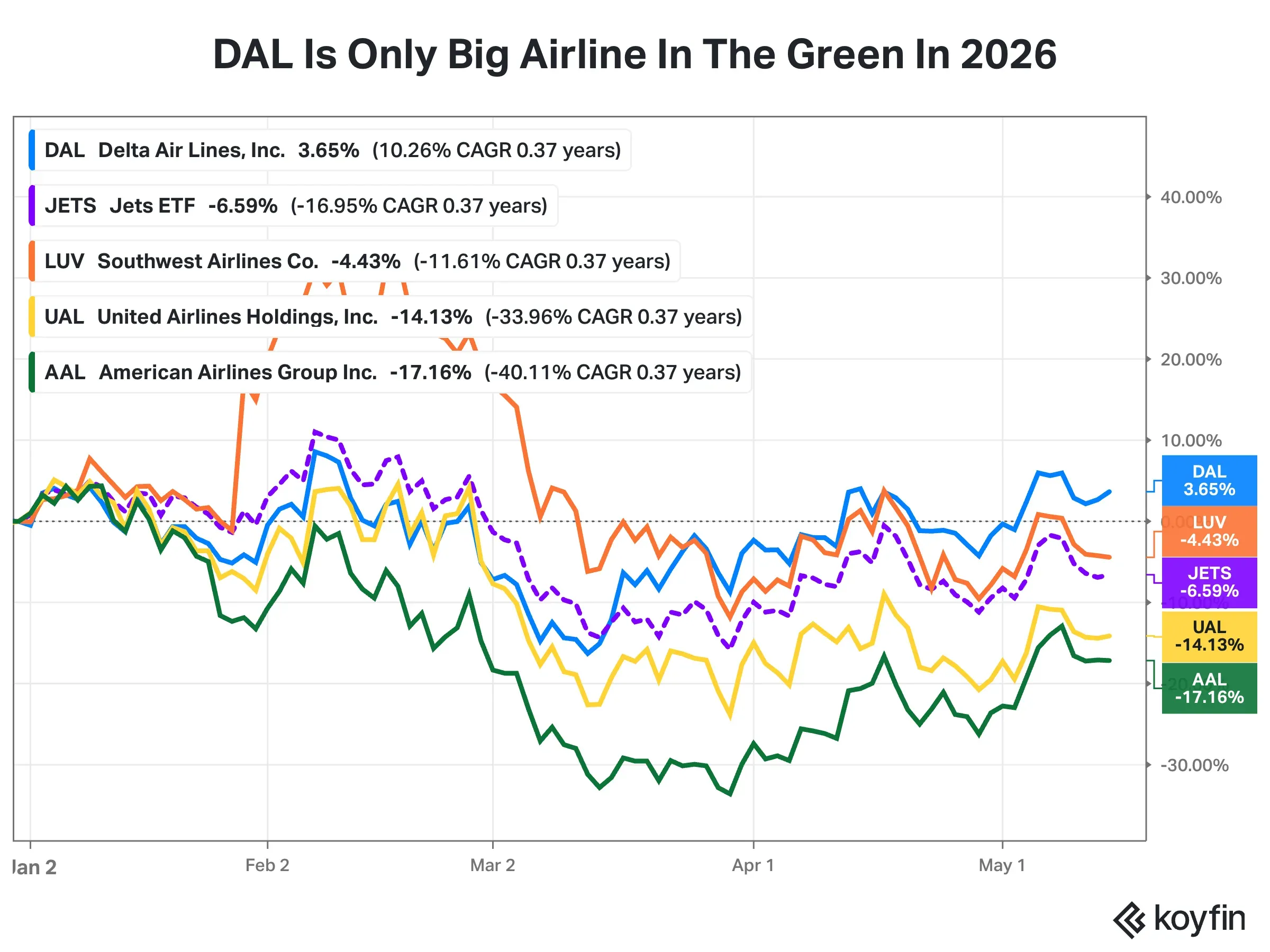 Despite its good performance, the airline is facing public criticism from Elon Musk after the carrier selected Amazon’s (AMZN) upcoming Leo satellite network over SpaceX’s Starlink service for future in-flight internet connectivity.
Musk Locks Horns With DAL’s Choice
Replying to a post on X earlier this week, the SpaceX CEO accused Delta of prioritizing a restrictive customer experience over convenience.
Advertisement|Remove ads.
“Delta wanted to make it painful, difficult and expensive for their customers. Hard to see how that is a winning strategy,” Musk said.
In late March, Delta Air Lines signed a deal with Amazon to install Amazon Leo on 500 planes starting in 2028, aiming to make in-flight internet faster for passengers on both domestic and international routes.
The new agreement builds on Delta’s longstanding reliance on Amazon Web Services, which already powers several of the airline’s technology systems.
Advertisement|Remove ads.
“This agreement gives us the fastest and most cost-effective technology available to better connect the world today, and it deepens our work with a global leader that shares our ambition to build what’s next — creating even stronger human connection for our people and our customers for years to come,” said Ed Bastian, Delta’s CEO, in March.
In a separate post late Thursday, Musk warned that Delta’s decision to go with Amazon Leo will eventually cost them customer traffic. “They will lose passengers over this,” he said.
According to a report on PCMag, United shot back at Musk’s jibe, saying, “The assertion in question is not accurate.”
Advertisement|Remove ads.
Musk responded after SpaceX investor Ron Baron said Delta may want more control over how passengers use in-flight Wi-Fi. Musk said on X that Starlink avoids complicated login requirements and is designed to work smoothly, like home internet.
“Not exactly. SpaceX requires that there be no annoying “portal” to use Starlink.
Starlink WiFi must just work effortlessly every time, as though you were at home,” Musk said.
Advertisement|Remove ads.
Musk also shared support from the YouTube sensation, Mr. Beast, who strongly backed Starlink, saying he would only fly on planes offering the service because it reliably supports his global productions and works in remote areas without traditional internet.
The back-and-forth comments have ignited a fresh rivalry in the aviation and satellite industries.
The Satellite Internet Showdown
The larger debate centers on whether Amazon Leo can compete with Starlink’s existing infrastructure. Amazon’s satellite system remains in an earlier deployment phase. Starlink already operates on multiple airlines, including some United Airlines Holdings (UAL) routes.
Advertisement|Remove ads.
Amazon’s Leo system, however, remains in development and is expected to begin broader deployment in the coming years.
Starlink made $11.4 billion in revenue last year, which was 61% of SpaceX’s total sales. It also earned about $7.2 billion in adjusted EBITDA, giving it a 63% margin. Using SpaceX’s expertise, Starlink builds and operates satellites to provide fast, low-latency internet worldwide.
Meanwhile, DAL stock has gained more than 42% over the last 12 months.
Advertisement|Remove ads.
Also See: LUNR Stock Eyes Third Week Of Gains: Analyst Still Sees 37% Upside
For updates and corrections, email newsroom[at]stocktwits[dot]com.
Comments posted here will also appear on symbol pages.

Latest News
/filters:format(webp)https://news.stocktwits-cdn.com/large_Getty_Images_2212073770_5d748cf4e6.jpg)
/filters:format(webp)https://news.stocktwits-cdn.com/Anushka_Basu_make_me_smile_in_the_picture_b92832aa_af59_4141_aacc_4180d2241ba8_1_2_png_1086e0ed8c.webp) Anushka Basu·9h ago
Anushka Basu·9h ago/filters:format(webp)https://news.stocktwits-cdn.com/large_Getty_Images_2191588209_jpg_4bdcedf469.webp) Anushka Basu·10h ago
Anushka Basu·10h ago/filters:format(webp)https://news.stocktwits-cdn.com/large_Getty_Images_2260497335_jpg_9e5edc45ca.webp) Anushka Basu·11h ago
Anushka Basu·11h ago/filters:format(webp)https://news.stocktwits-cdn.com/large_Getty_Images_1239809188_jpg_1d9fac9e1f.webp) Anushka Basu·12h ago
Anushka Basu·12h ago/filters:format(webp)https://news.stocktwits-cdn.com/large_Getty_Images_915443252_7521437c51.jpg) Anushka Basu·14h ago
Anushka Basu·14h ago/filters:format(webp)https://news.stocktwits-cdn.com/large_arthur_hayes_2026_OG_jpg_9f3524f8b1.webp) Anushka Basu·15h ago
Anushka Basu·15h ago