


Advertisement|Remove ads.
El-Erian Sees A New ‘Unsettling’ Economic Risk Emerging In 2026 – And It’s Not Inflation Or Affordability
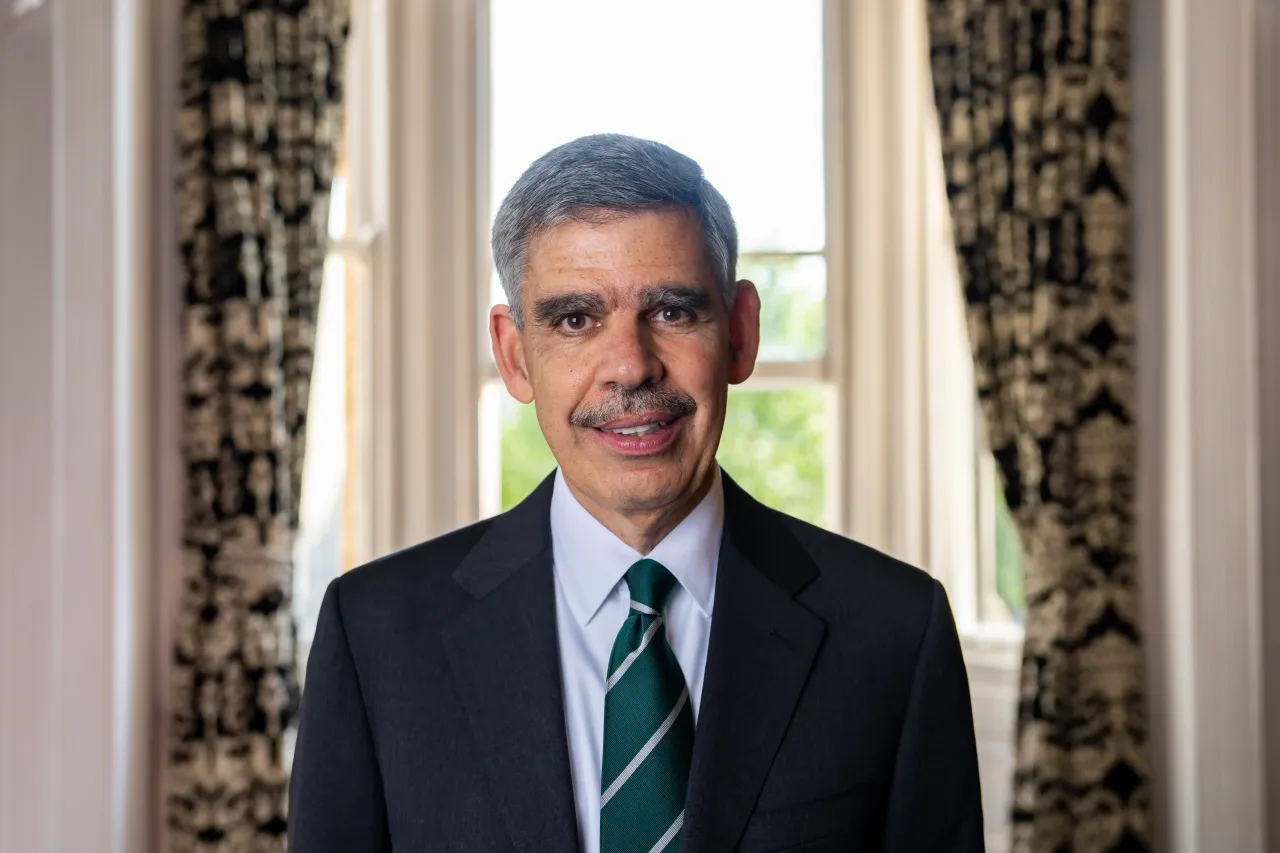


- El-Erian highlighted that a key shift in the economy is the emergence of an AI-driven growth dynamic.
- AI capex bolstered U.S. economic growth in 2025, and the economist expects it to remain historically high in 2026 due to the dual imperative of working “on” and “with” AI.
- El-Erian says the U.S. will move to the next stage in 2026, from building out data centers to their integration.
Advertisement|Remove ads.
Mohamed El-Erian, Chief Economic Advisor at Allianz, on Friday warned of an “unsettling” phenomenon of employment decoupling from Gross Domestic Product (GDP) due to the advent of artificial intelligence technology.
The economist stated in an opinion piece for Project Syndicate that forecasting a scenario for the U.S. economy won’t be as straightforward as it was before because of an increased probability of more extreme outcomes.

“The US economy is not so much on a single trajectory as it is locked in a tense tug-of-war between three distinct futures: a ‘Goldilocks-lite' central baseline, a productivity-fueled upside scenario, and a volatile downside scenario,” El-Erian said.
Advertisement|Remove ads.
What Is Changing?
El-Erian highlighted that a key shift in the economy is the emergence of an AI-driven growth dynamic. Capital expenditure in AI has sustained the U.S. economy's growth in 2025, and the economist expects AI capex to remain historically high in 2026 due to the dual imperative of working “on” and “with” AI.
However, while AI capex dominated 2025, El-Erian says the U.S. will move to the next stage in 2026, from building out data centers to their integration.
Consumer-Driven Strength Weakening
El-Erian added that a resilient consumer base, coupled with the AI capex, complemented U.S. economic growth in 2025. However, he thinks that this consumer-driven strength is weakening.
Advertisement|Remove ads.
The economist added that with the Fed set to ease monetary policy, prices may remain elevated, hitting low-income households particularly hard.
He expects inflation to remain above the Federal Reserve’s 2% target in 2026, too, and that lines up with the Fed’s forecast of core inflation hovering around 2.5% next year.
Decoupling Of Employment From GDP
What’s worrying El-Erian is the decoupling of employment from GDP.
Advertisement|Remove ads.
“Historically, robust economic growth has been inextricably linked to strong job creation. But this relationship appears to be under pressure, meaning that growth in 2026 may be accompanied by a relatively stagnant labor market,” he said.
The economist says jobless growth would keep affordability a political as well as a social flashpoint, with inequality likely to remain a hot-button issue.
Why Is It Important
In a goldilocks scenario on steroids, El-Erian says the U.S. could experience a non-inflationary boom.
Advertisement|Remove ads.
But an equally probable situation is an increase in volatility due to politics, global economic developments, policy errors, and financial instability. This makes the task that much more difficult for policymakers, according to El-Erian, since they will have to account for these multiple possible outcomes.
Meanwhile, U.S. equities gained in Friday’s pre-market trade. At the time of writing, the SPDR S&P 500 ETF (SPY), which tracks the S&P 500 index, was up by 0.23%, the Invesco QQQ Trust ETF (QQQ) rose 0.4%, while the SPDR Dow Jones Industrial Average ETF Trust (DIA) gained 0.09%. Retail sentiment around the S&P 500 ETF on Stocktwits was in the ‘bearish’ territory.
The iShares 7-10 Year Treasury Bond ETF (IEF) was down by 0.17% at the time of writing.
Advertisement|Remove ads.
For updates and corrections, email newsroom[at]stocktwits[dot]com.
Comments posted here will also appear on symbol pages.

Latest News
/filters:format(webp)https://news.stocktwits-cdn.com/gettyimages_2275481199_594x594_2ece639a98.jpg)
/filters:format(webp)https://news.stocktwits-cdn.com/Heera_1_1c30cb0170.PNG) Heera Hari·34m ago
Heera Hari·34m ago/filters:format(webp)https://news.stocktwits-cdn.com/large_Getty_Images_2201668075_jpg_cae68c6d02.webp)
/filters:format(webp)https://news.stocktwits-cdn.com/Prabhjote_DP_67623a9828.jpg) Prabhjote Gill·45m ago
Prabhjote Gill·45m ago/filters:format(webp)https://news.stocktwits-cdn.com/large_Getty_Images_1237524770_d165e1c091.jpg)
/filters:format(webp)https://news.stocktwits-cdn.com/Anushka_Basu_make_me_smile_in_the_picture_b92832aa_af59_4141_aacc_4180d2241ba8_1_2_png_1086e0ed8c.webp) Anushka Basu·1h ago
Anushka Basu·1h ago/filters:format(webp)https://st-everywhere-cms-prod.s3.us-east-1.amazonaws.com/large_Salesforce_logo_527d466034.jpg)
/filters:format(webp)https://news.stocktwits-cdn.com/Harshita_3cfe02022c.jpg) Harshita Tyagi·1h ago
Harshita Tyagi·1h ago/filters:format(webp)https://st-everywhere-cms-prod.s3.us-east-1.amazonaws.com/large_micron_technology_office_resized_89c8685837.jpg) Prabhjote Gill·2h ago
Prabhjote Gill·2h ago/filters:format(webp)https://news.stocktwits-cdn.com/gettyimages_2295864769_594x594_a0f8bc4c36.jpg) Harshita Tyagi·2h ago
Harshita Tyagi·2h ago