


Advertisement|Remove ads.
FDA Decision Watch: RHHBY, VTRS And IRD Face Key October Drug Rulings As MRK Withdraws Application



- Tecentriq’s application is backed by Phase 3 data showing a 50% reduction in the risk of recurrence or death in certain stage III colon cancer patients.
- Roche is looking to make Enspryng the first at-home subcutaneous treatment for thyroid eye disease.
- The FDA will decide on Viatris and Opus Genetics MR-141 on October 17.
Advertisement|Remove ads.
The U.S. Food and Drug Administration (FDA) will deliver several closely watched decisions over the next two weeks, with Roche (RHHBY) awaiting rulings on two potential label expansions and Viatris (VTRS) and Opus Genetics (IRD) facing decisions on an eye-care treatment.
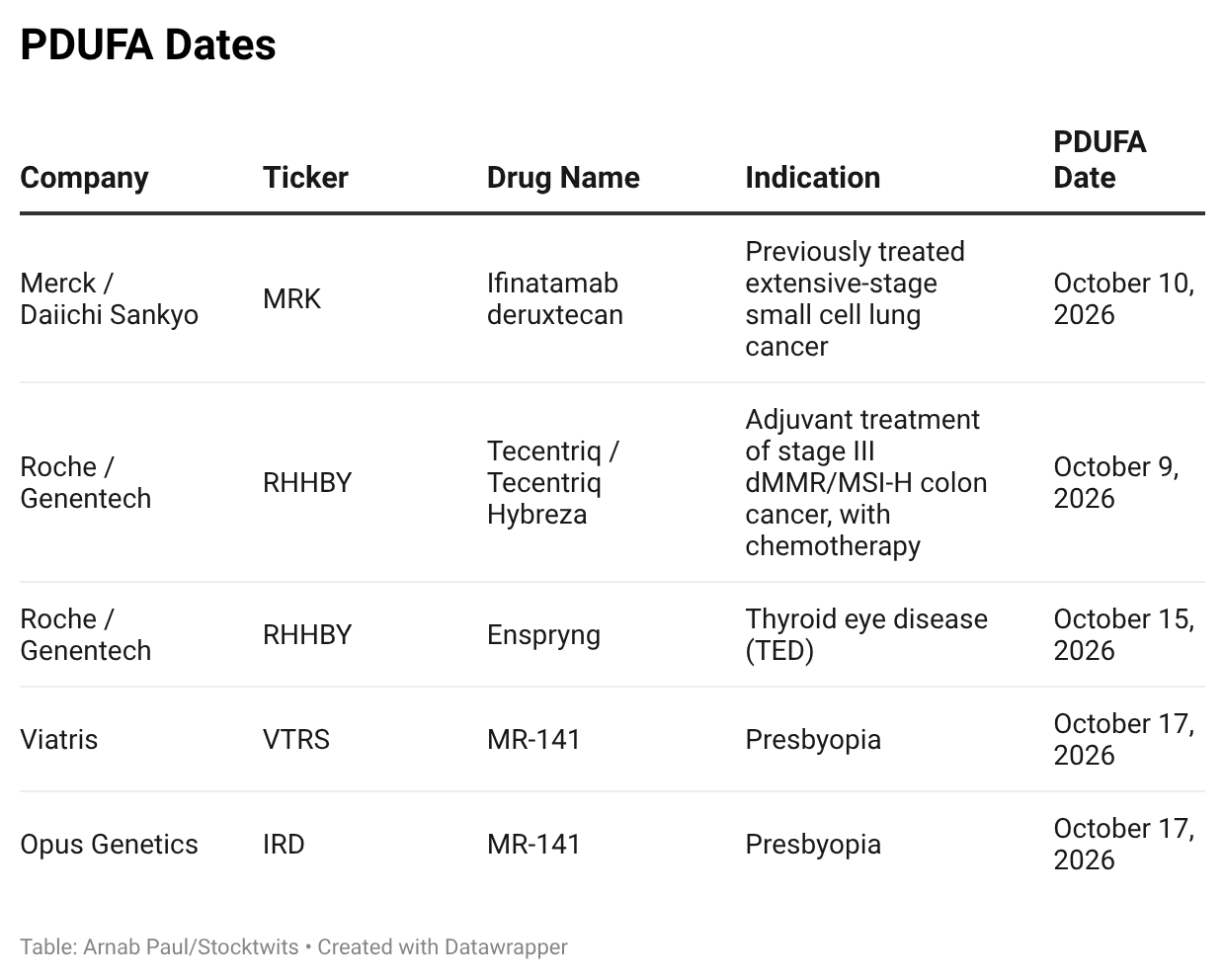
Roche is awaiting FDA decisions on expanding Tecentriq for certain patients with stage III colon cancer and Enspryng for thyroid eye disease. Viatris and Opus Genetics also face an FDA decision on MR-141 for Presbyopia.

A PDUFA date is the target deadline by which the FDA aims to complete its review of a drug application. The agency can approve the application or issue a Complete Response Letter (CRL) rejecting it.
Advertisement|Remove ads.
Roche Awaits Colon Cancer Therapy Decision
Genentech, a wholly owned unit of Roche, is seeking approval for Tecentriq and its injectable formulation Tecentriq Hybreza, used with chemotherapy after surgery in patients with stage III colon cancer. The FDA decision is expected on October 9.
The FDA has already granted the application Priority Review. The application is based on the Phase 3 ATOMIC study, which enrolled 712 patients. Adding Tecentriq to FOLFOX6 chemotherapy reduced the risk of cancer recurrence or death by 50% compared with chemotherapy alone. At 36 months, 86% of patients on the Tecentriq combination remained disease-free versus 76% in the chemotherapy group.
Advertisement|Remove ads.
Enspryng Faces October 15 Decision
Roche has another FDA catalyst on October 15, when the agency is expected to decide whether to expand Enspryng to thyroid eye disease.
Thyroid eye disease is an autoimmune condition that can cause swelling around the eyes, bulging eyes and double vision. If approved, Roche said Enspryng could become the first at-home subcutaneous treatment for the disease.
In the Phase 3 SatraGO-2 trial, 53% of patients treated with Enspryng achieved the main goal of improvement in eye bulging, compared with 23% on placebo. A second study, SatraGO-1, showed a numerical benefit but did not reach statistical significance on its primary endpoint.
Advertisement|Remove ads.
Viatris, Opus Genetics Eye Presbyopia Expansion
On October 17, the FDA is expected to rule on MR-141, from Viatris and Opus Genetics, for Presbyopia, the age-related loss of near focusing ability.
The companies are working under a global licensing agreement signed in 2022, under which Viatris has the rights to develop and commercialize the eye drop, including exclusive U.S. commercialization rights, while Opus retains an economic stake in the program.
The treatment is already sold as Ryzumvi for reversing pupil dilation. The new application seeks to expand its use to Presbyopia and is backed by the Phase 3 VEGA-2 and VEGA-3 trials, both of which met their primary and key secondary endpoints.
Advertisement|Remove ads.
The application could expand into a much larger market, with Viatris estimating that the condition affects about 90% of U.S. adults over age 45.
MRK Drops Off FDA Calendar After Withdrawing Cancer Drug Filing
The FDA was scheduled to decide on Merck and Daiichi Sankyo’s Ifinatamab Deruxtecan in previously treated extensive-stage small cell lung cancer on October 10. However, the companies withdrew the application on September 25 following discussions with the regulator, which said that the available data, including results from the Phase 2 IDeate-Lung01 trial, were not sufficient to support accelerated approval for the indication.
How Have VTRS, IRD, MRK And RHHBY Stocks Performed In 2026?
Apart from VTRS, whose retail sentiment on Stocktwits was ‘neutral,’ retail sentiment for the three stocks on the platform trended in the ‘bearish’ territory.
Advertisement|Remove ads.
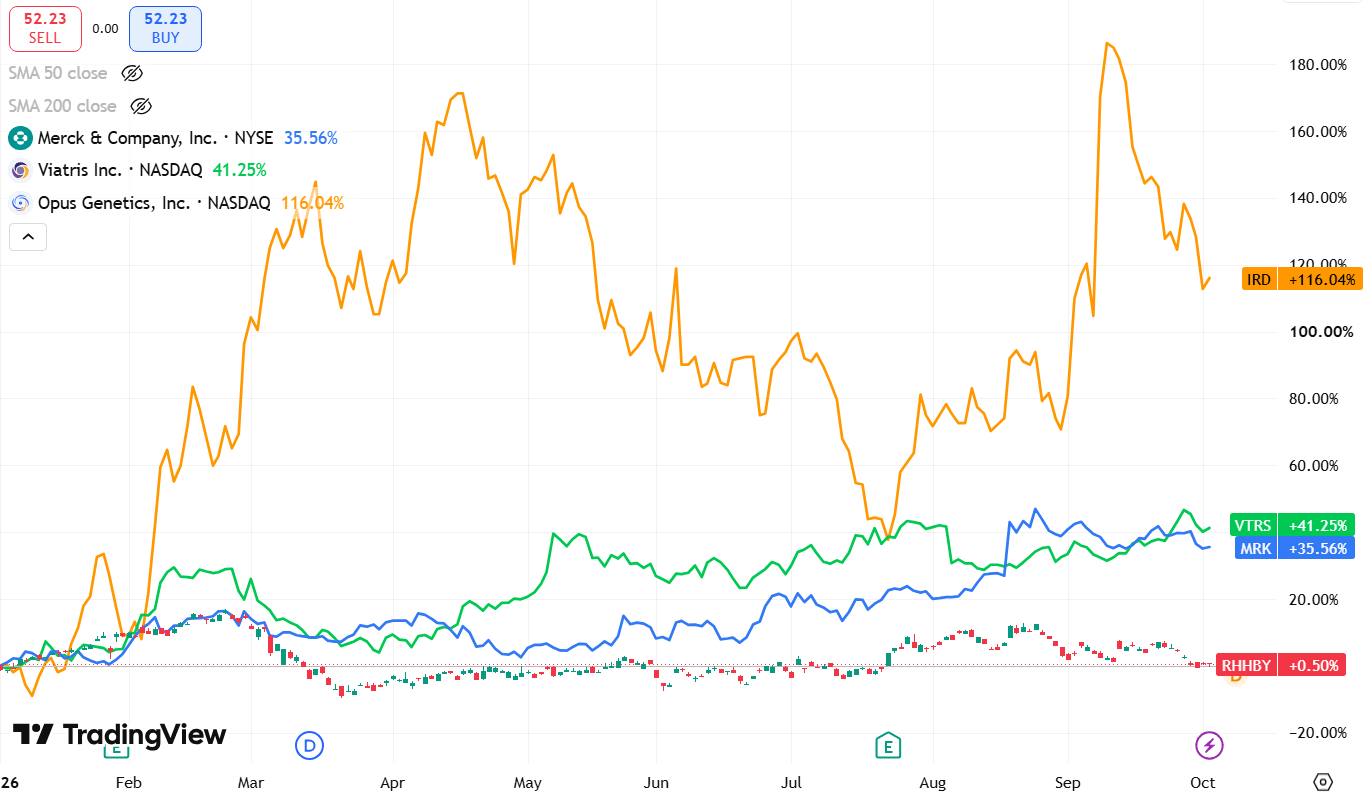 Among the stocks mentioned above, Opus Genetics has been the standout performer year-to-date, surging about 116%, while Viatris and Merck have gained roughly 41% and 36%, respectively. Roche has largely lagged the group, with shares up only about 0.5%.
For updates and corrections, email newsroom[at]stocktwits[dot]com.
Comments posted here will also appear on symbol pages.

Latest News
/filters:format(webp)https://news.stocktwits-cdn.com/large_Getty_Images_2295226888_dcdb8e346d.jpg)
/filters:format(webp)https://news.stocktwits-cdn.com/Prabhjote_DP_67623a9828.jpg) Prabhjote Gill·12m ago
Prabhjote Gill·12m ago/filters:format(webp)https://news.stocktwits-cdn.com/large_Trending_stock_resized_may_jpg_bc23339ae7.webp)
/filters:format(webp)https://news.stocktwits-cdn.com/vivekkrishnanphotography_58_jpg_0e45f66a62.webp) Arnab Paul·18m ago
Arnab Paul·18m ago/filters:format(webp)https://st-everywhere-cms-prod.s3.us-east-1.amazonaws.com/large_merck_logo_resized_05f46cfc54.jpg) Arnab Paul·48m ago
Arnab Paul·48m ago/filters:format(webp)https://news.stocktwits-cdn.com/gettyimages_2268540678_612x612_61ca3b12d2.jpg)
/filters:format(webp)https://news.stocktwits-cdn.com/Heera_1_1c30cb0170.PNG) Heera Hari·53m ago
Heera Hari·53m ago/filters:format(webp)https://news.stocktwits-cdn.com/large_Tom_Lee_9782f9c21f.webp) Prabhjote Gill·56m ago
Prabhjote Gill·56m ago/filters:format(webp)https://news.stocktwits-cdn.com/large_Getty_Images_1231213491_c9dc5aa96b.jpg)
/filters:format(webp)https://news.stocktwits-cdn.com/1707726834303_jpg_11f20a9aa9.webp) Shashank Nayar·1h ago
Shashank Nayar·1h ago