


Advertisement|Remove ads.
EXCLUSIVE: General Fusion CEO Greg Twinney Says Fusion's Safety Profile Could Unlock A Bigger Market Than Fission


- Twinney said that one of the most noteworthy differences between the two is that fusion does not produce long-lived radioactive waste, as fission can, and it does not use fuels that could be weaponized.
- The other significant advantage that Twinney sees is the abundance of fuel, as fusion reactors primarily use deuterium, which can be extracted from seawater.
- The CEO also said that the better safety profile means a lighter regulatory framework for fusion technology, which could help it scale faster once commercial viability has been demonstrated.
Advertisement|Remove ads.
General Fusion Group Ltd. (GFUZ) made history on Monday, becoming the first pure-play nuclear fusion energy company to trade on a major public stock exchange. In an exclusive interview with Stocktwits, CEO Greg Twinney argued that fusion is not just a cleaner alternative to fission but is a fundamentally larger market opportunity.
GFUZ stock surged 21% on its debut, added over 25% on Tuesday, and was trading about 2.5% lower in the overnight session.

The Vancouver-based company, backed by Amazon founder Jeff Bezos, among others, went public through a SPAC merger with Spring Valley Acquisition Corp. III, which provided General Fusion with approximately $150 million in cash. Earlier, Twinney told the Wall Street Journal that the funding is sufficient to meet the scientific milestones required by its demonstration machine.
Advertisement|Remove ads.
The listing arrives at a pivotal moment. Surging electricity demand driven by the AI boom, the global spread of electrification, and the energy appetite of large-scale computing has renewed urgency around new sources of firm, clean power. Fusion has attracted growing investment and government attention as a potential long-term answer.
According to the Financial Times, the number of private fusion companies has more than doubled over the past five years, intensifying competition at a time when the technology is still roughly a decade from commercialization. General Fusion is targeting its first commercial plant around 2035.
Does Nuclear Fusion Have An Edge Over Fission?
Twinney's bull case for fusion starts with what it doesn't produce. Unlike fission, fusion does not generate long-lived radioactive waste, does not use fuels that could be weaponized, and carries no risk of a meltdown.
Advertisement|Remove ads.
"Fusion is just inherently safe. We're not needing to engineer safety into it in the same way that you need to with fission," he told Stocktwits. "When fusion fails, it kind of just fails safely and there's not really any fallout from that."
That safety profile has a direct commercial implication: regulators around the world are moving to govern fusion "in a much lighter way" than conventional nuclear, Twinney said, which he believes creates the potential to site fusion plants closer to population centers and industrial demand. That's a significant advantage over fission, which requires remote, heavily secured facilities. "We get all the benefits that fission can provide without the downsides," he said.
There's another significant advantage. Fusion reactors primarily use deuterium, which can be extracted from seawater and is "massively abundant." The other component, tritium, is rarer in nature but can be bred through the interaction of a neutron and lithium. Fission, by contrast, relies on uranium and other finite sources.
Advertisement|Remove ads.
"The overall market size because of the safety profile and the abundance of fuel in fusion is much bigger than fission," Twinney said.
Fusion Vs Fission: What Are The Timelines Like?
While advanced nuclear companies such as Oklo Inc. (OKLO) and NuScale Power Corp. (SMR) are often thought of as being closer to commercialization than fusion technology, Twinney said that the gap may not be as large as investors assume.
While the road to commercialization for fusion technology has its challenges, including achieving reactor durability, tritium fuel breeding, economic viability, and the ability to efficiently extract and convert fusion energy into electricity, he argues small modular reactor (SMR) timelines also struggle with regulatory hurdles that can make timelines less predictable than they appear today.
Advertisement|Remove ads.
"I know that the timelines for SMRs, which can be very unpredictable due to regulations and those types of things, [are] probably not that different," he said.
According to Twinney, the combination of abundant fuel supplies and a lighter regulatory framework could ultimately enable fusion to scale faster than conventional nuclear technologies once commercial viability has been demonstrated.
However, Twinney does not view fusion and fission as mutually exclusive technologies. "They will be complementing each other," he said. "And I think that fusion kind of rounds out the nuclear circle if you think about it that way," he added.
Advertisement|Remove ads.
When asked about criticism from former Commonwealth Fusion Systems CTO Dan Brunner, who, in a recent interview with the Financial Times, said General Fusion's commercialization timeline was "very hard to believe," Twinney said the company’s timelines were based on real experimental results from its Lawson Machine 26.
The machine is designed to demonstrate that plasma can be heated through mechanical compression rather than superconducting magnets or high-powered lasers, he said, adding that the company's early results validated the operating principles behind its MTF approach that are “not based on fiction or papers being written.”
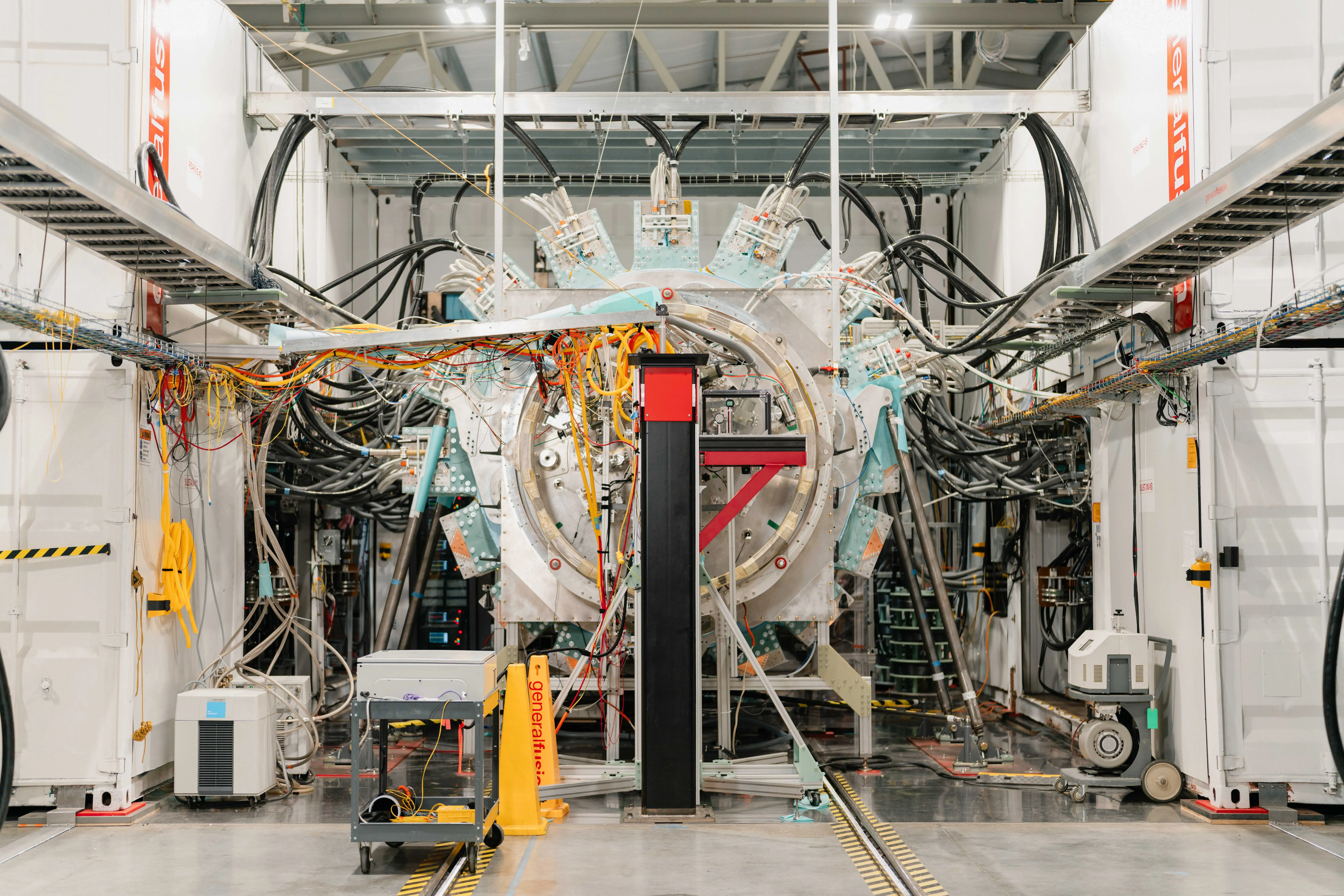
The timelines “are based on our real results from machines that we have built and operated and then eventually written papers on. But those are real results papers, not theoretical papers,” he said.
Advertisement|Remove ads.
General Fusion’s Cost Advantage
Twinney also emphasized that General Fusion's approach could offer a cost advantage over many competing technologies. While many other fusion developers rely on expensive superconducting magnets, high-powered lasers, or advanced materials that have yet to be proven at commercial scale, General Fusion's Magnetized Target Fusion (MTF) system uses mechanical compression and a liquid-lithium wall that can protect reactor components from neutron damage, help with breeding tritium fuel, and absorbing fusion energy as heat that can be converted into electricity using conventional steam turbines.
In an earlier interview with Stocktwits, Chief Strategy Officer Megan Wilson had also pointed to the economic advantages of MTF, which eliminate the need for expensive magnets, targets, lasers, or exotic, not-yet-invented materials. The technology also eliminates the need for frequent replacement of components damaged by neutron exposure, she had said.
“Our plants are designed to be cost-competitive compared to coal, steam, and natural gas,” she had said then. “They are expected to deliver four times as much energy per unit of fuel as fission, without long-lived radioactive waste, positioning them as the superior nuclear technology for sustainable growth.”
Advertisement|Remove ads.
By avoiding costly magnets and lasers and using existing industrial technologies, Twinney said he believes General Fusion has a clearer path to building an economically viable power plant, as the company’s design has from the beginning aimed to avoid the major barriers to commercializing fusion.
"What we are trying to do at General Fusion, and our power plant design from the beginning, has been we want to avoid the major barriers to commercializing fusion. Not just demonstrate a bunch of fusion, but actually avoid the barriers to commercializing it," he said.
GFUZ Stock: Retail Stance
On Stocktwits, retail sentiment around GFUZ stock is ‘bullish’ amid ‘high’ message volumes.
Advertisement|Remove ads.
One bullish user said, “$GFUZ once this starts gaining traction and available on all platforms you will see this fly.”
However, another user said, “$GFUZ Got short dis trash at 22.”
Advertisement|Remove ads.
For updates and corrections, email newsroom[at]stocktwits[dot]com.
Comments posted here will also appear on symbol pages.

Latest News
/filters:format(webp)https://news.stocktwits-cdn.com/large_Getty_Images_2292004491_8f62e72b72.jpg)
/filters:format(webp)https://news.stocktwits-cdn.com/unnamed_jpg_9dff551b50.webp) Anan Ashraf·17m ago
Anan Ashraf·17m ago/filters:format(webp)https://news.stocktwits-cdn.com/large_Getty_Images_2270719078_54f1c6207b.jpg) Anan Ashraf·29m ago
Anan Ashraf·29m ago/filters:format(webp)https://news.stocktwits-cdn.com/large_hims_logo_9ad9b7d21e.jpg) Anan Ashraf·1h ago
Anan Ashraf·1h ago/filters:format(webp)https://st-everywhere-cms-prod.s3.us-east-1.amazonaws.com/large_bloom_energy_resized_d69c98fd7a.jpg)
/filters:format(webp)https://news.stocktwits-cdn.com/1707726834303_jpg_11f20a9aa9.webp) Shashank Nayar·1h ago
Shashank Nayar·1h ago/filters:format(webp)https://news.stocktwits-cdn.com/large_Getty_Images_2219723511_103fa4d061.jpg) Anan Ashraf·2h ago
Anan Ashraf·2h ago/filters:format(webp)https://news.stocktwits-cdn.com/datadog_resized_jpg_20b6f8ccc0.webp) Shashank Nayar·3h ago
Shashank Nayar·3h ago