


Advertisement|Remove ads.
GM, Ford Back In WWII Mode? Pentagon Reportedly Wants Detroit To Make Weapons Amid Sliding Auto Sales
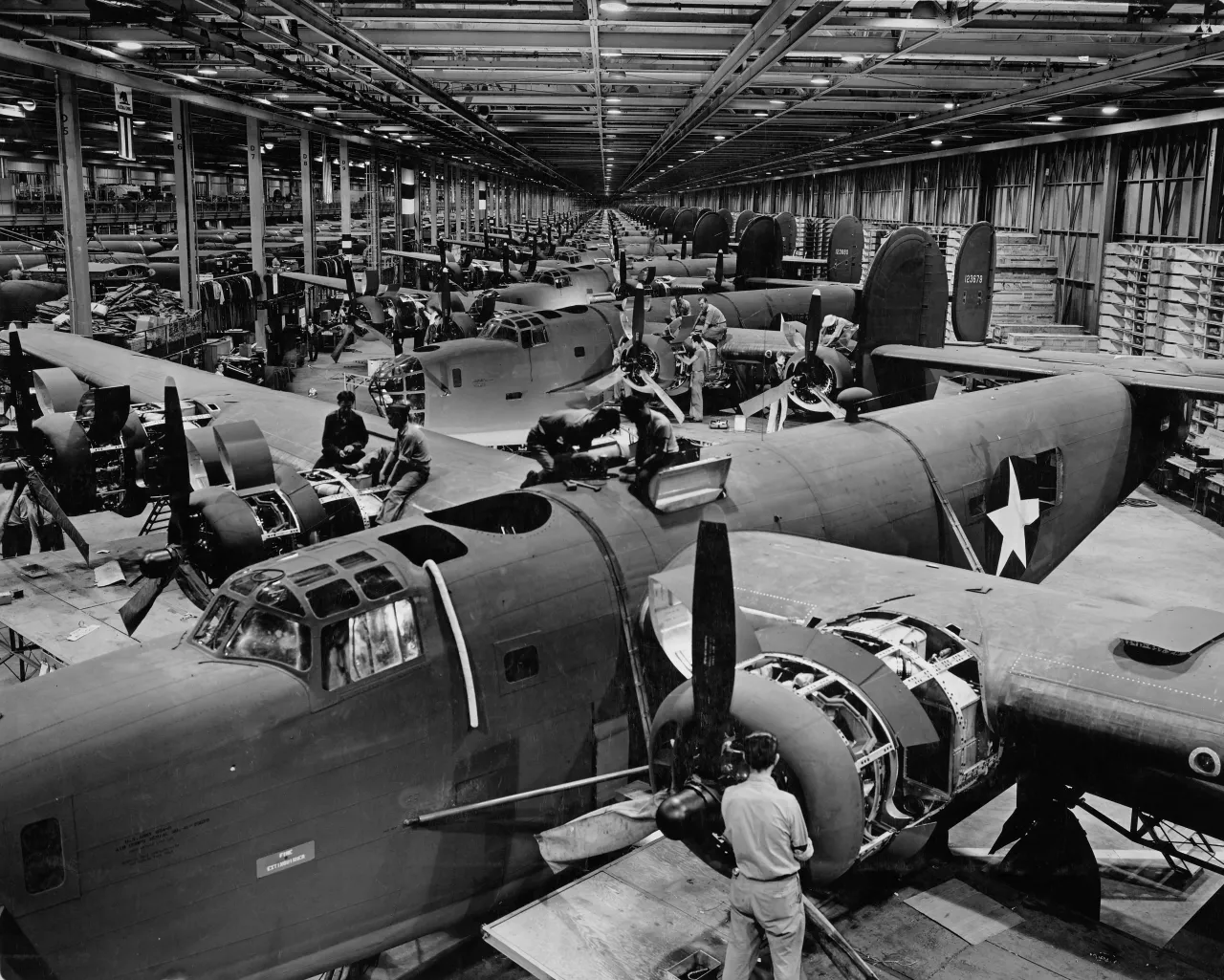


- Ford and General Motors are reportedly in talks with U.S. defense officials about expanding into weapons and military-vehicle production as the Pentagon seeks to rebuild munitions capacity.
- The effort would revive a wartime playbook last seen during World War II, when Detroit automakers halted civilian production to build bombers, tanks, and military trucks at scale.
- Wall Street remains split on the automakers ahead of Q1 earnings later this month.
Advertisement|Remove ads.
General Motors Co. (GM) and Ford Motor Co. (F) have had little to celebrate in U.S. markets lately, with both automakers facing stock pressure from declining sales amid economic and geopolitical uncertainty that has kept costs high and consumers cautious. Now, an unexpected lifeline may emerge from Washington.
The Trump administration is exploring whether major American manufacturers could play a larger role in weapons production, echoing a practice last seen during World War II, the Wall Street Journal reported on Wednesday, citing people familiar with the discussions. Senior defense officials have already held talks with several top executives, including GM CEO Mary Barra and Ford CEO Jim Farley. GE Aerospace and vehicle and machinery maker Oshkosh are also reportedly part of the conversations.

Advertisement|Remove ads.
Why Trump's Team Wants Automakers To Pivot To Defense
According to the Journal, the Pentagon's interest has been driven by the wars in Ukraine and Iran, which have depleted U.S. munitions stocks, and by the defense industrial base's need for more capacity to keep pace.
GM operates a defense subsidiary that builds a lightweight infantry squad vehicle based on the Chevrolet Colorado pickup, and is expected to be a leading contender to build a larger squad vehicle for the U.S. Army to replace the Humvee. Oshkosh, meanwhile, builds tactical troop carriers for the Army and U.S. allies, although that hardly contributes significantly to total revenue.
Detroit Has Gone Into War Mode Before
During World War II, Detroit's automakers halted civilian production entirely to become what President Franklin Delano Roosevelt called America's "Arsenal of Democracy," churning out bombers, aircraft engines, and military trucks at a scale that helped turn the tide of the war.
Advertisement|Remove ads.
Ford's Willow Run plant in Michigan became one of the most celebrated wartime manufacturing facilities, producing B-24 Liberator bombers at an impressive rate. Across its plants, Ford built nearly 278,000 military vehicles, including tanks, armored cars, and general-purpose vehicles. The company's trucks and equipment also saw widespread use through the Korean and Vietnam conflicts.
How Wall Street, Retail Traders Feel About Ford And GM
Ford shares are down 2% year to date, and GM is off 4%, with both lagging the Dow Jones Industrial Average. On Stocktwits, retail sentiment for Ford was last at 'neutral,' while GM scored an 'extremely bullish' reading.
Advertisement|Remove ads.
Both automakers are due to report first-quarter earnings toward the end of the month. Wall Street's near-term views are mixed.
According to The Fly, Deutsche Bank upgraded GM to 'Buy' from 'Hold' earlier this week, raising its price target to $90 from $83. The firm attributed recent weakness to geopolitical volatility tied to the U.S.-Israeli strikes on Iran rather than any fundamental deterioration, and described the pullback as "an attractive entry point to gain exposure to a potential multi-year re-rate story."
Goldman Sachs was more cautious, trimming its price target on GM to $91 from $104 while keeping a 'Buy' rating, and cutting its Ford target to $13 from $15 while maintaining 'Neutral.' The firm expects auto manufacturers and suppliers broadly to deliver in-line to softer-than-expected first-quarter results, citing rising input costs and weak auto sales in China as the primary drags.
Advertisement|Remove ads.
For updates and corrections, email newsroom[at]stocktwits[dot]com.
Read Next: Lucid, Beyond Air, Conagra Stocks Hit 52-Week Lows: What's Behind The Drag?
Comments posted here will also appear on symbol pages.

Latest News
/filters:format(webp)https://news.stocktwits-cdn.com/large_Getty_Images_2281173544_jpg_d65fbb26dd.webp)
/filters:format(webp)https://news.stocktwits-cdn.com/IMG_8805_JPG_6768aaedc3.webp) Deepti Sri·9m ago
Deepti Sri·9m ago/filters:format(webp)https://news.stocktwits-cdn.com/large_Bloom_Energy_jpg_915ade69f9.webp)
/filters:format(webp)https://news.stocktwits-cdn.com/Aashika_Suresh_Profile_Picture_jpg_2acd6f446c.webp) Aashika Suresh·1h ago
Aashika Suresh·1h ago/filters:format(webp)https://news.stocktwits-cdn.com/large_ast_spacemobile_b748e9159f.jpg) Deepti Sri·1h ago
Deepti Sri·1h ago/filters:format(webp)https://news.stocktwits-cdn.com/large_Getty_Images_2246348048_45d4f713f7.jpg)
/filters:format(webp)https://news.stocktwits-cdn.com/shivani_photo_jpg_dd6e01afa4.webp) Shivani Kumaresan·2h ago
Shivani Kumaresan·2h ago/filters:format(webp)https://news.stocktwits-cdn.com/large_rocketlab_jpg_fcfa5bb73e.webp) Deepti Sri·2h ago
Deepti Sri·2h ago/filters:format(webp)https://news.stocktwits-cdn.com/large_Getty_Images_1694437094_56a69176d2.jpg) Aashika Suresh·2h ago
Aashika Suresh·2h ago