


Advertisement|Remove ads.
IndiGo Faces Margin Pressure Despite Revenue Growth; SEBI Analysts Turn Cautious
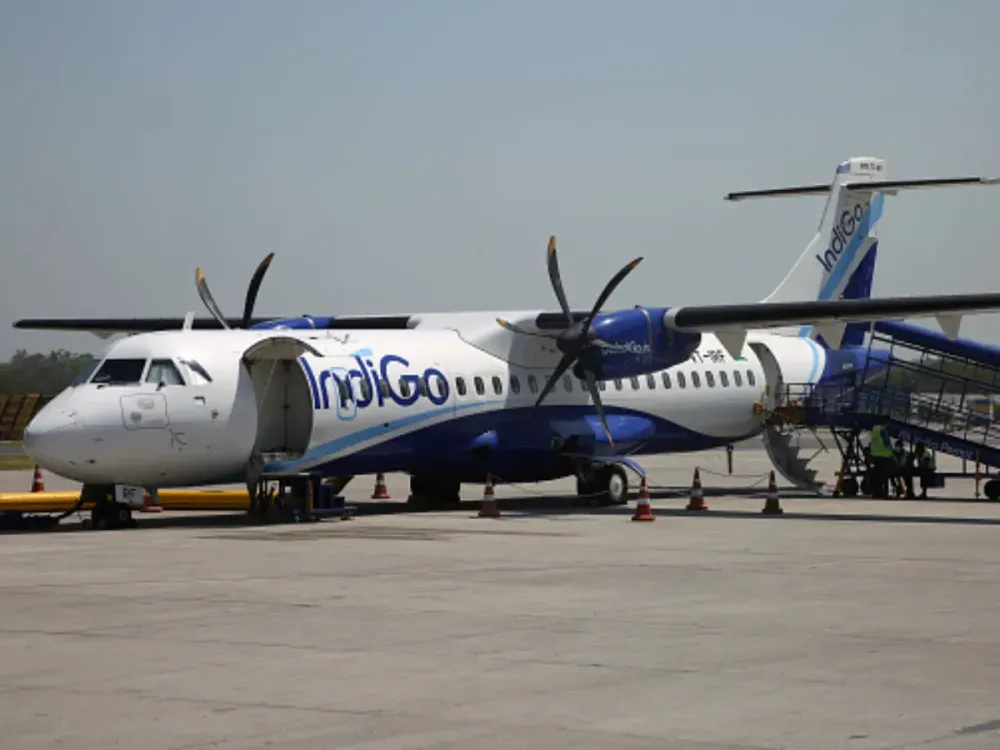


IndiGo shares rose 2% in afternoon trade on Thursday after reporting a first quarter (Q1) revenue of ₹20,496 crore, up 4.7%. The company also reported a net profit of ₹2,176 crore, down nearly 20% year-over-year, as higher costs and forex losses pressured margins.
Meanwhile, EBITDAR (EBITDA before rent) held flat at ₹5,739 crore.
SEBI-registered analyst Vijay Kumar Gupta noted falling yields and a dip in load factor as signs of weakened pricing power.
Advertisement|Remove ads.
Fundamental Breakdown
While the airline expanded its capacity by 16.4% year-over-year, actual passenger traffic grew 13.5%. About 4.2 crore people flew with IndiGo during the quarter on the back of strong demand at home.
Advertisement|Remove ads.
However, net profit was pressured by falling yields, forex losses, and rising costs related to maintenance, airport charges, and depreciation.
The company reported a net fleet reduction of 18 aircraft during the quarter. While lower aviation turbine fuel (ATF) prices helped ease fuel costs, other operating expenses remained elevated.
IndiGo saw a solid 22.1% jump in ancillary revenue last quarter, while its non-fuel, non-forex operating costs stayed within the company’s expected range.
Advertisement|Remove ads.
Despite rising costs and margin pressure, management said it remains cautiously optimistic.
For the second quarter (Q2), IndiGo expects mid- to high-single-digit growth in capacity and plans to keep expanding internationally while staying efficient.
Technical Breakdown
Advertisement|Remove ads.
On the technical front, Gupta pointed to key resistance levels at ₹5,800–₹5,805 and ₹5,937.5. Price rejection was observed near recent highs, suggesting potential exhaustion if the stock fails to break through with volume.
A successful breakout above ₹5,937.5 could indicate further upside.
Advertisement|Remove ads.
Gupta highlighted ₹5,625 as a critical pivot zone under Murrey Math, currently serving as support.
A breakdown below this level could shift momentum to the downside, with further support near ₹5,312.5 and ₹5,000. Deeper support zones are located at ₹4,687.5 and ₹4,375.
SEBI-registered analyst Rajneesh Sharma also flagged a bearish engulfing pattern forming near the upper channel on the weekly chart.
Advertisement|Remove ads.
He noted divergences in Relative Strength Index (RSI) and On-Balance Volume (OBV) that suggest weakening momentum.
Sharma identified short-term support in the ₹5,190–₹5,300 range and deeper support between ₹4,900 and ₹5,000. The long-term trend, however, remains intact above ₹4,150.
Advertisement|Remove ads.
SEBI-registered investment advisor Financial Independence Services (FIS) echoed a cautious stance, rating the stock as “neutral to weak.”
While they acknowledged the company’s top-line growth and network expansion, they pointed to margin pressure, forex-related losses, and external disruptions as reasons for near-term caution.
Advertisement|Remove ads.
FIS added that cautious optimism could return once cost and foreign exchange headwinds stabilize.
On Stocktwits, retail sentiment was ‘bearish’ amid ‘high’ message volume.
INDIGO’s stock has risen 27.4% so far in 2025.
Advertisement|Remove ads.
For updates and corrections, email newsroom[at]stocktwits[dot]com.
Comments posted here will also appear on symbol pages.

Latest News
/filters:format(webp)https://news.stocktwits-cdn.com/large_Getty_Images_1140163617_f532763e0e.jpg)
/filters:format(webp)https://news.stocktwits-cdn.com/Anushka_Basu_make_me_smile_in_the_picture_b92832aa_af59_4141_aacc_4180d2241ba8_1_2_png_1086e0ed8c.webp) Anushka Basu·4h ago
Anushka Basu·4h ago/filters:format(webp)https://news.stocktwits-cdn.com/large_Getty_Images_1241727187_186fa8e2c2.jpg) Anushka Basu·5h ago
Anushka Basu·5h ago/filters:format(webp)https://news.stocktwits-cdn.com/large_Grant_Cardone_e02d86f642.webp) Anushka Basu·6h ago
Anushka Basu·6h ago/filters:format(webp)https://news.stocktwits-cdn.com/large_Getty_Images_2291403399_8dbede0ce6.jpg) Anushka Basu·7h ago
Anushka Basu·7h ago/filters:format(webp)https://news.stocktwits-cdn.com/large_us_treasury_yields_jpg_074c6369d6.webp)
/filters:format(webp)https://st-everywhere-cms-prod.s3.us-east-1.amazonaws.com/i_OS_App_Icon_1_8054f2a2fe.png) Stocktwits News Desk·9h ago
Stocktwits News Desk·9h ago/filters:format(webp)https://news.stocktwits-cdn.com/large_Getty_Images_2203983775_jpg_74bdd5dd43.webp) Stocktwits News Desk·9h ago
Stocktwits News Desk·9h ago