


Advertisement|Remove ads.
Kevin Hassett Says He Would ‘Vote Against’ Fed Rate Hike, Citing Sharp Slowdown in Recent Inflation
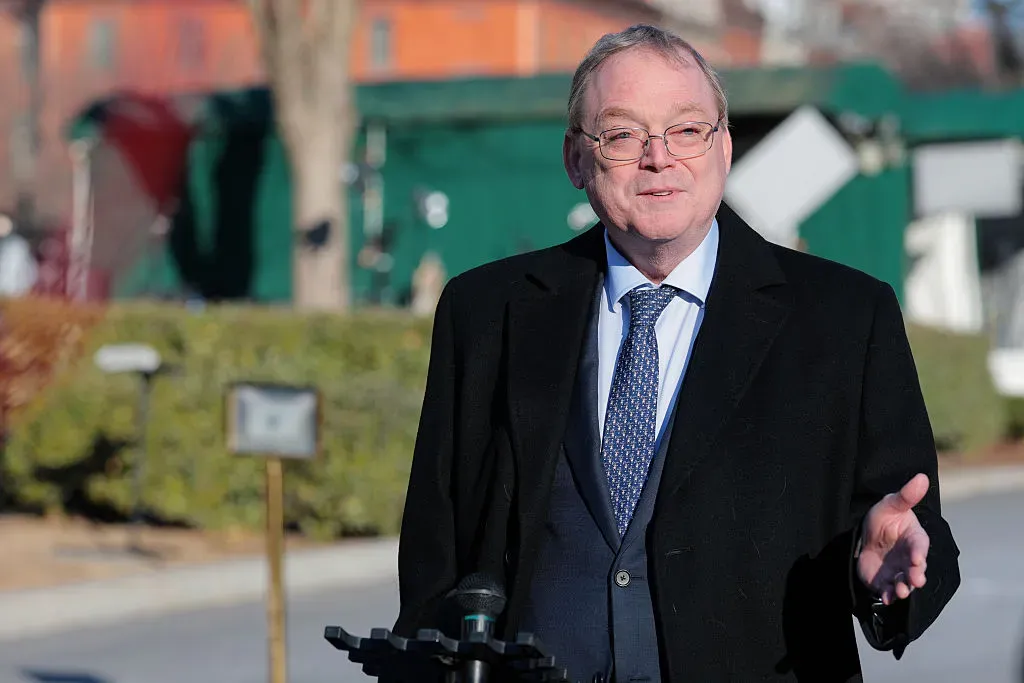


- Hassett pushed back against the idea that strong economic growth automatically requires tighter monetary policy.
- He added that the White House would “understand and respect the decision” if the Fed ultimately raised rates despite his view.
- According to him, “non-economic thinking is a thing of the past” with new Fed chair Kevin Warsh at the helm of the central bank.
Advertisement|Remove ads.
White House economic adviser Kevin Hassett on Monday pushed back against expectations of a rate hike, saying he would vote against the move if he were on the central bank’s policy committee, citing a sharp slowdown in recent inflation.
"The market says that they're likely to hike tomorrow; I would vote against if I were there," Hassett said in an interview with CNBC. He added that the administration would "understand and respect the decision" if the Fed moved ahead with a hike.
"If you look at the sort of near-term memory and the stochastic process that drives inflation, you can see that things are slowing down.”
– Kevin Hassett, Economic Adviser, White House
U.S. equities edged lower in pre-market trade on Tuesday, with the Federal Open Market Committee’s (FOMC) two-day meeting kicking off later on Tuesday. The CME FedWatch data showed markets pricing in a 92.7% probability of a quarter-point rate hike in September.
Advertisement|Remove ads.
The SPDR S&P 500 ETF (SPY) fell around 0.27%, the SPDR Dow Jones Industrial Average ETF (DIA) slipped 0.11%, and the Nasdaq-100 tracking Invesco QQQ Trust (QQQ) moved 0.10% lower. Retail sentiment around SPY on Stocktwits trended in ‘bearish’ territory over the past day.
Meanwhile, Tuesday morning saw the yield on the benchmark 10-year Treasury note rise to its highest since 2007, reaching 5.041%.
Hassett Sees Recent Inflation Data Pointing Lower
Hassett stated that recent inflation readings deserve more weight when assessing where price pressures are headed. He said that when forecasting CPI, the most recent three or four months typically carry the most explanatory power because "there's a lot of momentum in inflation."
Advertisement|Remove ads.
He pointed to the latest three-month trend in core CPI, noting it averaged about 0.2% annualized, compared with substantially higher readings in the preceding three months.
Hassett also pushed back on the idea that strong economic growth necessarily calls for tighter monetary policy. "I think with Kevin [Warsh] there, that kind of sort of non-economic thinking is a thing of the past,” he said.
Loretta Mester Makes The Case For A Rate Hike
“I think they will do it [rate hike]. I think they should do it,” former Cleveland Fed President Loretta Mester told CNBC in a separate interview.
Mester pointed to several factors supporting tighter policy, including strong demand growth, continued investment beyond artificial intelligence, and resilient consumer spending. She also stated that the labor market remains near the Fed's estimate of maximum employment, even though job growth has slowed.
Advertisement|Remove ads.
“The part of the mandate that's problematic right now is inflation,” Mester said. “It's been high. It's been high for a long time, and more important than that, there isn't really convincing evidence that it's on a downward path back to 2%.”
Mester also acknowledged that some of the current inflation pressure is related to higher oil prices, but said that the Fed cannot simply wait for the shock to fade.
Advertisement|Remove ads.
For updates and corrections, email newsroom[at]stocktwits[dot]com.
Comments posted here will also appear on symbol pages.

Latest News
/filters:format(webp)https://st-everywhere-cms-prod.s3.us-east-1.amazonaws.com/large_Novavax_Building_wc_3710f59b94.jpg)
/filters:format(webp)https://news.stocktwits-cdn.com/unnamed_jpg_9dff551b50.webp) Anan Ashraf·31m ago
Anan Ashraf·31m ago/filters:format(webp)https://st-everywhere-cms-prod.s3.us-east-1.amazonaws.com/large_vistra_logo_resized_b234a57c26.jpg)
/filters:format(webp)https://news.stocktwits-cdn.com/1707726834303_jpg_11f20a9aa9.webp) Shashank Nayar·41m ago
Shashank Nayar·41m ago/filters:format(webp)https://news.stocktwits-cdn.com/large_Getty_Images_2234380335_1_jpg_543ec32107.webp) Anan Ashraf·42m ago
Anan Ashraf·42m ago/filters:format(webp)https://news.stocktwits-cdn.com/large_Getty_Images_2185274734_jpg_68a729bf31.webp) Shashank Nayar·1h ago
Shashank Nayar·1h ago/filters:format(webp)https://news.stocktwits-cdn.com/large_Getty_Images_678074927_2fe2ed8084.jpg) Anan Ashraf·2h ago
Anan Ashraf·2h ago/filters:format(webp)https://news.stocktwits-cdn.com/large_Getty_Images_2274190440_jpg_d3d9d517e3.webp) Shashank Nayar·2h ago
Shashank Nayar·2h ago