


Advertisement|Remove ads.
Michael Burry Shares 'Three Great Charts' That Show Big AI Capex Could Unwind As Badly As Housing Did In 2008


- “A cycle that builds at 0.85 percentage points a year can unwind at a similar pace, and that, rather than the buildout itself, is the macro risk if AI demand disappoints,” Torsten Slok, a chief economist at Apollo, said.
- Burry, best known for predicting the 2008 financial crisis, has been a vocal skeptic of the current AI supercycle.
- Five of the biggest U.S. tech companies – Amazon, Alphabet, Meta Platforms, Microsoft, and Oracle – will spend about $800 billion in combined capital expenditures this year.
Advertisement|Remove ads.
“The Big Short” investor Michael Burry is looking closely at “three great charts” by a prominent financial analyst comparing the rapid AI data center buildout to the housing boom-and-bust of the 2000s, suggesting elevated risks for the AI sector and the broader economy.
Burry, best known for predicting the 2008 financial crisis, has been a vocal skeptic of the current AI supercycle. He was among the earliest investors to bet against key AI beneficiaries such as Nvidia and Palantir, and has more recently turned bearish on the broader semiconductor sector, even as it has rallied sharply on gains in Intel, Advanced Micro Devices and memory chipmakers.
Apollo’s Chief Economist Flags AI Risk To Economy
Late Thursday, Burry shared the post from Apollo Global Management Partner and Chief Economist Torsten Slok where the latter estimated that cloud companies’ capex would run at roughly 3% of the U.S. GDP every year from 2027 to 2029, up from 0.3% of GDP in 2019 and 1.4% in 2025.
Advertisement|Remove ads.
That is twice the peak of the telecom and fiber buildout of the late 1990s, which topped out at 1.2% of GDP in 2000 before collapsing and tipping the economy into the mildest post-war recession. Data center investments are, however, still less than half the size of the residential investments, which peaked at 6.6% of GDP in 2005.
“The bottom line is that the data-center buildout is smaller than housing in level but larger in the change in share of GDP, and faster than either previous cycle,” Slok wrote.
The same arithmetic runs in reverse, he argued. The housing market's unwind, from 6.2% of GDP in early 2006 to 3.0% by the end of 2008, is what made that recession severe, while telecom's much smaller reversal produced the mildest one.
Advertisement|Remove ads.
“A cycle that builds at 0.85 percentage points a year can unwind at a similar pace, and that, rather than the buildout itself, is the macro risk if AI demand disappoints,” Slok wrote.
Big Tech Capex Seen Around $1 Trillion Next Year
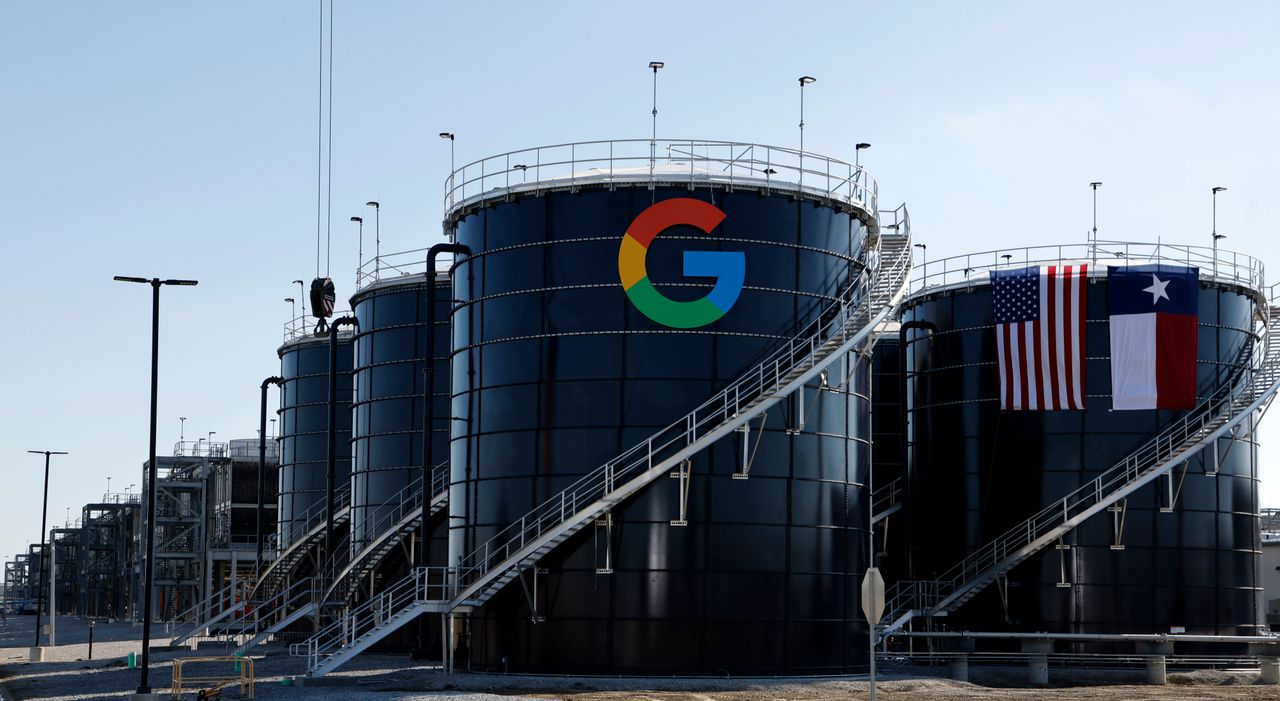
Five of the biggest U.S. tech companies – Amazon, Alphabet, Meta Platforms, Microsoft, and Oracle – will spend about $800 billion in combined capital expenditures this year, a majority of which will flow into new data centers.
S&P said in May that the U.S. hyperscalers’ accelerating AI investments could reach $1 trillion in 2027, driven by AI demand, rising component costs and capacity expansion. It highlighted Microsoft, Alphabet, Amazon and Meta continuing to lift spending.
Advertisement|Remove ads.
Following Big Tech earnings, BofA raised its estimates and now expects aggregate hyperscaler capex to exceed $1 trillion in 2027, with 2026 spending estimated at $800-$900 billion. Evercore ISI, Raymond James, and Moody’s have also arrived at estimates of roughly $1 trillion.
Peter Diamandis, X Prize Foundation’s executive chairman and an early investor in Tesla, said on X that 2,441 proposed data-center projects in the U.S. are scheduled to break ground between 2026 and 2028, representing as much as $2.48 trillion in planned investment.
“That pipeline is roughly 5 times the cost of building the original Interstate Highway System (inflation-adjusted) — except this infrastructure doesn’t move cars; it moves intelligence,” Diamandis said, without mentioning the source of his data.
Advertisement|Remove ads.
Burry’s Recent Trades
Burry has continued to position against what he sees as an AI bubble, arguing that today’s AI infrastructure boom could eventually lead to excess capacity.
Since late 2025, he has built or expanded bearish positions in Nvidia, Palantir, Caterpillar, Applied Materials, Micron, Oracle, and Nebius. More recently, he exited his Microsoft long, initially closed a profitable Oracle short before re-entering it days later, rolled some Nvidia puts into 2027, reduced his Palantir put exposure while maintaining a direct short, and kept his shorts in Nvidia and Caterpillar.
Outside AI, Burry has selectively added to long positions. He more than doubled his stake in Flutter Entertainment after its post-earnings selloff, exited DraftKings, and maintained or added to Fiserv, Zoetis, and Mercado Libre, arguing that these businesses remain attractive long-term value opportunities despite near-term headwinds.
Advertisement|Remove ads.
For updates and corrections, email newsroom[at]stocktwits[dot]com.
Advertisement|Remove ads.
Comments posted here will also appear on symbol pages.

Latest News
/filters:format(webp)https://news.stocktwits-cdn.com/large_Getty_Images_2280120668_jpg_fa8f332632.webp)
/filters:format(webp)https://news.stocktwits-cdn.com/Whats_App_Image_2026_05_11_at_09_45_43_1_jpeg_a08c0cf251.webp) Aveek Bhowmik·27m ago
Aveek Bhowmik·27m ago/filters:format(webp)https://news.stocktwits-cdn.com/large_viking_jpg_7a4076836e.webp)
/filters:format(webp)https://news.stocktwits-cdn.com/unnamed_jpg_9dff551b50.webp) Anan Ashraf·35m ago
Anan Ashraf·35m ago/filters:format(webp)https://news.stocktwits-cdn.com/large_susan_collins_jpg_839b2259c1.webp)
/filters:format(webp)https://news.stocktwits-cdn.com/1707726834303_jpg_11f20a9aa9.webp) Shashank Nayar·1h ago
Shashank Nayar·1h ago/filters:format(webp)https://news.stocktwits-cdn.com/large_Anthropic_ec1c7b5ee9.jpg) Aveek Bhowmik·2h ago
Aveek Bhowmik·2h ago/filters:format(webp)https://news.stocktwits-cdn.com/large_Getty_Images_2219301415_jpg_7634ca599c.webp) Anan Ashraf·2h ago
Anan Ashraf·2h ago/filters:format(webp)https://news.stocktwits-cdn.com/large_Getty_Images_2227347090_jpg_672398fbc4.webp) Aveek Bhowmik·3h ago
Aveek Bhowmik·3h ago