


Advertisement|Remove ads.
Michael Saylor Says Strategy's STRC Is Now Steadier Than The S&P 500's Biggest Tracker: ‘A Milestone For Digital Credit’



- Saylor said STRC's 30-day historical volatility has fallen to 9%, below the 10% on the SPDR S&P 500 ETF Trust, calling it a milestone for digital credit.
- He described STRC and Strive's SATA as digital credit competing with private credit, high-yield bonds, and bond ETFs for income allocations.
- The claim has narrowed since March, when his chart showed STRC at 2% and below the bond fund BND, which it now sits above.
Advertisement|Remove ads.
Strategy's (MSTR) Michael Saylor said the company's Variable Rate Series A Perpetual Stretch Preferred Stock (STRC) was now less volatile than the SPDR S&P 500 ETF Trust (SPY), calling the move "a milestone for Digital Credit" on Saturday.
Saylor put STRC's 30-day historical volatility at 9%, against 10% for SPY. "We're harnessing the power of Bitcoin while reducing price volatility for income investors," he said.

"This is what financial engineering should do." SPY is a fund that tracks the S&P 500 (SPX) and trades like a stock.
Advertisement|Remove ads.
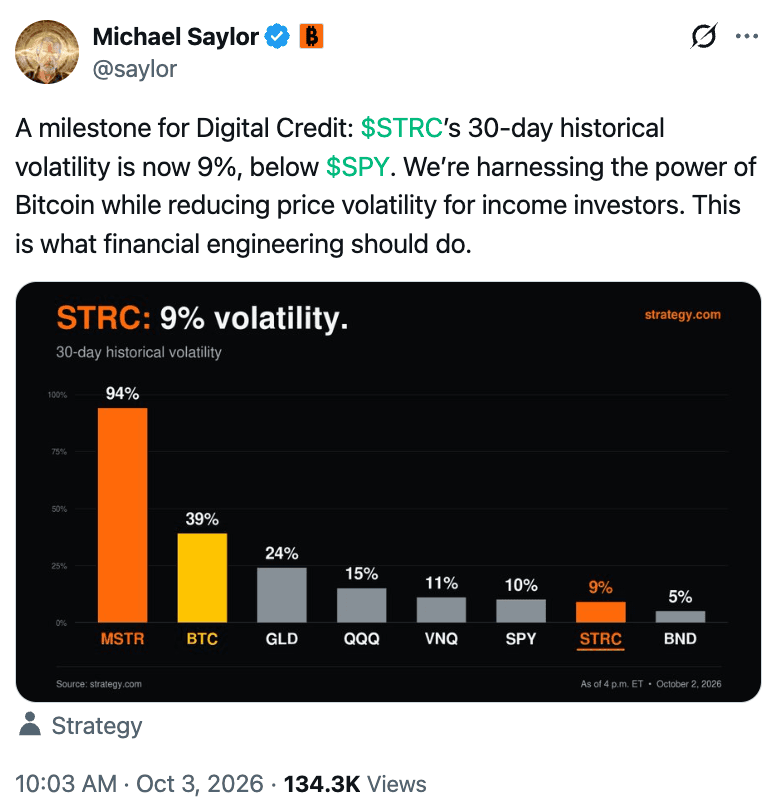
Where STRC Ranks On Volatility
The chart measured STRC against funds that stood in for each major asset class. Strategy's own common stock was the most volatile line at 94%, with Bitcoin at 39%. SPDR Gold Shares (GLD), which tracks bullion, stood at 24%. The Invesco QQQ Trust (QQQ), which tracks the Nasdaq-100 index, was at 15%, and the Vanguard Real Estate ETF (VNQ) at 11%.
Only one line sat below STRC. The Vanguard Total Bond Market ETF (BND) came in at 5%, which placed Strategy's preferred between stocks and bonds on its own chart.
MSTR stock closed almost flat on Friday, down by 0.31%. On Stocktwits, the retail sentiment around MSTR remained in the ‘bullish’ zone, while chatter around it stayed at ‘normal’ levels over the past day.
Advertisement|Remove ads.
In comparison, SPY stock closed in the green on Friday. On Stocktwits, the retail sentiment around SPY moved to ‘extremely bullish’ from ‘bullish’ while chatter around it stayed at ‘normal’ levels over the past day.
The Pitch Behind The Chart
The choice of comparisons was deliberate. Saylor set out the reasoning on Wednesday, which laid out a three-tier framework for Bitcoin treasury companies.
He described Bitcoin as digital capital, Strategy's STRC and rival Strive's (ASST) SATA as digital credit, and the two companies' common stock as digital equity. Digital credit, he wrote, competed for income allocations against private credit, high-yield bonds, preferred securities, and bond or income ETFs.
Advertisement|Remove ads.
That was why STRC was being measured against SPY and BND. Saylor said that the preferred belongs in an income investor's bond sleeve, not in a crypto allocation.
He also made the case for Strive. "I want Strive to succeed," he wrote. "I want every well-managed issuer of Bitcoin-powered Digital Credit to succeed." He cited SIFMA figures putting global equity market capitalization at $157.8 trillion and global fixed-income debt at $160.7 trillion at the end of 2025, and said a tenth of one percent of either would be roughly $160 billion.
The Gap Has Narrowed
The claim Saylor made was narrower than the one he had made in March. He posted that STRC had been less volatile than every company in the S&P 500 and every major asset class over 30 days, while paying an 11.5% dividend yield. That chart cited had put STRC at 2%, below BND at 6%.
Advertisement|Remove ads.
STRC now sits above BND. Volatility across the rest of the chart has fallen over the same period, with Bitcoin down from 50%, gold's tracker from 37%, QQQ from 19%, and SPY from 15%. STRC also hit a record-low volatility of 1.5% in March.
Not A Locked-In Spread
Saylor also wrote that Bitcoin appreciation was uncertain and that Bitcoin itself paid no coupon, and said the margin between long-term asset returns and financing costs has to be earned through management. "It is not a locked-in interest spread," he wrote. He added that the mechanism ran both ways, and that falling Bitcoin prices, widening credit spreads, and contracting equity multiples can reinforce one another as readily as the upside can.
Read also: BlackRock's IBIT ETF Flashes Golden Cross As SEC Approves Triple-Leveraged Bitcoin, Ethereum ETPs
Advertisement|Remove ads.
For updates and corrections, email newsroom[at]stocktwits[dot]com.
Comments posted here will also appear on symbol pages.

Latest News
/filters:format(webp)https://news.stocktwits-cdn.com/large_Getty_Images_2294264991_a1d08b075d.jpg)
/filters:format(webp)https://news.stocktwits-cdn.com/Anushka_Basu_make_me_smile_in_the_picture_b92832aa_af59_4141_aacc_4180d2241ba8_1_2_png_1086e0ed8c.webp) Anushka Basu·6h ago
Anushka Basu·6h ago/filters:format(webp)https://news.stocktwits-cdn.com/large_Getty_Images_1925090359_f160f05588.jpg) Anushka Basu·7h ago
Anushka Basu·7h ago/filters:format(webp)https://news.stocktwits-cdn.com/large_Getty_Images_2213700296_87303c323b.jpg) Anushka Basu·8h ago
Anushka Basu·8h ago/filters:format(webp)https://news.stocktwits-cdn.com/large_franklin_templeton_OG_jpg_4b3a7330d9.webp) Anushka Basu·9h ago
Anushka Basu·9h ago/filters:format(webp)https://news.stocktwits-cdn.com/large_Getty_Images_1445160636_5780a5fdde.jpg) Anushka Basu·11h ago
Anushka Basu·11h ago/filters:format(webp)https://news.stocktwits-cdn.com/Getty_Images_540198451_jpg_3e5f3d8ee7.webp) Anushka Basu·12h ago
Anushka Basu·12h ago