


Advertisement|Remove ads.
Nvidia GTC 2026: So, What's Wall Street's Verdict?
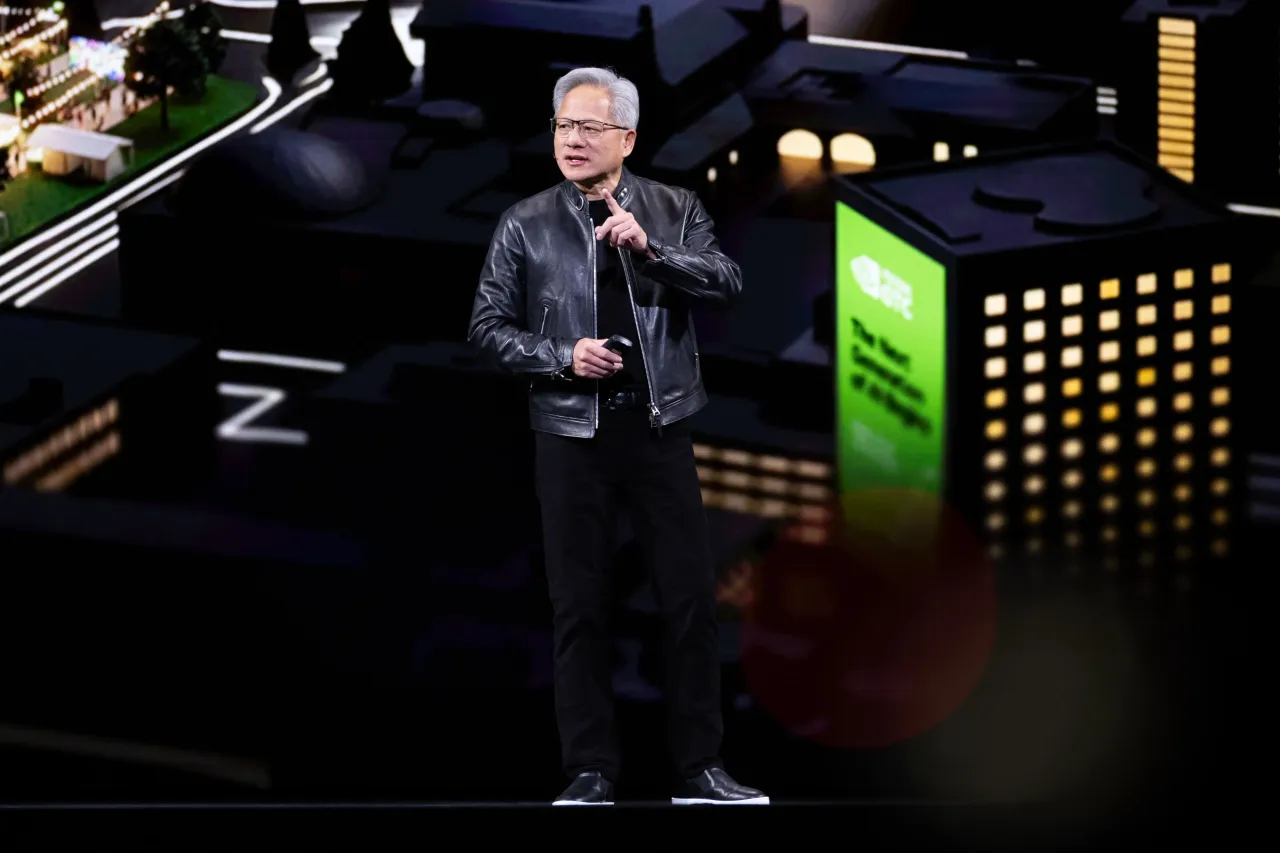


- Nvidia’s flagship AI processors would help generate $1 trillion in sales through 2027 - CEO Jensen Huang at GTC.
- The AI chip giant is pushing deeper into CPUs, has launched specialized chips for AI workloads, and has announced a chip for data centers in outer space.
- NVDA stock closed a mere 1.7% higher on Monday, the opening day of the GTC, which typically features major announcements; Stocktwits sentiment ‘neutral.’
Advertisement|Remove ads.
Wall Street analysts lauded Nvidia Corporation’s announcements on the opening day of its annual developer summit, GTC 2026, saying the company’s new technologies and growth forecasts firmly counter the emerging view that AI momentum is slowing.
In a packed two-and-a-half-hour keynote, CEO Jensen Huang said Nvidia’s flagship AI processors would help generate $1 trillion in sales through 2027. The company forecast in October that its data center servers business would bring $500 billion in sales through the end of 2026.
Nvidia announced plans to push deeper into central processing units, introduced special chips for AI workloads made with technology acquired from startup Groq, and even said it was developing chips for data centers in outer space.
Advertisement|Remove ads.
Analysts’ View On GTC Updates
Nvidia updated order visibility “beats the bogey,” Wells Fargo analysts said in an investor note. The research firm retained its ‘Overweight’ rating on NVDA stock at $265, implying a 45% upside from the stock’s last close.
Wedbush said Huang’s keynote reinforced the company's position "at the top of the AI demand curve for 2026 and beyond" and that the "AI Revolution is accelerating, not decelerating, despite the market noise." Demand strength is coming from every direction, the research firm pointed out, calling the $1 trillion backlog guidance a "stunner."
Nvidia shares climbed as high as 4.8% up on Monday before ending the day’s session 1.7% higher at $183.22, suggesting that some investors remain skeptical despite the company’s record-breaking financial outlook and pole position in the AI market. Share gained 0.1% in the overnight session.
Advertisement|Remove ads.
“Demand is measurably stronger than even the highest expectations, and investors are still having a hard time getting comfortable with that,” Deepwater Management co-founder Gene Munster said.
Moor Insights & Strategy CEO Patrick Moorhead said that while $1 trillion is more of a demand projection than a firm revenue forecast, the directionality matters. “Hyperscalers are not pausing. They are building 3-5 year infrastructure roadmaps around $NVDA silicon.”
Nvidia’s product and services ecosystem is hard to match, he said. “$NVDA is now selling training GPUs, CPX pre-fill accelerators, Groq LPU decode processors, standalone Vera CPUs, and a unified software stack connecting them. No other company can offer that combination today. That is the actual moat, not any single product cycle.”
Advertisement|Remove ads.
Muted Nvidia Stock Move
Nvidia shares have faced pressure in recent months owing to investors turning negative on tech and software stocks broadly and, more recently, the market volatility related to the U.S.-Iran war. NVDA is down 1.8% year-to-date.
Currently, 54 of 57 analysts recommend ‘Buy’ or higher for the stock, two recommend ‘Hold,’ and one recommends ‘Sell,’ per Koyfin. Their average price target of $267.54 implies a 46% to the stock’s last close.
Although retail traders were upbeat about the news coming out of the GTC, Stocktwits sentiment for NVDA shifted only to ‘neutral’ from ‘bearish’ the previous day. Message volume for the ticker rose 767% over the last 24 hours.
Advertisement|Remove ads.
Recap Of Major Announcements At Nvidia GTC
NemoClaw: Nvidia announced a new enterprise platform for companies to create internal AI agents. It combines the OpenClaw agent platform with components of Nvidia's Agent Toolkit to add privacy and security controls.
Server Racks: Nvidia announced the Groq 3 LPX, an inference server rack featuring 256 Groq 3 LPUs (language processing units) and built-in high-speed memory, enabling AI tasks to run quickly and efficiently. It also unveiled a new server rack with 256 Vera CPUs.
Orbital data center platform: Nvidia unveiled Space-1 Vera Rubin for orbital data centers, saying its GPU will deliver up to 25 times more AI compute for space-based inferencing compared to the H100.
Advertisement|Remove ads.
Vera CPU: Nvidia unveiled Vera CPUs for data centers, saying that the orchestration of work divided between various types of computers and software — a job performed by general-purpose CPUs — is becoming more important.
Vera Rubin update: Nvidia said its next-generation Vera Rubin GPUs have entered full production.
Partnerships: Nvidia discussed new or expanded pacts with companies such as IBM, Hewlett-Packard Enterprise, and Adobe. It also strengthened ties with Uber, saying it was planning a fleet of Nvidia software-driven autonomous vehicles by 2028.
Advertisement|Remove ads.
For updates and corrections, email newsroom[at]stocktwits[dot]com.
Advertisement|Remove ads.
Comments posted here will also appear on symbol pages.

Latest News
/filters:format(webp)https://news.stocktwits-cdn.com/large_Getty_Images_2237640344_jpg_bc97a7240c.webp)
/filters:format(webp)https://news.stocktwits-cdn.com/Anushka_Basu_make_me_smile_in_the_picture_b92832aa_af59_4141_aacc_4180d2241ba8_1_2_png_1086e0ed8c.webp) Anushka Basu·15m ago
Anushka Basu·15m ago/filters:format(webp)https://news.stocktwits-cdn.com/large_Getty_Images_2290038559_c6f6528203.jpg)
/filters:format(webp)https://news.stocktwits-cdn.com/Whats_App_Image_2026_05_11_at_09_45_43_1_jpeg_a08c0cf251.webp) Aveek Bhowmik·25m ago
Aveek Bhowmik·25m ago/filters:format(webp)https://news.stocktwits-cdn.com/large_Getty_Images_2257538219_jpg_2976ffdb40.webp)
/filters:format(webp)https://news.stocktwits-cdn.com/IMG_9209_1_d9c1acde92.jpeg) Yuvraj Malik·2h ago
Yuvraj Malik·2h ago/filters:format(webp)https://news.stocktwits-cdn.com/large_Getty_Images_2242116732_jpg_8edfaf9518.webp)
/filters:format(webp)https://news.stocktwits-cdn.com/shivani_photo_jpg_dd6e01afa4.webp) Shivani Kumaresan·2h ago
Shivani Kumaresan·2h ago/filters:format(webp)https://news.stocktwits-cdn.com/large_Getty_Images_1238536755_391df938ce.jpg) Anushka Basu·2h ago
Anushka Basu·2h ago/filters:format(webp)https://news.stocktwits-cdn.com/large_Getty_Images_2259521181_jpg_b4c58b3d45.webp) Shivani Kumaresan·2h ago
Shivani Kumaresan·2h ago